
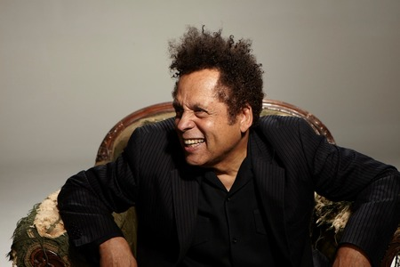


Garland Jeffreys,
who performs with his band tonight at The Basement, stands tall in the ranks of early-’70s rock musicians whose work anticipated the New Wave of the later part of that decade, but his first records were grounded in rock 'n’ roll basics. When Jeffreys released the 1970 full-length Grinder’s Switch Featuring Garland Jeffreys, the influence of The Band’s Music From Big Pink was everywhere in rock — listen to the first albums by Joy of Cooking and Little Feat. In fact, Jeffreys was as much a fan of Big Pink as everyone else. He had met Levon Helm and worked on Grinder’s Switch with pianist Stan Szelest, a Buffalo musician who had played with The Hawks, who would later record as The Band. But Jeffreys moved on, adding reggae to a an approach that was similar to that of the era’s singer-songwriters. His ‘70s and early ‘80s records revealed Jeffreys as a musical omnivore, and if his wide-ranging interests made him hard to market during those years, he has made a recent comeback that clarifies and extends the virtues of his earlier music.
Born in Brooklyn on June 29, 1943, Jeffreys is African-American and Puerto Rican, and has often written about the ambiguity of racial identity. Growing up in a family of jazz fans, Jeffreys got an early education in that American musical form — as he told me a couple of weeks ago from his New York City home, his uncle turned him onto Chet Baker and Miles Davis. As were many teenagers in the early '50s, Jeffreys was a fan of singer Frankie Lymon, and Jeffreys began singing in New York street-corner vocal groups. Intending to major in political science, Jeffreys went to Syracuse University, where he met an aspiring songwriter named Lou Reed. Jeffreys switched to art, and studied Renaissance painting in Italy before returning home to perform in New York City clubs.
The songs Jeffreys wrote for the Grinder’s Switch album reveal his debt to The Band — ”Sister Divine” and “Won’t Ya Come Back Home” are idiosyncratic country-rock amalgams. His 1973 self-titled debut is his most straightforward singer-songwriter statement, but the record combined reggae, blues and intelligent, observant lyrics in unpredictable ways.
Jeffreys released a 1973 single, “Wild in the Streets,” which featured the playing of keyboardist Dr. John, drummer Rick Marotta and guitarist David Spinozza. It remains one of Jeffrey’s most famous songs — check out Jeffreys’ original, and then listen to cover versions by Chris Spedding and The Circle Jerks. “Wild in the Streets” appeared on 1977‘s Ghost Writer, which also included “Rough and Ready,” a song with a very Television-like guitar lick. Ghost Writer remains Jeffreys’ most well-known album, but I also like 1979‘s American Boy and Girl and 1981's Escape Artist. By the early '80s, Jeffreys had modified his vocal style — I think he sounds a little like Leon Russell on Garland Jeffreys, but his singing on Escape Artist suggests a fusion of the styles of Springsteen and Graham Parker.
Escape Artist contains “Jump Jump,” one of his greatest recordings. A four-measure guitar figure merges with accordion before Jeffreys begins singing. Jeffreys is walking down a Paris street and thinking about Victor Hugo, Claude Monet and “V. Van Gogh.” The song is about the competing pressures of history and the present — as he sings, “Jump jump / Let’s make the great escape / All due respect to art for art’s sake / Jump jump / We’re gonna have some fun.” It’s an amazing song, and you have to admire a songwriter who can rhyme “another museum” with “we hardly can see 'em.”
After Escape Artist, Jeffreys released 1982's Guts for Love, and took a break from recording. He released Don’t Call Me Buckwheat in 1991, played to adoring crowds in Europe, and returned to form with 2011‘s great The King of In Between and this year’s equally accomplished Truth Serum. He still lives in New York, and he sounds as intelligent, direct and unpretentious as you would expect from such a shape-shifting artist.
Garland, you just got back from playing some European shows. How did that go?
Great. I played Italy, a bunch of Italy shows. They awarded me this very special award for songwriters, the Tenco Award. I’m very happy about it, because I have a very close relationship with the Italians. [Named after Italian songwriter Luigi Tenco, the award has in past years gone to Randy Newman, Leonard Cohen, among others.] I went to school in Florence at one point when I was an undergraduate, in the early part of my life. I speak Italian fluently, and so Europe, in general, has been a great place for me over the years.
European audiences seem to love American artists — the European career of jazz saxophonist Ben Webster is one example — and often appreciate them more than Americans do. Why is that?
You’re posing all the questions, and you and I both know what the answers are. Ever since I was a kid, I saw all the signs — just growing up, you see all the signs, you know. If your eyes are open and you’re living, you know what’s going on around you. And I guess this led to a certain lifelong activity around the issues of race. You know, you hear of all these wonderful black artists in Europe, and you know who’s been there, including Charlie Parker, and including Ben Webster. The way I deal with it, and the way I’ve dealt with it, I’m a little different than that period, because I’ve made a lot of headway in that area. You know, I’ve persisted in writing the kinds of songs that I want to write. I particularly like this period we’re in now, where the record companies are not involved. They’re not a part of it any more. They can’t dictate, they can’t persuade, none of that. We manage our own situations, like, we’re all grown up now.
Tell me about working with Larry Campbell, who co-produced The King of In Between and played on Truth Serum.
Larry is great. I’ve loved working with him. I remember when we worked on that first album together, he could respond very quickly to things. He was able to say, “Your voice sounds great here,” and that was great: Somebody that I can rely on and trust, because he has a certain impeccability, you might say, an impeccable nature. He’s a very good decision-maker, so when you’re working in the studio with someone like him, a good producer, you feel comfortable.
I hear you’re related to the jazz singer Carmen McRae.
Carmen McRae was a distant relative. I discovered that around the time I did the [1978] Soundstage [television] show. I did one song with Sonny Rollins and another one with Carmen. Around that time, I found out that she was a relative of mine, on my mother’s side. In fact, my mother’s not alive anymore, but they looked a little bit alike. She was great — when we did that show, it was an unusual thing, because we did the song with Sonny, one of my songs. It was fantastic, the way he played. Sonny backs me up on the song, and then it’s time for his solo. He steps out just a little bit, and plays his solo, and steps back and supports he again, just comps like he’s supposed to do in a jazz band. He doesn’t step out, take over, move me out of the way. He doesn’t have to. I really learned something from that show.
Did you start out as a street-corner singer influenced by rhythm and blues, Garland?
I would say 1950, ‘51 or ‘52, around that time, and maybe ever a little later, that’s when I started to hear that music, as a young kid. I listened to jazz all along. My father and mother were into Count Basie, big Count Basie and [Duke] Ellington fans. Then my uncle, my mother’s brother, he loved Miles, that was his man, anything like that, that was cool and wasn’t pop. He liked to hear Miles, you know, Chet Baker. That’s on the whole jazz front. But then in my own choices, I heard Frankie Lymon. I was what, 12, 13, same age as Frankie. But my own step into making some music came from a couple of guys who lived on my block, Davy and Stetson Nichols. Davy could sing as good or better than Smokey Robinson. He had a falsetto that was brilliant. We would go into a spot where there was an echo kind of sound, some sort of sound that we could come up with, and I learned from them, and of course, going along with a lot of the other music that was just coming up, that wasn’t jazz, that wasn’t, say, black pop, but that was for younger folks, including myself. I still have the Teenagers album with Frankie Lymon on the cover with The Teenagers. Frankie Lymon was my idol.
You waited until you were in your late 20s to record. Did this give you time to find your own voice?
I think you hit the nail on the head. I went to the Institute of Fine Arts in New York, on Fifth Avenue and 70th Street, fantastic institution. I had already been in Italy, had that experience, and I had the first-hand experience of seeing the work of Giotto, all these incredible painters, the stuff that I loved, and I still love. I came back from Italy. I was living in the East Village, and I was figuring out what my next step was. I realized that I didn’t want to go any further, because it was too much of an academic life. I had been living in the East Village for a few months, and I had already met [Charles] Mingus. I was a young guy who was beginning to develop really fast. Lou Reed and I were friends from the mid-’60s, all those years, and that was an influence on me. It was an influence when I was in Syracuse, and we spent a lot of time together. We were friends from back then.
What about working with John Cale on his Vintage Violence album?
Cale and I were very close at one time. I wrote that song for him [“Fairweather Friend”] on Vintage Violence. That was a time when he and Lou were really at odds with each other, and John and I had already become friends, and I sort of supported him in that period. John was on the scene at that time, and we had a house north of Woodstock [N.Y.]. We were practicing and working up songs. He was going out on his own, and it was not easy. He was definitely the core player in that band [The Velvet Underground]. Sometimes there are clashes as to who’s stronger and who isn’t.
You’re known for your use of reggae music. How did you become interested in it?
I had a cousin in Jamaica, and I would go down there, and she had a spot where you could get some great food. Of course, I knew about Winston Grennan, the great drummer, and Jackie Jackson, Neville Hinds, all these guys from the studio in Kingston. I recorded two tracks, “Midnight Cane” and "Bound to Get Ahead Someday,” from that studio. The first part was really Jimmy Cliff, and then I heard all the early Bob Marley stuff, and I said, “Wow, this is something.” And then, I met Marley a couple times — once outside Max’s Kansas City here in New York, where he teased me because I had my album I had just made in my hand. I said, “Look at this, man,” like, I didn’t know him yet. He said, “Oh, cool, man, you cool, man, you go to Jamaica, man,” like that, a little more subtle than that. He definitely teased me. I was pissed off at him. I didn’t like it. Then we met again one night in Chicago when we were playing different venues at the same time.
How was your relationship with Atlantic and A&M, the labels you recorded for in the ‘70s?
I was with Atlantic Records, and the way I see it, I think that the record business and the artist have an adversarial relationship. I don’t see very much harmony in that kind of relationship, especially when you want to do things that are out of the box. I’ve been able to fight for my approach in my music all along. Everything that you see that I’ve recorded, there’s been a bit of a battle: They would A&R me, get me to do stuff, people who know nothing about music, in a lot of cases. I had the support of a couple of very key people at A&M, but that didn’t mean they knew anything about music. I think we’re in a different time now.



