


The idea for the dynamic, multi-artist concert being presented Jan. 27 at Ingram Hall on the Vanderbilt Blair School of Music campus started as a question.
For many Jews, Nobel laureate Elie Wiesel was the gold standard when it came to Holocaust awareness. At age 15, Wiesel was deported to the Auschwitz-Birkenau and Buchenwald concentration camps, where his parents and his younger sister were killed. Wiesel wrote the Night trilogy about his experiences in the Nazi death camps and devoted his post-Holocaust life to bearing witness to what happened.
When Wiesel died in 2016 at age 87, Ira Antelis remembers asking himself, “Who takes over the mantle now, as people are aging, so that the Holocaust won’t be forgotten?”
Antelis, a composer and music producer, spent that weekend doing a deep dive on all things Wiesel and learned that the author had written the foreword to a book called We Are Here: Songs of the Holocaust, a collection of songs in Yiddish, written by Jews in ghettos and Nazi camps during World War II. That resonated with Antelis and his professional background. He decided to produce a concert of that sonic folklore.

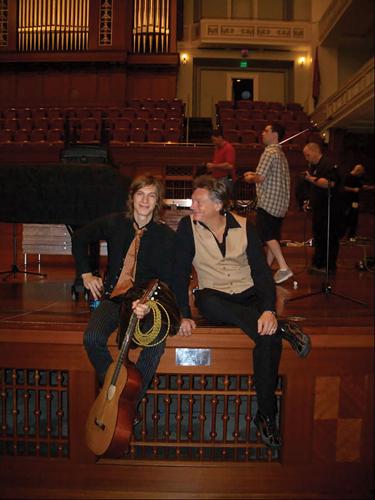
Landon and Gary Pigg, performing in We Are Here
There were, in fact, 14 different songbooks written by Jews in concentration camps and ghettos. Most of the people who wrote the songs died in the camps and knew that was likely their fate. While some of the lyrics certainly are sad, Antelis says, “They never lost the thought that there will be a better tomorrow.” He selected and produced a selection of songs to highlight a range of styles, including some 1940s folk and even some satire. That meant he could produce a show that was poignant and meaningful, but not a funeral experience.
Antelis enlisted the help of his friends David Mendelson and Rabbi Charlie Savenor. Due to coronavirus pandemic delays, the initial concert took longer to organize than planned, but eventually met with success at a Chicago synagogue. They then produced We Are Here for a sold-out audience at The Salt Shed in Chicago and again at New York’s Carnegie Hall.
“I get choked up thinking about it, because this music deserves to be played on the most prestigious stage in the world,” Savenor says of the Carnegie Hall experience.

Justin Jesso, performing in We Are Here
The trio continued to look for venues that are not synagogues to attract a broader audience to the messages of resilience and hope. A Vanderbilt University graduate, Mendelson wanted to bring We Are Here to his alma mater. Vanderbilt has the oldest Holocaust lecture series of any U.S. university, and has several pieces by Holocaust survivors, including György Kádár, in its fine arts collection.
Mendelson met Darren Reisberg, vice chancellor for administration at Vanderbilt, who oversees Dialogue Vanderbilt, an initiative to help people talk about difficult topics. While We Are Here is more listening than talking, Reisberg thought bringing it to campus made sense.
At each concert, different presenters introduce each song in English, and then each song is performed by different musicians. In Nashville, there will be 14 songs, one from each songbook. Presenters and performers include singer-songwriters Justin Jesso and Gary and Landon Pigg, as well as Linda Hooper of the Paper Clips Project. (Side note: If you have not been to Whitwell, Tenn., to experience the educational center and memorial that Hooper created at Whitwell Middle School, get in the car and go.).

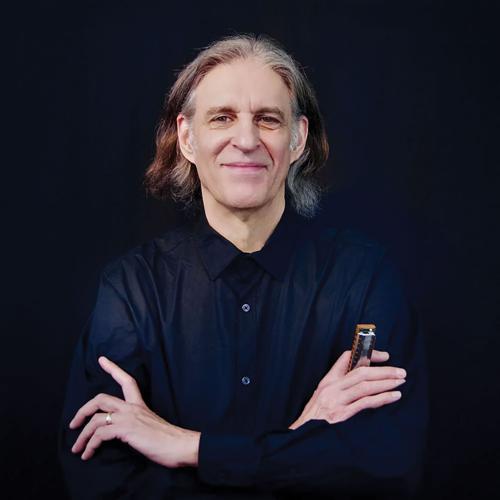
Howard Levy, performing in We Are Here
For the first time in the We Are Here lineup, there will be a spoken-word piece and an instrumental by Howard Levy, who Antelis says is the world’s best harmonica player. The finale will be performed by a choir of 80 people, including Blair students. Tickets are available online for $10 and are free for Vanderbilt students. They are priced to make the experience available to whoever wants to attend. We Are Here is intentionally not political, and the idea started before Oct. 7, 2023.
“It being on International Holocaust Remembrance Day is really the timeliness part,” Reisberg says. “We’ve seen hate proliferate in the world all the time, and we’re certainly not immune from it now. The politics of what may be happening globally is not the focus of this event that is more focused on a time in history that we do not want to be seen repeating itself.”



Post a comment as anonymous
Report
Watch this discussion.
(0) comments
Welcome to the discussion.
Log In
Welcome to the discussion.
Keep it clean. Please avoid obscene, vulgar, lewd, racist or otherwise abusive language. Comments featuring hate speech or threatening or violent content will not be tolerated.
PLEASE TURN OFF YOUR CAPS LOCK.
Be truthful. Don't knowingly lie or mislead.
Be proactive. Use the “report” link on any comment that violates our comment policy.
Share with us. We'd love to hear your feedback.