
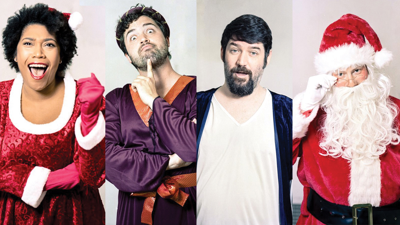


When you think of Yuletide theatrical productions, you probably don’t think of Spider-Man: Turn Off the Dark, the legendarily ambitious musical that set box-office records on Broadway despite delays, cast injuries and pans from critics. However tenuous such a connection may seem on the surface, it actually makes perfect sense to a big group of Nashville musicians, actors, and light and sound technicians.
Thursday and Friday, local performance collective The Spaceship of the Imagination (whose name is a reference to Carl Sagan’s Cosmos) will stage Krampus Gone Wild, a colorful, creative take on the traditional Christmas pageant. With green-screen action, live music and a clever spin on the story of Krampus (the goat-demon who punishes bad children at Christmas in European folklore), it promises to be unlike any holiday undertaking you’ve ever seen. Krampus Gone Wild is the group’s largest production yet. Where past shows have been what executive director, writer and synthesist Matt Rowland calls “jukebox Christmas musicals,” Krampus will use a variety of media, and finds inspiration in — you guessed it — the massive ambition of the aforementioned Spider-Man production.
“Last year, the first time the actors ever got a script it was Monday, and we’re running the play on Thursday,” Rowland tells the Scene via phone during a break in rehearsal. “It was so last-minute. This year we were like, ‘Let’s do something really crazy. What happens if we work on this for six months?’ ”
Rowland and co-creators David Bermudez, Peter Wallace and Corey “Catfish” Taylor began work on Krampus Gone Wild in May. Their roster quickly grew to nearly 40 performers and production professionals dedicated to turning their Spidey dreams into reality. Since then, those involved have met weekly to write, plan and rehearse the show.
“We’re so far ahead, even though there are a lot of little things to get together and put in place,” says Rowland. “It’s really neat what a bunch of minds co-creating and having creative vision in their own spaces can really do.”
It’s been 10 years since the Spaceship’s debut at Mercy Lounge. But the ambition to scale up the show was inspired more by the passion of their community that’s grown around what began as a ragtag group of synth enthusiasts than by celebrating any milestone.
“It definitely wasn’t like, ‘It’s our 10th anniversary!’ ” says Rowland. “The Scene’s review of the first one 10 years ago famously said something like: ‘Now we know what TBA means. It doesn’t mean a Be Your Own Pet reunion. It means something really stupid.’ It’s just grown from there. It’s such a big group of fun idiots. It just has a life of its own.”
One essential component of the group’s ability to broaden its horizons is the location they’ve secured for the second year in a row: Trinity Community Commons at Trinity United Methodist Church. Rowland & Co. worked with the church’s Nate Paulk to ensure that the event would be a fruitful experience for everyone involved.
“We have three rooms in this church that they just give to us,” Rowland says. “Some of our proceeds are going to go to them, because we want to help them keep the lights on. Through them helping us out, who knows, in five years we could be keeping the lights on for them. [Paulk’s concern is to build] a community of communities, and that’s what our thing is.”
Another big factor in pulling off such a large production is the addition of Greg Burns, whose day job is managing production and front-of-house sound for Greensky Bluegrass. His contributions to Krampus include helping the collective figure out just how to translate their big ideas to a smaller church stage.
“He knows everything,” Rowland says of Burns. “Having Greg around this year and us being six months out and talking to Greg about things — we all have ideas, but they have to be mirrored back to us in a reasonable way that’s like: ‘OK. You want to do this. Well we can do this.’ ”
Community is clearly a driving force for the Spaceship, as the passion of the cast and crew attests. Rowland and his team hope the show will continue to grow, and in the future serve even larger swaths of the community.
“I hope one day this can be six months of employment for our core players,” he says. “It’s just working. Since everybody has so much ownership of it — it’s everybody. I think every musician in town has been involved in projects where you see it work and you’re like, ‘Oh, OK, well this is working.’ Then it just happens. You can tell when something is a fun idea that somehow gives back to everybody. It’s just a righteous thing.”



