
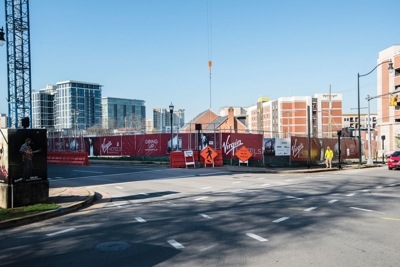


Virgin Hotels Nashville's construction Site
Sir Richard Branson had a wonderful time in Nashville when he visited in September. The billionaire tycoon gushed over Music City in a travel diary posted on the website of his multinational (indeed, extraplanetary) company. At the top of the post is an all-smiles photo of him posing with then-Mayor Megan Barry, hard hats on and dirt-filled shovels in hand, breaking ground at the Virgin Hotels Nashville site. Further down the page are pictures of the knighted Brit yukking it up with country music royalty like Emmylou Harris and John Prine at RCA Studio A. In a somewhat ironic twist, the famed studio — which became a flashpoint for the fight to save Music Row from total gentrification — hosted a cocktail reception that followed the groundbreaking ceremony.
“I was surrounded by gifted musicians, songwriters and producers,” Branson wrote on his blog, where he boasted about catching up with luminaries like Chris Isaak, Kenny Chesney, Miranda Lambert and Anderson East. “It is what Nashville is known for after all (and why I think it’s such a great location for a Virgin Hotel!).”
The tail end of that statement might, from a property developer’s standpoint, prove true when the multimillion-dollar luxury hotel opens in 2019. But for preservation-minded Nashvillians who’ve been advocating for years to protect Music Row’s historic buildings from the market forces that erect glass skyscrapers, the hotel’s location at the corner of Division Street and 17th Avenue South came at a great historical cost.
For 135 years, the site was home to the Pilcher-Hamilton house. After the Nashville landmark was demolished in 2014 to make way for the Virgin complex, late local activist and trailblazer Betty Nixon wrote an op-ed for the Scene lamenting an unsuccessful bid to add the house to the National Register of Historic Places. The former Metro Council member described historic preservation as a public-policy dilemma, and pointed to rezoning efforts by her fellow council member Jim Hamilton, whose family owned and lived in the home for many years, and his neighbors — “mostly older residents of Music Row” — who aimed to reap the economic benefits of urban renewal.
“I agree that the rights of private property owners should always inform the discussion of how we deal with important historic properties,” Nixon wrote. “[But] once development reaches critical mass, the big boys and girls want a piece of the action. Unfortunately, the piece they want all too often destroys the very character that made the area attractive in the first place. … What do we need to do differently to be sure that when a visitor wakes up and looks out the window of a Nashville hotel, he knows he is in Nashville, Tennessee, not in Cleveland or Indianapolis?”
Concerned Nashvillians like Nixon had good cause to feel that they might see Music City history disappear before their eyes. The Pilcher-Hamilton House was one of several historic buildings that faced the wrecking ball in 2014. The Hillsboro Village site of Bradley Studio, where Kitty Wells cut “It Wasn’t God Who Made Honky Tonk Angels,” was also demolished that year, and it had looked as though 30 Music Square West, home of Studio A and its then-tenant Ben Folds, would be next. A deep-pocketed condo developer bought the building, but Folds’ open-letter plea to save it went viral. It sparked a grass-roots movement that culminated in a successful 11th-hour $5.6 million bid by Leiper’s Fork philanthropist, historian and real estate mogul Aubrey Preston. Preston was later joined in his efforts by partners and fellow philanthropists Chuck Elcan, a Nashville health care executive, and Mike Curb, a music mogul. Sharon Corbitt-House and Mike Kopp from Folds’ management team, and songwriter Trey Bruce also played key roles in the preservation effort.
“I think because of that fight, we have a new high-water mark of paying attention, and developers listening to preservationists,” says Bruce. “I think our city officials and politicians pay more attention now.”
Over the past three years, Studio A has returned to its former glory. Its current tenant, Dave Cobb, has cut Grammy-winning records by Chris Stapleton and Jason Isbell in Studio A, and helped bring hope back to Music Row in the process.
Jenn Harrman, president of Historic Nashville Inc., moved to Nashville while Studio A was under threat — something she remembers first reading about while still living in Chicago. She agrees the morale boost from saving Studio A has been paramount to ongoing preservation efforts.
“Here is this property that has so much incredible history, and then because of this event, it has sparked a whole new era of history moving forward,” she explains. “Now we can use it as an example for so many other places and so many other properties in that same area.”
Many Music Row properties remain on redevelopment death row, while others have already fallen. Harrman notes that all of the Music Row buildings that have been on Historic Nashville’s annual “Nashville Nine” watch list have now been torn down. They include the Florence Crittenton Home for Unwed Mothers on Division Street, which was later home to Warner Bros. Records and WNSR broadcasting studios, and the building on Music Square East where Billboard opened its first Nashville branch office, which played host to numerous other industry offices and haunts like the bar Sammy B’s.
According to research compiled and provided to the Scene by Carolyn Brackett, who is a senior field officer for the National Trust for Historic Preservation and director of an ongoing National Treasures project dedicated to researching and preserving Music Row, 37 properties on the row were razed between 1980 and 2010. Another 32 properties were demolished between 2013 and 2016 alone, 22 of which were razed after Studio A was spared — and all but one to make way for either apartment complexes or parking lots.
Brackett says the key to preservation is winning over the district’s property owners. Historic Nashville hopes to do that via its Preservation Easement Program, whose goal is to provide federal income tax and state property tax deductions that will discourage owners of historic properties from applying for demolition permits.
“What’s really important for us to keep in mind is that not everybody over there is wanting to or ready to sell their property,” she says. “There are people who, this is their life’s dream — is to be on Music Row, in the music industry — and they just need some resources, some help, some encouragement to be able to stay on Music Row and to have it become not so cost-prohibitive.”
Some property owners and developers are already integrating studios into their facilities. A few Music Row homes converted to studios double as Airbnb properties, and The Chelsea condo in 12South includes a studio and practice space among its amenities. Plans for a studio inside the Virgin Hotels complex were mentioned in early press releases, but they have disappeared as quietly as the Pilcher-Hamilton House.



