
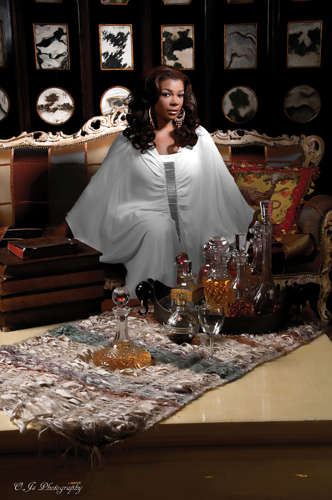


Anyone who grew up during the heyday of black radio will immediately gravitate to Syleena Johnson’s exceptional album Rebirth of Soul. It’s an album of classic soul covers, and although the record’s sound is as 21st century as it gets, there’s a distinctive and individualistic quality to it that was commonplace among vocal albums when the LP’s featured songs were originally released — something that often gets buried on contemporary records dominated by production zeal and studio mastery. In many ways, Rebirth of Soul is the project that fans who’ve followed Johnson’s career since her 1996 debut Love Hangover have been waiting for.
Rebirth of Soul, which was released by Shanachie Records in November, marks the second time in her career that Johnson has teamed with her father, legendary Chicago blues and soul man Syl Johnson, who produced and selected all the material. (Syleena Johnson electrified listeners with her contributions to her father’s 1994 comeback album Back in the Game.) While a large chunk of the hip-hop and urban contemporary audience might not be familiar with the gritty blues and earthy soul that is the elder Johnson’s specialty, they’ve heard his music sampled through hits by Kanye West (whom Syleena Johnson has also worked with), Jay-Z, Usher and the Wu-Tang Clan.
In a note posted to her website, Syleena Johnson explains that prior to sessions for this record she’d never worked in the old-school way: cutting songs in real time while backed by live musicians. “The inspiration behind Rebirth of Soul is my father,” Johnson writes. “I wanted to honor him and classic soul music in a time when AutoTune and creative beats reign supreme. While I’m not against this type of creative musicianship, there is so much more to the real thing.”
The list of Chicago luminaries who provide excellent backing includes saxophonist Willie Henderson, an ace player and producer who contributed to hits from Barbara Acklin, The Chi-Lites and Tyrone Davis, among others. Tom Washington, another veteran Chicago musician, is responsible for the inspired arrangements on Rebirth. Drummer Moe Jennings, who appeared on late-career albums by Muddy Waters and Howlin’ Wolf as well as Curtis Mayfield’s Superfly soundtrack, lends crisp rhythmic support, which other artists in the future sadly won’t be able to take advantage of — sessions for Rebirth were among Jennings’ last prior to his death.
Still, none of that would mean much if Johnson was doing straight covers without bringing anything new to the table. She has forged an impressive career as a vocalist and songwriter despite operating in an urban music landscape wherein individuality is sometimes sacrificed for commercial success. She’s managed to consistently demonstrate singular skill and the ability to incorporate explosive social commentary into material that’s also been commercially successful, and she brings all of those assets to bear on Rebirth of Soul.
On the record, she tackles a variety of material made famous by other artists. Her takes on “I’d Rather Go Blind,” “Make Me Yours” and “There’ll Come a Time” — songs whose definitive versions were cut by Etta James, Bettye Swann and Betty Everett, respectively — get turned completely around in fierce, inspired treatments that emphasize Johnson’s powerful, shimmering abilities. Calling some of the earlier renditions “iconic” isn’t going too far: Johnson’s stirring “Chain of Fools” stands on its own next to Aretha Franklin’s epic version. That’s something of a family tradition: Syl Johnson’s majestic rendition of “Take Me to the River” arguably stands supreme over even Al Green’s original.
Over a series of six albums from 2001 to 2014, Syleena Johnson addressed subjects ranging from infidelity to domestic abuse to life changes brought about by marriage and having a child. Not only did she write the lion’s share of the material, but she also enlisted numerous top hip-hop and urban music stars as collaborators, including Busta Rhymes, Jermaine Dupri and Common. She even found time to be a prolific session musician, earning a Grammy nomination for “All Falls Down” (a song from West’s 2004 debut The College Dropout on which she was the featured vocalist) and to dabble in reggae via a duet LP with Musiq Soulchild (2013’s 9ine).
Above all, the renewal of Johnson’s special association with her father makes Rebirth of Soul a marvel. The album includes two amazing versions of his compositions. “We Did It” is commendable, but her searing, updated presentation of his 1969 protest anthem “Is It Because I’m Black” is unforgettable. The lyric encapsulates the pain and confusion inflicted by systemic racism that’s just as pervasive as it was half a century ago — “I wonder why you do me like that” is one line whose simplicity belies its ability to communicate a complex message. There’s no better tribute to the legacy of soul music than how Johnson brings her father’s song into the 21st century with a vengeance.
Email music@nashvillescene.com



