
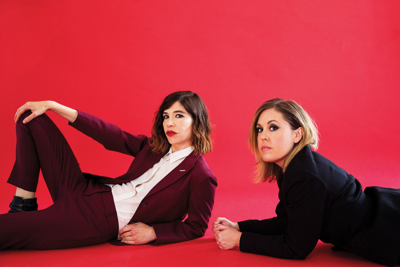


Sleater-Kinney announced some incredibly exciting news on Instagram just eight days into 2019: “Sleater-Kinney. Produced by @st_vincent. 2019.” Accompanying that caption is a photo of the band — guitarist Corin Tucker, drummer Janet Weiss and bassist Carrie Brownstein — standing behind Annie Clark (aka St. Vincent). The post racked up thousands of ecstatic comments when shared across the women’s Instagram accounts. There were fire emojis. So many fire emojis. Then the narrative took a sharp, unexpected turn.
On July 1, after the band released two singles and announced a fall tour, Weiss announced she was leaving the band. She posted a letter to her social media that read, in part: “The band is heading in a new direction and it is time for me to move on.” Gossip and conspiracy theories took over the newsfeed. Fire emojis turned to puke emojis, and fans sounded off in the comments. “S-K is now a Portlandia skit of St. Vincent,” wrote one Instagrammer, reacting to Tucker and Brownstein’s letter wishing Weiss well. “Time to unfollow and archive my love for my once fave band,” wrote another.
Despite the distractions and drama, The Center Won’t Hold stands as one of Sleater-Kinney’s most intriguing albums to date. The record pulses with electronic experimentation inspired and aided by Clark, as well as Sleater-Kinney’s organic urgency. Ahead of the group’s show Monday at the Ryman, Brownstein chatted by phone with the Scene about performing at the historic venue and the monsters that inspired one of her favorite songs on the record — as well as The Great British Bake Off.
I’m so excited that Sleater-Kinney is playing the Ryman for the first time. Obviously that venue has huge historical significance. Does it resonate with you in any way?
Yeah, I think any time you get to play a historic venue, where it’s been the home to amazing performances and artists over the years, you feel both in awe and a certain amount of pressure, I think, to just live up to this legacy of the room itself.
I read in a previous interview that one of the reasons The Center Won’t Hold happened was because the TV adaptation of your memoir Hunger Makes Me a Modern Girl wasn’t picked up by Hulu. Did that spur a new creative direction at all?
Well, we knew we were going to write another record, so [the series not getting made] more, just, freed up logistical time. My memoir was looking back, and as I was adapting that for television and making the pilot, that also was looking back. And that’s never been a comfortable space for me creatively, to be steeped in anything that’s nostalgic or sentimental.
But it did remind me that, particularly with my relationship to music, that I wanted to feel very much in-the-moment. I wasn’t ready to sort of put that into this glass case of history and send it packing. So I think it instilled in me a new sense of urgency, which is really what I need with Sleater-Kinney. When we came back in 2015 with No Cities to Love, we also came back with a real desire and want. And it’s the kind of musical container and entity that demands a lot of dedication, intention and passion. It has to feel kind of urgent. It’s always good to find that urgency, because often you’re not inspired otherwise.
Well, and the timing was so perfect. A year after No Cities to Love comes out, obviously we know what happened to the country. Did Trump winning the election somehow make it feel even more urgent or important?
For the 25 years we’ve been a band, we’ve always been in conversation with the times we live in, with the sociopolitical climate, with our own personhood within that atmosphere and environment. So that doesn’t change things. It’s always been a band in conversation with itself, a band in conversation with our audience, with culture.
And if anything, our job is to continue to make songs that feel relevant, but also that last. There’s still a deliberation, there’s still an editorial process. There’s still the craft of making good songs. Because even if your music feels so on-the-nose and so of-the-moment, the moment is fleeting. Ideally, you want your songs to have meaning to people a year from now or five years from now, when they’re not as context-specific.
Do you remember which song came first for The Center Won’t Hold?
Yeah, actually, “Hurry on Home” I think was one of the first songs that I wrote for the album. And I think for Corin, it was “Ruins.”
I’m glad you mentioned “Ruins.” I think that’s my favorite song on the record right now. It’s so creepy and intriguing. Can you talk a little bit about what influenced that song? It’s so different from anything Sleater-Kinney has done before.
One thing I’m so proud of on this record is just the amount of room that Corin and I gave each other to figure out who we were as songwriters in the present moment. I think of that as such an amazing Corin song. She’s always someone who’s played with persona and identity and character in her songs, well before I did. That falsetto, that bridge where it’s sort of haunted and psychedelic, and also just sounds like a siren call. There’s just the heaviness to it and the kind of broken-down second verse. Like, to me, it really just sounds like something decomposing and also living at the same time. It really captures something so corrosive and deadly and haunted.
I’m very proud of her for that song, and I think it’s definitely one of her favorites, and one of mine, and one that we’re really looking forward to playing. She had all this imagery in her mind that was kind of in that Godzilla vein — something monstrous that we had kind of collectively assembled and now couldn’t get rid of. I guess you’re playing with two monster myths. You have Frankenstein and Godzilla in that song — piling on all the myths [laughs]. There is something that feels, like, horrific about it in a way that’s very exciting, and live, we really get to expand it, because there’s all that improvisation at the end. That’s really fun to explore.
One of the reasons “Ruins” hits so hard, too, is that it’s followed up by “Love,” which is somewhat of a Sleater-Kinney origin story, right? To go from horror to “Here’s how we found one another, and here’s what we’ve been through together, and it’s all full of love.” I love the juxtaposition between the two songs. Was that done on purpose?
Yeah, certainly in the sequencing it was. Obviously the songs weren’t written in tandem. Sequencing is irrelevant to some people, because we listen to music so much as singles and, you know, sort of decontextualized from the album. But I think for us, and the story of this record, it was almost like we needed to re-establish collaboration and togetherness as a means of hope — as a means of optimism.
And that song, though it starts obviously with something that’s self-referential, it is really such an homage to connection as a fulcrum for survival. After the very [destructive] ideas of “Ruins,” I think we wanted to build something back up in the next song. And almost just to remind ourselves, in the middle of the record, that this is why we’re able to continue everything that came before this song. And everything that comes after this song is because of what we’re speaking to in the subject of the song itself, which is the fondness for one another, and the joy.
Speaking of joy, I saw on Twitter that you also love The Great British Bake Off. Do you really love it as much as I’m hoping you’re loving it? No pressure! But I love that show.
No, no, no. As much as social media is a performance for all of us, that was a very earnest tweet. [The Great British Bake Off] has a slightly soporific effect now, because I have used it to sort of soothe myself right before sleep. Like when I get tired of reading, and I kind of need to shut my brain off further, I’ll put on an episode of it, and it does have a strangely restorative effect. It makes me feel vaguely hopeful. I just — yeah, I love it.
Everything’s so transactional now, and that show just completely bypasses all of that. You don’t see a single brand, nobody’s promoting anything, and you just realize how nice it feels to be in a world where we’re not being sold anything. Because even politics, you know — we’re being sold ideas, we’re being sold hate, or we’re being sold opinions. There’s something so clean about [the show].



Post a comment as anonymous
Report
Watch this discussion.
(0) comments
Welcome to the discussion.
Log In
Welcome to the discussion.
Keep it clean. Please avoid obscene, vulgar, lewd, racist or otherwise abusive language. Comments featuring hate speech or threatening or violent content will not be tolerated.
PLEASE TURN OFF YOUR CAPS LOCK.
Be truthful. Don't knowingly lie or mislead.
Be proactive. Use the “report” link on any comment that violates our comment policy.
Share with us. We'd love to hear your feedback.