
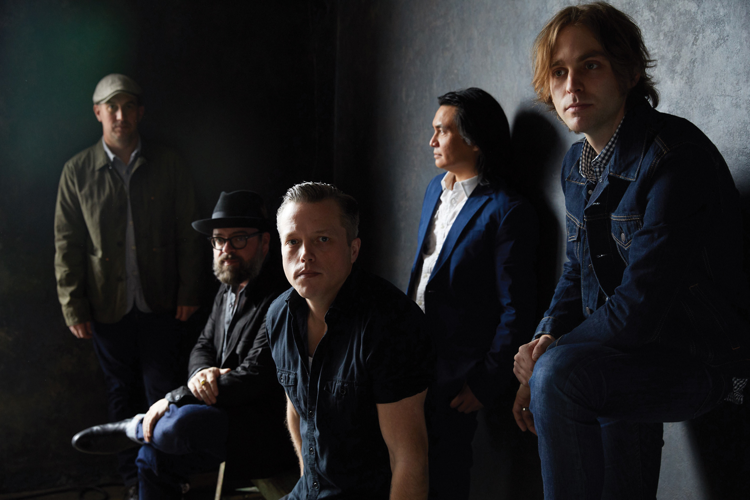


Jason Isbell is pulled over on the Natchez Trace, somewhere between Nashville and Florence, Ala. The 38-year-old Grammy-winning king of a country called Americana is driving himself to perform at a benefit show near his hometown of Green Hill when he stops to get on the phone for an interview.
The land between North Alabama and Nashville is familiar for Isbell and, in a way, represents the journey of his career. Perhaps you know the story by now: After coming of age personally and musically in and around Muscle Shoals, Isbell achieved national prominence with the Drive-By Truckers before striking out on his own. After a stint in rehab that helped him quit drinking, he settled in Nashville with now-wife Amanda Shires. Here he’s reached artistic and commercial heights from which he has yet to descend. Isbell has some more shows on the books in October that he’ll be able to drive himself to: five sold-out nights at the Ryman Auditorium.
But with his new album The Nashville Sound, out Friday, Isbell makes his way into some new territory. The earnest, plainspoken poetry for which he’s earned critical acclaim and deeply devoted fans is as potent as ever. But his new collection of songs is a direct conversation with our political and cultural moment, more so than any of his recent output. Put it this way: You didn’t need to know who was president in 2013 to understand the themes of love, loss and redemption on that year’s Southeastern, but the fear and loathing stirred up by Donald Trump’s presidential campaign is relevant context for The Nashville Sound.
“I’m trying to document a period of time in my life, and sometimes to do that I have to document the setting,” says Isbell. “I have to put myself in a real place, which is, right now, a very tumultuous place as far as people’s beliefs go.”
On The Nashville Sound, that means inhabiting characters on all sides of what seems to be a deepening divide. The main character in “Cumberland Gap” could very well be a Trump voter, the son of a coal miner in a town decaying from the inside out: “Maybe the Cumberland Gap just swallows you whole,” Isbell belts through the chorus.
“A lot of people call it politics. I don’t really think I’m discussing politics on this record,” he says. “Politics — that’s the system. That’s how we exchange beliefs. That’s Robert’s Rules of Order. That’s boring to me. I’m more concerned with people’s beliefs and what you hold dear. I think that’s what we’re really dealing with right now — the clash between people who hold strong beliefs based on trying to make the world a better place and people who are scared to death.
“I think the people who are afraid are panicking,” he continues, “and therefore their voices are getting louder, and they’re being heard more clearly because they’re all drowning. So they’re flailing around and doing everything they can because they’re scared. They’re scared that their money is going to be taken away, or that they’re never going to be listened to by their government, or that they don’t matter, or that immigrants are going to take their jobs, or that somebody is going to get away with breaking the rules, and it’s not going to be them.”
On songs like “Cumberland Gap,” Isbell’s talent for writing songs that flow like short stories is as obvious as it’s ever been. In a few verses, he conveys something that stacks of newspaper stories about the mysterious rural Trump voter haven’t been able to: an empathetic view that neither romanticizes nor condescends to its subject.
Isbell’s longtime fans (and Twitter followers) will know his personal point of view, which he also expresses in “Hope the High Road.” The song expresses a determination to rise above during this ugly season in American history, and Isbell howls a line of resistance in the bridge: “There can’t be more of them than us.” But his pen is just as sharp when he turns it on himself.
Rather than exploit white guilt, the lyrics of “White Man’s World” offer a clear-eyed reckoning with the white supremacy and privilege baked into American society. They also show Isbell struggling to balance despair about the present with hope for the future. “I’m a white man living in a white man’s nation,” he sings. “Think the man upstairs musta took a vacation / I still have faith, but I don’t know why / Maybe it’s the fire in my little girl’s eyes.”
Ultimately, Isbell sees fear as a self-fulfilling prophecy. We keep wanting to build walls, he says, but what we’re really building is our own cage. Even as the turbulence causes him to posit, at one point in our conversation, that “we’re going through a really serious growth spurt here as a civilization, and, you know, the experiment might not work,” he resists despair.
“I’m not going to be afraid of the world getting worse,” he says. “I’m going to feel fortunate that my daughter is not old enough for me to have to explain to her what’s going on right now. And I’m also going to keep resisting bad things, and keep pushing back when I see something that’s obviously bullshit. Because I do think we’re still making progress. I think we’re climbing up a really long ladder, and we may have fallen a few rungs, but we’re still climbing up. We didn’t fall all the way off the ladder just yet. At least, that’s what I tell myself, you know, in hopes that that’ll turn out to be true.”

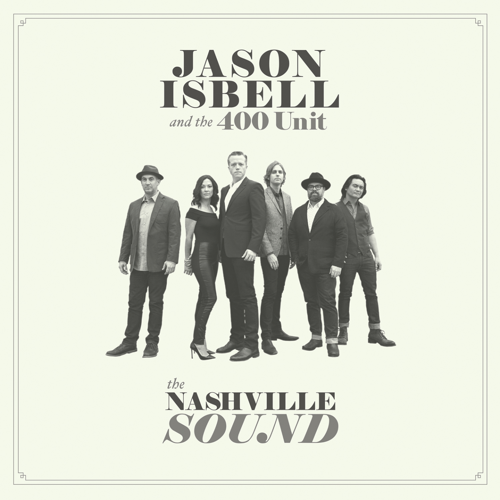
Even if our uneasy sociopolitical climate seems all-consuming, The Nashville Sound is not a one-note record. Isbell’s ace band The 400 Unit is a more powerful presence than they’ve been in years, which Isbell says he felt compelled to acknowledge by putting the band’s name and image on the album cover. Between songs about red-state and blue-state characters are tunes like “If We Were Vampires,” a moving meditation on the way death inevitably parts even the strongest of couples. The album’s centerpiece, “Anxiety,” was co-written with Shires, and it dissects mental health with the same poetic scalpel that “White Man’s World” takes to race.
You’d be hard-pressed to find someone betting against him now, but Isbell’s willingness to follow where the muse leads is a testament to his confidence, courage and curiosity as a songwriter — as well as the infrastructure he’s built for himself outside the music business establishment. The Nashville Sound is the third consecutive album he’s self-released, and whether or not audiences like the sound of it, he’s not getting fired.
“I’m not on a major label,” he says. “It’s not like if the crowd doesn’t respond the right way to my music, then they’re just going to shelve it, call it a tax write-off and try something different. That’s not my method. You know, if I write something, I meant to write it. I goddamn well meant to write it just like that. And if people want to like it, come along for it, fine. And if not, I’ll play to the ones that do.”



Post a comment as anonymous
Report
Watch this discussion.
(0) comments
Welcome to the discussion.
Log In
Welcome to the discussion.
Keep it clean. Please avoid obscene, vulgar, lewd, racist or otherwise abusive language. Comments featuring hate speech or threatening or violent content will not be tolerated.
PLEASE TURN OFF YOUR CAPS LOCK.
Be truthful. Don't knowingly lie or mislead.
Be proactive. Use the “report” link on any comment that violates our comment policy.
Share with us. We'd love to hear your feedback.