
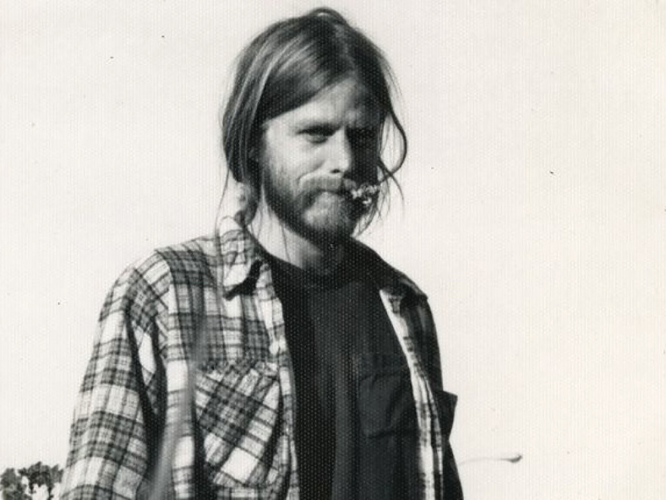
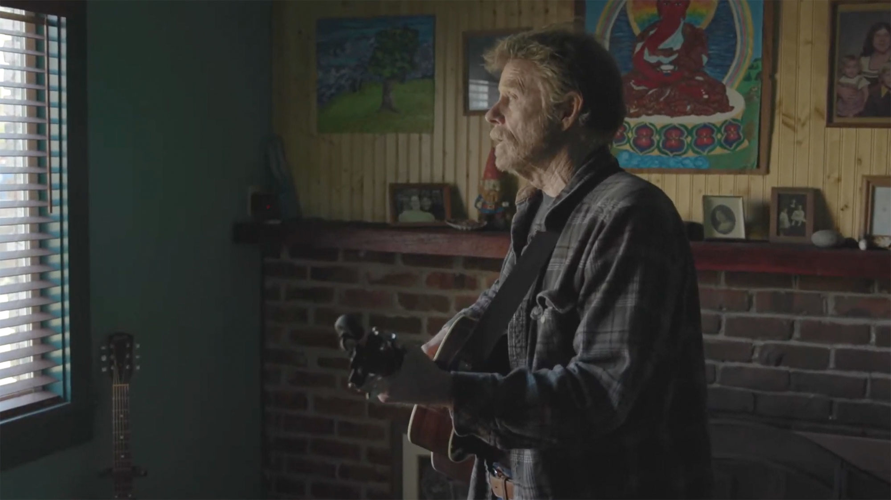


East Memphis singer-songwriter Bob Frank was a witty, often prophetic lyricist and engaging vocalist who never received the exposure or acclaim he deserved. No less a luminary than the great producer and multi-instrumentalist Jim Dickinson called him “the greatest songwriter you never heard.” Frank, who died in 2019 at his home in El Sobrante, Calif., seemed destined for bigger things when his self-titled debut was released on the Vanguard label in 1972. A Vietnam vet who’d been signed as a contract writer for Tree Publishing in Nashville, Frank had little interest in the usual mandate to crank out hits for the top country acts of the era.
Unfortunately, what happened to him serves as an object lesson in music-business politics. Frank landed a deal as an artist with Vanguard, much-loved for groundbreaking folk, jazz and blues records. What ultimately resulted was definitely an unusual item — a 12-song set produced on Music Row. The album contained a host of distinctive, prickly and odd numbers Frank penned about subjects ranging from the vagaries of auto theft to the joys of drinking wine and getting high. The tunes aren’t exactly the kind of stuff that lands you on the Billboard Hot 100, but they featured a pleasing, striking baritone delivery, and had a punch and poignancy that made them worth hearing.
Sadly, if not unpredictably, Bob Frank didn’t do much to help Bob Frank professionally. Part of that was due to limited promotion, but a larger portion was the result of a rather ugly dispute that erupted during a New York City showcase intended to spotlight the artist. Instead, it ended up destroying his Vanguard career. Frank maintained he’d been told by label executives he had creative control over the album, something that didn’t prove to be the case. During the performance at the famed club Max’s Kansas City in Manhattan, Vanguard expected Frank to play songs from the record. He instead opted to play new songs he was writing. When a Vanguard exec intervened and implored Frank to play the songs on the album, his response was: “If they want to hear those songs, tell them to go buy the fucking album.” His time on Vanguard ended rather quickly after that fiasco.
This incident is part of a rainbow of colorful details from Frank’s life spotlighted in the comprehensive three-disc set Within a Few Degrees: A Little Gest of Bob Frank. In mid-December, archival label Light in the Attic released the collection, which includes two full CDs and a DVD of producer-director Isaac Pingree’s highly entertaining, alternately humorous and disconcerting 75-minute film Within a Few Degrees. The documentary covers Frank’s life, revealing how he was very well-respected in the business; the aforementioned Jim Dickinson cut his songs, as did Chris LeDoux, Gary McMahan and Jerry McGill. The film also covers the nearly three decades it took for Frank to make another record, during which time he struggled to make a living, doing jobs including working for the city of Oakland, Calif. But when the records came — beginning in 2001 with A Little Gest of Robin Hood, his reimagining of a 15th-century narrative poem — they were very well-received. While Frank continued to collaborate with distinctive songwriters like John Murry and Chuck Prophet and release outstanding records like Keep on Burning and World Without End on his own Bowstring Records, Bob Frank was becoming a sought-after collector’s item. In 2014, Light in the Attic reissued Bob Frank as a co-release with Vanguard.

Frank was able to watch the documentary before his death. The sardonic perspective revealed by his personal commentary in the film also informs his take on the film. Frank liked it, according to Pingree & Co., and said: “I come off as just one more ordinary, fucked-up mind!”
The two CDs collect a host of his work. One is called Nashville Demos, and per the title, it features recordings of songs Frank wrote while under contract to Tree. (The cover includes a photograph of Exit/In with Bob Frank as the star attraction on the marquee.) The other is called The Cassette Tape Years, and features home recordings from the ’70s to the ’90s, the period between Bob Frank and Robin Hood. Despite the sometimes poor audio quality of the source material, the songs are emblematic of Frank’s compositional personality. They don’t boast overpowering melodies or flowery storylines, but offer clever insights and prickly observations, and are sung with verve and flair. It’s easy to understand how someone with his style and technique would have a tough time being shoehorned into a restrictive setting governed by someone else’s determination of what makes a hit.
Still, when you hear Bob Frank’s music, or his pithy comments, you better understand the special kind of talent he was, despite the poor treatment he received from the industry. The film and the recordings reaffirm that gifted performers don’t always attain the fame their skills merit, for reasons that are usually a lot more complicated than most folks will ever know.



Post a comment as anonymous
Report
Watch this discussion.
(0) comments
Welcome to the discussion.
Log In
Welcome to the discussion.
Keep it clean. Please avoid obscene, vulgar, lewd, racist or otherwise abusive language. Comments featuring hate speech or threatening or violent content will not be tolerated.
PLEASE TURN OFF YOUR CAPS LOCK.
Be truthful. Don't knowingly lie or mislead.
Be proactive. Use the “report” link on any comment that violates our comment policy.
Share with us. We'd love to hear your feedback.