
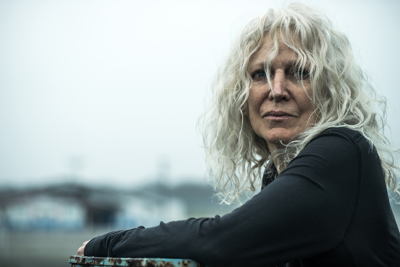


I called the legendary Nashville singer, songwriter and rock ’n’ roller Marshall Chapman on the phone, and merged onto the highway of her mind. It was an easy move, because Chapman is a world-class raconteur. In her rounded, commanding South Carolina drawl, Chapman tells me about traveling down Tennessee back roads with novelist William Gay, and recalls meeting Cowboy Jack Clement in Nashville in 1968. It’s legendary stuff, but Chapman has done the work that backs it up. In Nashville in the 1970s, Chapman learned songwriting in a vigorous milieu that proved perfect for the education of a bluff, funny practitioner of the art. Like Clement and the late John Prine, Chapman is a master of simplicity, and a great songwriter.
I caught up with Chapman, who is 71, at her Nashville home in April. On Friday, she’s releasing a new, Nashville-recorded full-length, Songs I Can’t Live Without, which finds her covering material by the likes of Leonard Cohen and Bob Seger. Her first album in seven years, Songs is an elegant holding pattern that offers listeners a glimpse into Chapman’s sensibility.
On Songs, Chapman ruminates over the material, supported by Neilson Hubbard’s minimalist production. The album works, but the pair of performances I saw Chapman give in April at Springwater were just as effective.
At the venerable dive bar — where she began a weekly residency in December 2019 that has since become a livestream concert that benefits the venue’s employees — Chapman sat barefoot on the stage and accompanied herself on guitar. She brought a deft touch to songs that have become classics, like “Why Can’t I Be Like Other Girls” and “Goodbye Forever.” They sounded wise, sturdy and worthy of infinite reinterpretation. The sets summed up Nashville singer-songwriterdom, but they also illustrated Chapman’s easeful performing style.
“I was like, ‘Gidget goes to Nashville and gets a record deal’ — that’s the story of my life,” Chapman tells me. She was born in Spartanburg, S.C., in 1949 and moved to Nashville in 1967 to attend Vanderbilt University. Along the way, she says, folk guitarist Norman Blake gave her tips on Travis picking — a guitar technique made popular by country artist Merle Travis — in 1965. She signed to Epic Records in 1976, and released her debut full-length Me, I’m Feelin’ Free, the following year. The followup, 1978’s Jaded Virgin, and 1979’s Marshall got good reviews in the rock press, but Chapman never quite broke through. Looking back at her major label work, Chapman turns reflective.
“I had zero control on the first two albums, and the third one, I really wanted to play rock ’n’ roll,” she says. “Back then, you either had to be country, or you had to be rock ’n’ roll. Making records was really painful back then, because I did not know how to get what I was hearing and feeling.”
I first heard Chapman’s Epic albums around 1980, and I recall being impressed by her songwriting, which I connected to the work of New Wave artists like Nick Lowe and Chrissie Hynde. Sonically, the records sounded conservative in the era of Lowe and The Pretenders, which meant they didn’t register as strongly as they could have.
After leaving Epic in 1980, Chapman regrouped. Star country outfit Sawyer Brown took “Betty’s Bein’ Bad” into the charts in 1985, resulting in a nice payday for the songwriter. The canned Nashville rock of her Epic albums didn’t obscure the quality of her songs, but she had needed something different — and more contemporary — all along.
She got it on 1995’s It’s About Time..., recorded live at the Tennessee State Prison for Women. The playing of her band, which included guitarists Eddie Angel and James Hollihan, combines the approaches of Rockpile and Tom Petty. It’s the ideal setting for Chapman songs like the Chuck Berry-style rocker “Bizzy Bizzy Bizzy.”
It’s About Time… serves as the ideal introduction to Chapman’s art, right down to the subtle drive of her band and her first-rate singing. Still, she proved herself a superb record-maker on her 2013 full-length Blaze of Glory, which may be her finest studio album to date. She duets with fellow Nashville tunesmith Todd Snider on the record’s “Love in the Wind,” and “Let’s Make Waves,” a co-write with Shannon Wright, is both silly and dead serious.
Produced by Chapman and Michael Utley, Blaze of Glory registers as country music, but Chapman’s concept also makes room for Americana. As on Songs I Can’t Live Without, Chapman gets tactful backing on Blaze from Music City ax man Will Kimbrough, who helps define the performances. She shines on The Delmore Brothers’ “Blues Stay Away From Me,” and she turns Hoagy Carmichael and Ned Washington’s “Nearness of You” to her own purposes.
Chapman’s songwriting is pared down and highly effective throughout Blaze of Glory. On Songs, it’s her actorly instincts that come through most strongly on the material she’s chosen to interpret. The song selections aren’t surprising, but her hushed reading of Bobby Charles’ “Tennessee Blues” adds new levels of complexity to a great song. Meanwhile, Chapman revisits her roots in classic rock on her versions of Bob Seger’s “Turn the Page” and J.J. Cale’s “After Midnight.”
As she tells me, she wasn’t pleased with the studio rock of Jaded Virgin, which may be her least effective record to date. You can hear how her record-making abilities have evolved by comparing that album’s somewhat sterile version of “Turn the Page” to the superb version included on Songs.
“I didn’t listen to Jaded Virgin for 25 years, because I hated it,” Chapman says. “It took me till I was 60 years old to just have the confidence and the experience to make records.”
Songs is an effective collection of covers, with rough edges left intact. Chapman slides through Cohen’s “Tower of Song” with style. Similarly, she turns seemingly banal material like Otis Blackwell and Elvis Presley’s “Don’t Be Cruel” into stripped-down music that transcends nostalgia. I enjoy hearing her interpretations of rock and pop standards, but Chapman has the smarts to sing almost anything. Given a more detailed aural depth of field than Hubbard provides on Songs, Chapman could make an interpretive record on the order of, say, Marianne Faithfull’s 2008 Easy Come Easy Go: 12 Songs for Music Lovers.
“I’ve always felt like a stranger in a strange land in Nashville,” Chapman says, “even though I adore Nashville now.”



