

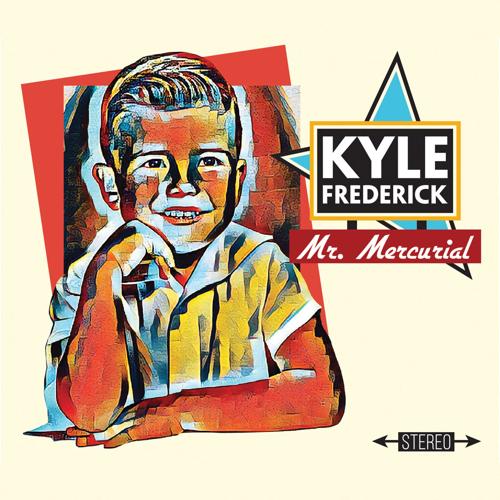


Stripping down rock ’n’ roll to its essentials is a method that goes back to the music’s earliest days. When you listen to Jerry Lee Lewis’ Sun Records singles, or Jonathan Richman’s 1972 proto-punk tune “Roadrunner,” you hear the sound of minimalist anxiety. Other techniques that rockers sometimes use are substituting keyboards for guitars or letting various percussion instruments stand in for drums, which is the approach The Beach Boys used on their 1977 album The Beach Boys Love You. These creative shortcuts to rock profundity provide the key to understanding the new album by Nashville-area singer, songwriter and guitarist Kyle Frederick. Called Mr. Mercurial, the LP was released Feb. 25.
In every way, Frederick’s latest music subverts the idea of a rock performance, and his subject is the way the anxieties of the modern world can be tamed by close attention to spiritual matters. Still, Mr. Mercurial rocks and rolls even as it eschews the traditional band setup of drums, bass and electric guitars. It’s a startlingly original record that colors outside the lines of Nashville music.
Indeed, Mr. Mercurial lives up to its euphonious title. It’s a suite of 13 mostly short tunes — some tracks run just over one minute — that adds up to an examination of spiritual malaise, celebrity culture and the myth of rock ’n’ roll. Co-producer Byron House, who also produced Frederick’s previous releases, adds percussion, keyboards and background vocals to Frederick’s songs. In addition, Frederick plays only acoustic guitar on the album, and his ingenious licks provide the backbone of every song. His guitar work derives from power pop and folk rock, but the singularity of his conception turns the clichés on their heads.
Frederick was born in Louisville, Ky., in 1960 and grew up in Bowling Green, aspiring to become a professional guitarist. Mr. Mercurial is both the product of his vast experience as a rock picker and the result of the process of making a multilayered rock record piecemeal in the studio.
“We worked on this for two years,” Frederick says from his home in Mt. Juliet, where he’s lived since 2005. “It took me a year to write it and a year to record it. It’s not my nature to be patient. This process absolutely requires it, and it’s helped me to slow down. I think it’s helping me to write too, you know what I mean? I’d love to do it where you could crank it up and just go, ‘Here are the songs.’ But I’ve become used to the process. It’s out of necessity.”
During his time in Bowling Green, Frederick joined a band with Bowling Green native Bill Lloyd, with whom he would later tour as guitarist for country-pop act Foster & Lloyd. Frederick also toured with a group called TyBarc, which opened shows for Brownsville Station and Black Oak Arkansas in the late ’70s. By the time he moved to Nashville in 1980, he was a first-rate guitarist, and he joined the band of country singer Joe Sun in 1981.

Frederick gained invaluable experience on the road with Foster & Lloyd and Sun, but you get the sense he wanted to do something more individualistic. As he tells me, he’s a fan of Todd Rundgren and British Invasion rock. Mr. Mercurial amounts to an abstraction of Beatles-derived music that stands tall with the work of XTC and Chris Bell. When Frederick uses the traditional format of drums, bass and electric guitars — as he does on “What the World Needs Now,” a track on his 2020 EP Mother Humble — the results are stunning.
Mr. Mercurial is the statement of a seeker after spiritual truths, which means “Write On” and “I Was There” mention Nelson Mandela, Moses, Jesus and Richard Nixon. Meanwhile, “The Tilda” is about the allure of actress Tilda Swinton, and exists on its own plane of eternal verities. As Frederick sings: “It won’t kill ya / To do the Tilda Swinton with me.”
On Mercurial, Frederick sings in the voice of an ordinary guy who seems as confused — and as elated — by the world as anyone else. Because his songs are so brief, they have a gnomic quality, as if he’s plucked them out of his subconscious, anchored them with riffs that often defy bar lines, and added touches of avant-garde pop to put them across.
Frederick’s music operates in its own aural universe, and its extreme compression will likely satisfy fans of the work of power-pop giants like Game Theory leader Scott Miller, though Frederick’s subtly Christian message sets it apart from, say, Game Theory’s 1987 album Lolita Nation. As he says, he’s not interested in doing the standard song-and-dance.
“It’s not a strategy,” he says of his creative process. “It’s realizing you have these parts, this melody, these words and these chords. I tend to go, ‘This is pretty economical, and I like it.’ ”



Post a comment as anonymous
Report
Watch this discussion.
(0) comments
Welcome to the discussion.
Log In
Welcome to the discussion.
Keep it clean. Please avoid obscene, vulgar, lewd, racist or otherwise abusive language. Comments featuring hate speech or threatening or violent content will not be tolerated.
PLEASE TURN OFF YOUR CAPS LOCK.
Be truthful. Don't knowingly lie or mislead.
Be proactive. Use the “report” link on any comment that violates our comment policy.
Share with us. We'd love to hear your feedback.