
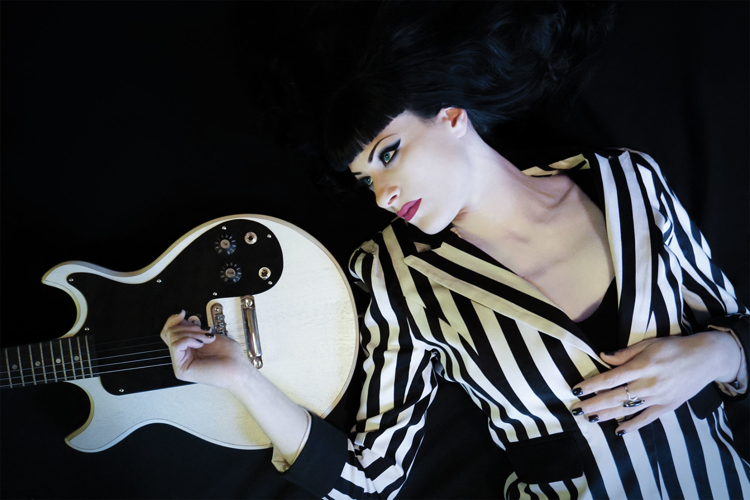
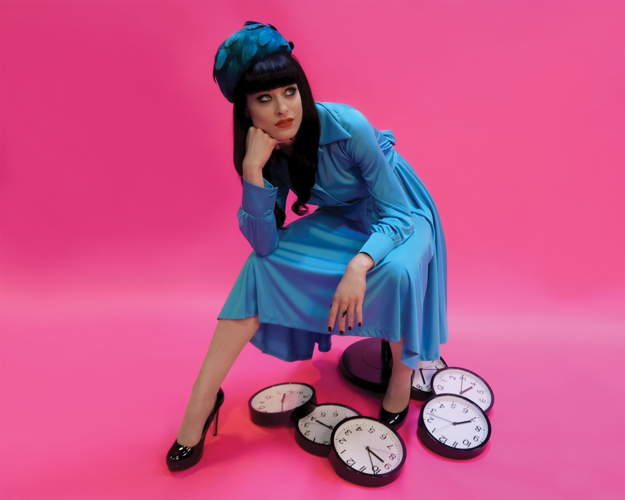


Olivia Jean does some of her best work in the dead of night. And it has little to do with her garage-goth persona.
“I named my album Night Owl for two reasons,” the singer, songwriter and multi-instrumentalist tells the Scene via email. She’s on a break from a busy year of touring, which she’ll wrap up Saturday at Little Harpeth Brewing. “I am an insomniac. [And] my creativity tends to get amped up at night. I find solace not having any distractions or guilt [about] staying inside and obsessing over projects.”
In August, Olivia Jean released Night Owl, her second solo LP, via her fellow Detroit native Jack White’s Third Man Records. Her 2014 debut Bathtub Love Killings, also a TMR release, was produced by White and features her playing almost all the parts herself. In stark contrast, Olivia Jean took on the task of producing Night Owl herself, calling on the players she wanted for each part. That doesn’t mean it was an easier job, of course — she still had to continually switch roles between being the person writing the song and the person responsible for translating it into a recording.
“It was overwhelming making rash decisions without second-guessing,” she says. “I enjoyed having a producer for Bathtub Love Killings. It helped me hear the song through others’ ears.”
The 14-track Night Owl is a showcase for an eclectic new sound for the 30-year-old musician, though it’s hard to put one particular label on the music she creates. You can hear the snarl of her garage-punk roots — a callback to her time fronting The Black Belles — along with kinetic guitar riffs and slapback echoes of surf music, the dreamy chime of Byrds-esque jangle-pop and more. Every song on the LP is its own unique conglomeration of styles. On some records, that stylistic diversity might scan as a lack of identity, but nowhere on Night Owl does Olivia Jean sound like anyone other than herself, even when she’s doing a cover.
“Different genres seem to mesh together without intention when I write,” she says. “I grew up loving punk, garage, surf — those elements all come out.”
Olivia Jean came of age at a time when the garage-rock scene was thriving in her hometown, thanks in no small part to White’s former band The White Stripes. She first experienced the Music City rock scene with the Belles in 2010, and despite the groundswell of activity at the time — with bands like JEFF the Brotherhood, Those Darlins and Diarrhea Planet then on the rise — she still didn’t feel quite at home in the country-dominated town. Nine years later, she’s made her home here, and she’s encouraged by the way rock has become an even bigger part of the music community. “I feel like my style of music can now live and breathe in Nashville,” she says.
The influence of surf rock — a genre that’s broadly associated with carefree days in the sun — throughout Night Owl seems ironic when you consider Olivia Jean’s lyrics, which focus on heartache, mental health struggles and the toxicity of perfectionism. However, the surf and ’60s-pop sounds aren’t really an anomaly. They help convey how she’s been able to stay positive in spite of the self-doubt that sometimes crept up on her during the process of making the album.
You can hear that in “Rhinestone,” which she says is her favorite song to play live. “Singing the lyrics live is therapeutic in a way,” she says. “It’s sort of like venting out frustrations to a friend.”
The glistening, grooving tune comes from the perspective of someone who’s been squeezed out of a former partner’s life by an interloper. The singer doesn’t downplay how brutal the experience feels, but at the same time, she’s not going to dwell on the past, as she sings: “Think it no more / I am mature / The fringe on her dress swept me out the door / Got nothing left / And nothing right / As I fade back to black and white.”

As she made Night Owl, Olivia Jean found herself craving insight from other musicians and producers. Her ultimate goal is to serve the song, and she’s decided that ultimately, the way for her to take control of that is to have someone else to bounce ideas off of.
“I’ve realized being a perfectionist is not a healthy trait as a musician,” she says. “It slows down the process, and at a point I begin to lose the spark I felt starting a song. … I feel that it’s very important for outside ears to listen to an album and introduce new ideas and constructive criticism. It helps to cleanse my palate. When I spend a long period of time working on songs I become emotionally attached. I need that fresh take on the music and extra push to set a song free.”



Post a comment as anonymous
Report
Watch this discussion.
(0) comments
Welcome to the discussion.
Log In
Welcome to the discussion.
Keep it clean. Please avoid obscene, vulgar, lewd, racist or otherwise abusive language. Comments featuring hate speech or threatening or violent content will not be tolerated.
PLEASE TURN OFF YOUR CAPS LOCK.
Be truthful. Don't knowingly lie or mislead.
Be proactive. Use the “report” link on any comment that violates our comment policy.
Share with us. We'd love to hear your feedback.