
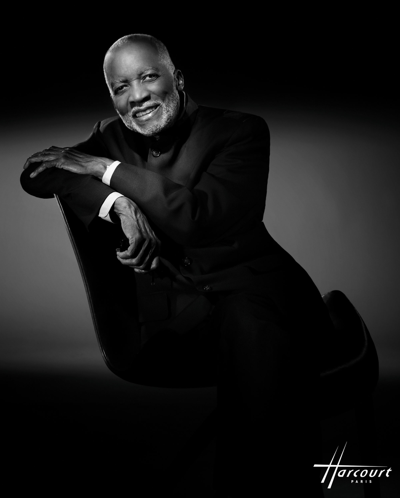


Acclaimed pianist, composer and bandleader Ahmad Jamal has been a headliner since the early ’50s, when he relocated from his native Pittsburgh to Chicago. That’s how he began one of the most remarkable and extensive careers in jazz history, which has included numerous international festivals and hosts of national tours. Still, there’s at least one place he hasn’t played: Nashville.
“That’s the home of the Grand Ole Opry, right?” he asks during a phone conversation. “Then to the best of my knowledge, I’ve never played there.”
Well, make that “haven’t played yet” — he’ll perform at the Schermerhorn on Friday. It’s amazing that there are still firsts to be had for Jamal, whose first recording session as a bandleader was in 1951. At that time, his group was called The Three Strings, later renamed The Ahmad Jamal Trio. Jamal quickly established the trademarks that made him a seminal jazz influence. These include a superb ability to manipulate and change tempos, immaculate phrasing, imaginative sweeps and flourishes within songs, innovative use of space in his solos, and a wonderful touch as a melodic interpreter. His immense technique made the small combo sound of piano, bass and drums feel like the sonic equivalent of a big band. No less a dignitary than Miles Davis — not known for giving out compliments — frequently cited the impact of Jamal’s playing on his own approach. But Jamal downplays those formidable skills.
“I’m first and foremost an ensemble player,” Jamal says. “Without the great musicians I’ve had in my groups over the years, nothing would have happened for me. I’ve never been the type to want the spotlight as a pianist. I prefer to work off and with other musicians.” Still, despite his modesty, Jamal’s brilliance has earned him multiple honors, among them a fellowship as an American Jazz Master from the National Endowment for the Arts, recognition from the Kennedy Center as a Living Jazz Legend, and a Grammy Lifetime Achievement Award.
The list of memorable albums in Jamal’s seven-plus-decade catalog is staggering, but one stands above the rest: his 1958 release At the Pershing: But Not for Me. Pianist Jamal, bassist Israel Crosby and drummer Vernel Fournier were recorded live at Chicago’s Pershing Hotel, with a set list that ranged from “The Surrey With the Fringe on Top” to his masterful arrangement and reworking of Nat Simon’s “Poinciana.” The album, released by Chess Records’ jazz imprint Argo, stayed on the Billboard all-genre chart for more than two years (107 weeks), and “Poinciana” became Jamal’s signature tune.
“You know, there were four of us who made Leonard Chess a millionaire by the time he sold that company,” says Jamal. “That was Chuck Berry, Muddy Waters, Bo Diddley and me. That album established the company’s jazz division. But you know, at the time — for me, it was just a good session we played. No way did I anticipate that kind of success, and I was grateful for it then and now. It just goes to show you never know what will hit, because I didn’t think that album would have that impact.”
That was just the beginning. Jamal continued an amazing run of recordings and live performances, seldom going more than a year or two without releasing an album. His music was introduced to the hip-hop generation via samples of his 1970 LP The Awakening, used extensively as the foundation for tracks by Nas, Common and DJ Premier, among others. The Jamal legacy has recently had two additions, including another first: Ballades, released Sept. 13, is his first mostly solo album. Jamal explains that the new record grew out of sessions for his 2017 album Marseille.
“Well, I was making this LP at a studio outside of Paris and was doing a lot of different things, some of them just fooling around,” he says. “But [producer Seydou Barry] came to me after we finished the first album and said, ‘We’ve got to put this other material out.’ I didn’t want to do it, but he insisted, so that’s how Ballades ended up getting released.”
Ballades contains dynamic solo interpretations of “Poinciana,” “Spring Is Here,” “What’s New” and “I Should Care.” Jamal takes the familiar melodies and does twists, turns and dips with them, never abandoning the established line, yet skillfully inserting and injecting enough inventions to make his versions distinctive. There are three enjoyable tracks on which he’s joined by bassist James Cammack, but hearing Jamal’s piano unaccompanied is a rare delight, the spice that makes Ballades something special.
At 89, Ahmad Jamal is busier than ever. He hasn’t divorced himself from contemporary happenings, saying he’s listening intently to what’s happening both nationally and on the local Chicago scene. But his primary focus remains on playing.
“I find there are still things I want to say and do on the piano,” he concludes. “I’m still learning after all these years, and that’s the greatest thing about playing music. You realize there’s always more out there for you to discover.”



