


Since we live in an era when a lot of received wisdom has been proven false, it might be time to to upend the notion that topical music isn’t built to last. This was true in the ’60s, when protest singers like Phil Ochs recorded tunes that were outdated virtually upon their release, because the words took precedence over the music. But the fractious state of Western democracy in the Trump era has spurred artists to create protest music that might endure, even if our current political malaise doesn’t.
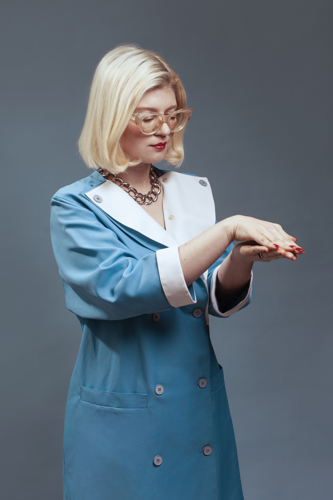
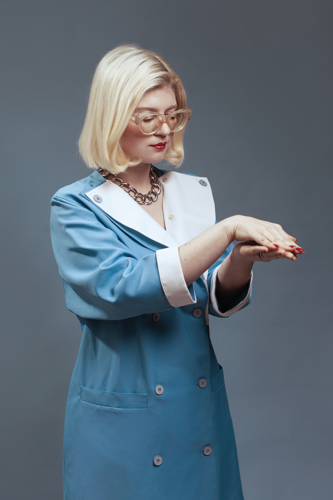
Among the records released in 2017 that fit this description are Mavis Staples’ Jeff Tweedy-produced and -written full-length If All I Was Was Black to comedian and singer Tim Heidecker’s Too Dumb for Suicide: Tim Heidecker’s Trump Songs. Add to this list two releases by Russian-born and German-based singer, songwriter and visual artist Mary Ocher: The West Against the People and Faust Studio Sessions and Other Recordings. Ocher combines real-world commentary with stylized musical settings in ways that suggest that political needs of the moment may now be more important than the concept of “timeless art” — and yet she produces art that can transcend the moment.
Ocher, who was born in 1986 in Moscow, immigrated with her family to Israel when she was 4 years old. She formed her first band, Mary and the Baby Cheeses, in Tel Aviv, and relocated to Berlin in 2007. Since then, she has released a string of full-lengths that veer from keyboard-driven abstraction to folk-influenced simplicity.
“I am a fan of krautrock, of course,” Ocher tells the Scene via e-mail from a tour stop in Britain, where she played a few dates before embarking on a monthlong tour of North America. “My favorite member of Can was Holger Czukay. I wrote him several emails.” Czukay, who played bass in the famed German experimental rock band, died in September. Ocher also mentions Can drummer Jaki Liebezeit, who died in January 2017.
Both The West Against the People and Faust Studio Sessions were recorded at Faust Studio in Scheer, Germany, a town on the Danube River. Ocher had production help from Hans Joachim Irmler, a former member of famed ’70s German progressive-rock band Faust, and Ocher describes the studio as a space with an abundance of tools designed to further creativity.
“We brought certain instruments with us,” she says. “But there was so much to play around with at the studio, more percussion, sound sculptures, guitars and keys.”
On The West Against the People, you can hear how artfully Ocher uses the conventions of experimental music that Faust, Can and other krautrock bands established more than 40 years ago. “Arms” lets her flexible voice float over a simple keyboard figure that anchors her performance, while “My Executioner” features an ominous drum pattern and Ocher’s post-Buffy Sainte-Marie vocals.
The West Against the People is a rock record influenced by the deconstructed rhythms of Can. Those aren’t featured as prominently on Faust Sessions, a simpler affair dominated by Ocher’s vocals. Faust Sessions is, in its way, derived from Sainte-Marie’s late-’60s and early ’70s work. Ocher mentions Sainte-Marie as an influence, along with a list of artists she terms “writers, composers and tinkerers,” among them electronic-music composer Bruce Haack, singers Patti Smith and Odetta, jazz harpist Dorothy Ashby and record producer Joe Meek.
As Ocher may discover when she plays solo at Fond Object’s Riverside Village location on Monday, the issue of influence in modern music has become vexed. The building that houses Fond Object sports a mural that features, somewhat whimsically, renderings of both Meek and Tom Petty. Ocher’s music draws upon many sources, but its effect is similar to that of any number of folk singers and rock iconoclasts. Throughout Faust Sessions, she sounds like a ’60s protest singer — “Across Red Lines” sports a folk guitar accompaniment, and she delivers an impassioned reading of guitarist Robbie Basho’s “Blue Crystal Fire.”
As her recent music makes clear, Ocher is guardedly optimistic about the future, which puts her in the company of the protest artists she admires. “I’m excited to see so much positive social change happening, despite the tension, the aggression and the resistance,” she writes. “If there was no real change, there would not have been such tension.”
Because Ocher’s music is essentially political, it’s a vehicle for her views on modern society, which is being deformed by such phenomena as anti-immigrant fervor in North America and Europe and the rise of Donald Trump and his supporters in the United States. Ocher’s work suggests that the great age of individualism that once found expression in the music of Joe Meek and Faust has entered its final stages. Just maybe, words matter more than music.



