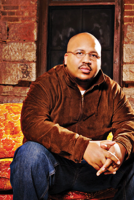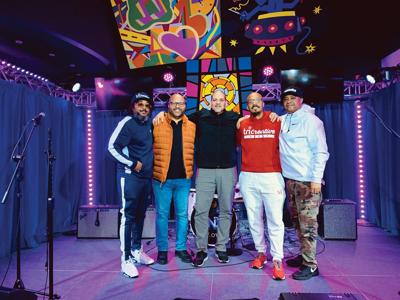


Lovenoise founders Antoine Nunn, Eric Holt, LaSalle Chapman, Chip Hockett and Bryce Page at WNXP's Sonic Cathedral
A story about Black Nashvillians making music will likely touch on the lack of available music-business infrastructure. It applies whether you’re talking with Black country players fighting to be treated fairly by the mainstream machine, or rappers, R&B artists and others in myriad genres trying to create a social and economic ecosystem for their art. One piece of this puzzle is live performance; it’s hard to be part of a scene if it’s always a struggle to play a show, or you seldom see people who look like you onstage.
While Nashville’s contemporary collection of music scenes isn’t perfect with respect to diversity, it has improved dramatically during the past 20 years. Many people have worked for this change, but a catalyst is easy to spot: Lovenoise. Today the organization helmed by Eric Holt and Bryce Page promotes some of the biggest shows in town, featuring international stars of hip-hop, neo soul and beyond. In late summer 2003, the duo was a group of five, rounded out by LaSalle Chapman, Chip Hockett and Antoine Nunn.
They were looking to put on a night of music, welcoming to everyone — but by Black Nashville music-makers and for a Black audience. It was a struggle to even secure a venue at first, but the weekly Sunday night party that Lovenoise held for years became a touchstone for many Black Nashvillians and inspired a shift in what it means to be part of “Music City” — broadening a cultural identity and brand so heavily tied to whiteness.
Making Noise, a four-part podcast about Lovenoise produced by Nashville Public Radio, launches Thursday. Music journalist and author Jewly Hight led the production team and hosts Making Noise. On a phone call with the Scene, she explains it was crucial to expand the podcast’s historical scope beyond Lovenoise’s 20-year history. Making Noise also examines the long-term effects of the construction of I-40 through North Nashville in the 1960s, which devastated Black neighborhoods and businesses and the legendary entertainment district on Jefferson Street. During the same period, the city funded projects like building the original Country Music Hall of Fame and Museum.
“We couldn’t just start with Eric Holt saying, ‘It was really hard to book shows’ — you gotta take in the full weight of ‘Why was it really hard to book shows,’” Hight says. “Because that shows you the hostile environment [Lovenoise was] stepping into.”
The podcast is brimming with voices, including all five Lovenoise founders. In addition to telling their history, they helped Hight and her team make connections for interviews and provided a massive array of artifacts. That includes a wealth of newly digitized audio and video, preserving a scene that didn’t yield a lot of widely distributed music.
Some folks you’ll hear from who were heavily inspired by Lovenoise shows are musicians like Jason Eskridge, as well as Mimi McCarley of urban-music-boosting organization Nashville Is Not Just Country Music. You’ll also hear Brian Sexton, who is Mayor Freddie O’Connell’s liaison with the Metro Council and who’s very active in efforts to make the city more livable for creative people amid inflated real estate prices and other pressures.
Lovenoise shifted its focus as Nashville changed around it. Making Noise also explores how the foundation the organization laid and continues to build on has changed the game in important ways — though there’s still much more to be done — for rappers and singers making waves today, like Tim Gent, Jamiah, Brian Brown, Lo Naurel and Chuck Indigo.
“It became really clear to me that because there had been these other generations of people working to make space here,” Hight says, “this rising generation of artists in hip-hop and R&B came in thinking differently from the very beginning … saying: ‘Of course I can make my own music here. Of course I can go about trying to build a career in Nashville, and I don’t necessarily have to have to leave.’”