


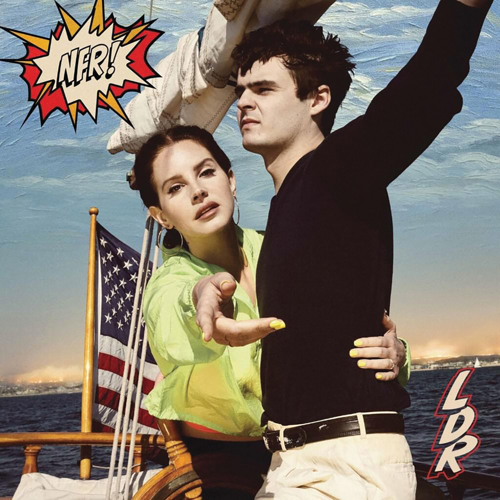


Since even before the release of her major label debut Born to Die in 2012, the singer and songwriter once known as Lizzy Grant’s internet-engineered bummer-babe persona Lana Del Rey has been both an experiment and an evolution in pop-culture mythos. Her character is a starry-eyed, self-medicated hopeless romantic with a penchant for tall tales, bad boys and high crimes, projected through a fetishized lens of Hollywood’s golden era. Del Rey staked out unclaimed sonic territory with lush, cinematic, beat-driven torch songs that wink wryly at their own inflamed melodrama. Her fascination with American pop art, cinematic glamour and desperate living has remained intact in each of her attempts at the Great American Pop Album.
But Del Rey’s sixth LP Norman Fucking Rockwell!, released in August, feels like the moment that all these ingredients eased from a rolling boil into a low simmer. In the process, it reveals Lana Del Rey as a fully actualized artist who’s reinvented herself several times over, while allowing her fingerprints to become visible.
Del Rey’s third LP, 2014’s Dan Auerbach co-produced Ultraviolence, has often been cited as her masterwork — the moment her songwriting caught up with her highly stylized delivery. It would also seem NFR! comes at a time when pop music has finally caught up with Lana Del Rey. From Drake’s brooding rap confessionals to the rise of Xanax-fueled emo underdogs like the late Lil Peep and the anxiety-influenced pop of Kim Petras and Billie Eilish, you can find the influence of Del Rey’s 2012 hit single “Summertime Sadness” all over. It’s become an anthem for the Information Age. Inundated by 24-hour news cycles, shocked till we’re numb by seemingly regularly scheduled national tragedies, lulled into infinite social-media scrolling — it seems we’re all officially on LDR’s level. In turn, Del Rey herself has returned with the antidote.

With NFR!, her escapist narratives, irreverent lyrics and narcotic soundscapes have never been so potent, or timely. A 90-degree sonic turn (not a full 180) is the most surprising and satisfying thing about this effort. The beat-driven, Spector-esque wall of sound that bowled you over on previous records has — with the help of rising pop superproducer Jack Antonoff — been stripped down to arrangements that sparkle with deliberate sparseness. Crafted with lightly strummed guitars, faintly stirring string arrangements and pianos that sound like they’re being touched ever so gently, NFR! is a slide down the Hollywood Hills into the folkie mecca of Laurel Canyon. Conceptually, thematically and sonically, almost everything on Norman Fucking Rockwell! seems to live in a postmodern diorama of the fabled birthplace of late-’60s folk-rock. Somehow, Del Rey has managed to capture both the peak of said music’s brilliance and the way it has faded into the recesses of music fans’ subconscious.
One track is very different from the rest of the record, but is still pretty impressive. Del Rey’s cover of ’90s reggae-rock trio Sublime’s “Doin’ Time” was recorded for a forthcoming documentary about the group, and its inclusion here seems to compensate for a dearth of radio-friendly tunes. As a single, it works … well, sublimely, as the only cut the kids will probably call “a bop.” That aside, the track feels like a bookmark wedged about a third of the way through NFR!’s 14-song run, which otherwise flows freely in an aggressively languid, seamless loop of listenability.
For all the style attached to this collage of fantasy, memory, cries for help and gripes into the ether, there’s also substance. Times aren’t great, and Del Rey is deep in daydreams of some place and time exponentially more marvelous. The girl can’t get no satisfaction. She’s fed up with her “man-child” of a romantic partner, but too in love with his genius to ditch him, as she sings in “Norman Fucking Rockwell.” Bored of stiff garden parties with Canyon housewives, she fantasizes about evading police to smuggle her lover out of the country (“Bartender”). Then, of course, there’s the gloriously hedonistic party she’ll throw him when he gets back (“California”). The two tracks that close the album, “Happiness Is a Butterfly” and “Hope Is a Dangerous Thing for a Woman Like Me to Have — but I Have It,” are Del Rey at her most dejected and vulnerable. Meanwhile, there’s also “The Greatest,” which grazes the fourth wall (without knocking it down) via the directness of lines like “Kanye West is blond and gone / ‘Life on Mars’ ain’t just a song / Oh, the livestream is almost on.”
In “Venice Bitch,” a sprawling nine-minute opus full of tangled guitars and dueling synths, her “fresh out of fucks forever” nihilism evokes the currently ubiquitous plague of existential dread. Her grim and ironic sense of humor and obsession with both a picturesque Hallmark romance — and/or a ride-or-die love affair, more passionate than the law will allow — leaves us with at least some sense of optimism, jaded though it may be. Many people recognize that the Trump motto “Make America Great Again” is built on a false premise that our country was an unassailable beacon of greatness at some point before. Del Rey’s music seems like a reminder that we can indeed make something great out of it.



