
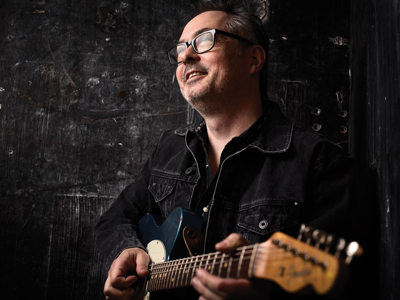


Somewhat improbably, Nashville singer-songwriter Kevin Gordon’s latest full-length Tilt and Shine may be the best rock ’n’ roll album anyone will release this year in Davidson County and its environs. Cut in Nashville with producer and guitarist Joe V. McMahan keeping the proceedings loose and experimental, Tilt and Shine skews to Americana even at its most abstract. It reveals, also somewhat improbably, Gordon’s appetite for pop, which encompasses blues, folk, soul and New Wave. Style is harnessed to serve form — Gordon’s oddball Southern rock provides the perfect backdrop for his narratives, which examine humankind through the lens of the South. Gordon achieves a poetic density of music and lyrics throughout Tilt and Shine that puts you in mind of the great blues masters, and he makes it sound easy.
Gordon cut Tilt and Shine at McMahan’s studio Wow & Flutter, where he also recorded his 2012 full-length Gloryland and 2015’s Long Gone Time. Like his previous collaborations with McMahan, Tilt and Shine features avant-garde blues guitar licks and challenging chord progressions. Gordon’s new music has an experimental edge that belies the slow gestation of the record itself.
“We took about a year to finish tracking and mixing, just kind of working on it in bits and pieces as schedules permitted,” Gordon tells the Scene from his Nashville home. “You know, I kinda like that way of working, because it allows you some time. You can let these tracks sort of sit there and age for a little while, and then you go back and listen to them again.”
For Gordon, who has earned considerable critical acclaim for his work over the past 25 years, Tilt and Shine represents one possible summation of his talents. Born in 1964 in Shreveport, La., he earned a masters in poetry from The University of Iowa Writers Workshop before moving to Nashville in 1992. He released his first full-length, Carnival Time, the next year, and continued to record over the following two decades, hitting his stride with the critically acclaimed Gloryland.
A brilliant record full of stutter-step blues shuffles and repurposed soul grooves, Gloryland peaks with the justly celebrated track “Colfax/Step in Time.” Over the course of the song’s 10 minutes, Gordon creates a surreal narrative, based on fact, about Louisiana, racism, the Ku Klux Klan and American identity. Meanwhile, “Tearing It Down” operates in a unique quasi-blues tonality that Gordon uses on Gloryland and Tilt and Shine. Gordon’s songs often take unconventional routes to get where they’re heading, and Tilt and Shine brims with inventions that seem spontaneous.
“The way Joe and I make records is kind of intuitive,” says Gordon. “We’re never really sure where we’re going. He probably has a better idea than I do, but he doesn’t tell me.” Gordon and McMahan’s approach results in performances that are, on Tilt and Shine, remarkably nondoctrinaire. “Gatling Gun” is a through-composed country-rock-soul tune with rich chord changes, while “DeValls Bluff,” about a real town in Arkansas, is a sinister piece of local color Gordon wrote with McMahan.
If some of Tilt and Shine plays with the conventions of blues and folk, Gordon becomes a pub rocker on the record’s “Drunkest Man in Town,” a song that splits the difference between soul and rock ’n’ roll. Like the similarly upbeat “Right on Time,” which Gordon performs in a circa-1983 New Wave-country-rock style, “Drunkest Man in Town” represents the commercial side of a great songwriter whose work has so far appealed mainly to songwriting adepts and Americana followers. Gordon is a songwriter’s songwriter, and he doesn’t write with the idea of commercial calculation in mind.
“We all want to be compensated for our efforts,” Gordon says. “But I gotta say, when I’m writing, that’s the furthest thing from my mind, and it has to be that way. I don’t know if that’s what poetry school did to me — it’s Art with a capital ‘A.’ I guess, with music, I try to make it with a small ‘a,’ you know.”
No matter how you render the word, Gordon displays considerable musical art on Tilt and Shine, a record that satisfies both formally and emotionally. Gordon’s rhythm-guitar style draws from blues and R&B, and he sings in a soulful voice that’s completely unaffected. The band — McMahan, drummers Paul Griffith and Jon Radford and bassist Ron Eoff, among others — cooks, with Griffith’s playing particularly inspired.
Tilt and Shine spices up standard Americana fare with hints of swamp pop and Springsteen-style songcraft. Gordon couches his literary narratives in playful post-boogie music, and both literature and rock ’n’ roll end up being served. If you ask me, that’s a pretty impressive achievement.



