
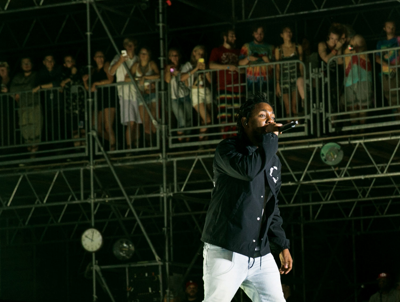


Kendrick Lamar performing at Bonnaroo 2015
During the 2015 BET Awards, just days after his 28th birthday, Compton-born MC Kendrick Lamar delivered a rousing performance of his song “Alright” while standing atop a vandalized police car, a massive, tattered American flag waving at his back. It was a powerful image. Later that night, the rapper won the BET trophy for Best Male Hip-Hop Artist — an award he’d won once before in 2013, and would go on to take home again in 2017.
“Alright,” the monumentally excellent fourth single from Lamar’s third album To Pimp a Butterfly, had come to be seen by some as a rallying cry for the Black Lives Matter movement. “We hate po-po,” raps Lamar at one point in the song. “Wanna kill us dead in the street fo’ sho’.” In March of that year, the U.S. Department of Justice had announced that Officer Darren Wilson wouldn’t be charged with a civil rights violation in the Ferguson, Mo., shooting death of Michael Brown. That decision loomed large in the American consciousness when Lamar played the BET Awards in June. It was a cathartic and cleansing performance.
But not everyone thought so. Shortly after the ceremony, noted blowhard Geraldo Rivera claimed that Lamar’s performance was “not helpful at all.”
“This is why I say hip-hop has done more damage to young African-Americans than racism in recent years,” said the pundit on an episode of Fox News’ The Five.
Beyond being wildly reductive and offensive, Rivera’s comment was powerfully ignorant. Hip-hop is an art form in part inspired by the oppression African-Americans experience as a result of systemic, institutionalized racism. To say that this art form is “more damaging” than the racism it exists as a response to ... well, it’s a testament to Rivera’s ineptitude.
But we aren’t here to plumb the depths of Rivera’s ignorance. That, after all, would take more words than we at the Scene have room for. Instead, consider this: Lamar samples a portion of that episode of The Five during the opening of this year’s DAMN., a record that, incidentally, debuted at No. 1 on the Billboard 200. Later, on the album track “YAH.,” Lamar raps: “Fox News wanna use my name for percentage. … Somebody tell Geraldo this nigga got some ambition / I’m not a politician, I’m not ’bout a religion.”
And therein lies one of Lamar’s key strengths: using institutionalized racism, cultural flashpoints and criticism of his art — albeit vapid criticism, in this particular case — to inspire more art. That crux, where his natural talent meets his knack for commentary, is what makes Lamar the most important MC on the contemporary music landscape.
Of course, if you’re eight paragraphs deep in an alternative-weekly newspaper’s feature about Kendrick Lamar coming to town, there’s a good chance you’re already well aware of the rapper formerly known as K-Dot’s cultural relevance. You’ve probably consumed much of Lamar’s catalog, from his 2011 studio debut Section.80 to 2012’s banger-riddled Good Kid, M.A.A.D. City and his 2016 compilation of untitled, unmastered demos released as, of course, untitled unmastered. You might even know that President Barack Obama told People that To Pimp a Butterfly’s “How Much a Dollar Cost” was his favorite song of 2015. Perhaps you really like the impossibly smooth, Rihanna-featuring trust anthem “LOYALTY.” almost as much as DAMN.’s swaggering lead single “HUMBLE.,” which dropped like a ton of bricks in late March, crushing any concern that the rapper’s proper studio follow-up to the Grammy-winning Butterfly might not meet the bar set by its predecessor.
Perhaps, if you’ve read this far into a feature ostensibly written about Kendrick Lamar’s show Aug. 30 at Bridgestone Arena, you just want to know what the concert will be like.
Videos from recent stops on The DAMN. Tour show that — after playing a clip from the aforementioned The Five segment — Lamar explodes onto the stage at the top of each show with a performance of “DNA.” Set lists show that he typically follows that up with selections from all over his catalog, like Butterfly’s phenomenal “King Kunta” and the molasses flow of Good Kid’s “Money Trees.” One fan-uploaded 80-minute video filmed at Dallas’ American Airlines Center in July shows Lamar pacing a big, empty stage, a massive video screen at his back. Aside from intermittent stretches of bombastic production — video clips, bursts of pyro, a martial-arts performer, some pretty gobsmacking lighting effects — this is the Kendrick Show. No DJ. No band. Just the most culturally relevant rapper in the game, showcasing his outsized talent.
I’ve seen Lamar perform four times. Once headlining Bonnaroo in 2015, once at a midday Bonnaroo set in 2013. I saw his opening set at Kanye West’s notoriously rant-heavy November 2013 Bridgestone Arena show, and in March 2013, I saw Lamar’s surprise performance at a tiny radio event in an Austin club during SXSW. Each concert was remarkably different from the one I’d seen before it, from the set list to the production to the size of the crowd and time of day. But a couple of things were identical each time: his undeniable charisma and world-class talent as a performer.
Plenty of active hip-hop performers have something relevant to say, and a handful of them operate at the highest echelon of pop stardom. But only one of them can be the best at it, and the best just happens to be a 30-year-old from Compton, Calif., who goes by the name Kendrick Lamar.



