
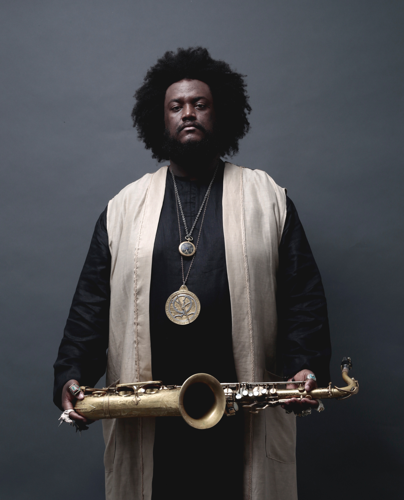
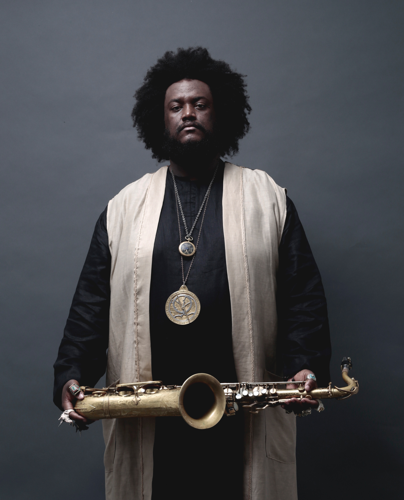


Los Angeles saxophonist, composer, arranger and bandleader Kamasi Washington eschews any notions that he’s the savior of jazz in the 21st century. The 36-year-old continually downplays the fame and recognition that’s come his way for two major accomplishments. One was writing the horn and string arrangements for and performing inspired sax solos on Kendrick Lamar’s landmark 2015 album To Pimp a Butterfly. The second happened that same year, when Washington released his fourth album, the acclaimed triple-LP set The Epic.
The Epic blends a 10-piece band with a vocal choir, complex string orchestrations and fiery combo interaction in a manner that has earned comparisons to John Coltrane’s A Love Supreme or Ornette Coleman’s This Is Our Music. With superb assists from comrades such as electric bassist Thundercat, vocalist Patrice Quinn and trombonist Ryan Porter, Washington neither runs out of ideas nor allows the music to become predictable or tedious over a span of nearly three hours. Even with that long-form scope, a handful of enterprising late-night urban contemporary stations began to play edited versions of songs like the potent sociopolitical piece “The Message” and “Hood,” the latter of which pays homage to Detroit DJ Robert Hood. The Epic offers something for everyone without ever succumbing to the mind-numbing blandness of fusion or smooth jazz at their worst.
As a result, Washington earned a host of honors, and his name recognition exploded. There were appearances at Bonnaroo, Coachella and NPR’s World Cafe, and The Epic topped 2015’s year-end lists for jazz critics as well as pop-and-rock types. Even the most cynical purists in the jazz universe regard Washington with appreciation rather than the usual suspicion reserved for jazz artists noticed by Rolling Stone and Entertainment Weekly.
Prior to The Epic, Washington was known primarily for his contributions to other artists’ work, from sessions with Ryan Adams and Snoop Dogg to collaborations with Wayne Shorter, Herbie Hancock, Nas, Chaka Khan and Lauryn Hill. The four-year process of writing and recording The Epic was a way for Washington to finally express his own musical ideas.
“You get lost in making music for other people, and those other people’s music can become what you are,” Washington told the Philadelphia Inquirer in November. “Every day, I was in the airport somewhere, going to play with someone. And I had a moment where I decided I was going to cancel all my gigs and not take anything for a month. I was just going to create something that is a true representation of who I am.”
Though it would be inaccurate to call Washington an innovator in the manner of Coleman Hawkins, Lester Young or Coltrane — who each impacted the entire vocabulary of saxophone playing — he does possess a striking, muscular tenor sax tone. There are times when he’ll venture deep into the upper or lower registers, but those effects are never overdone or calculated. He is equally credible and compelling on lush ballads as he is on uptempo, aggressive exchanges, and he’s thoroughly at home backing vocalists and rappers. His experience as a drummer and keyboard player has helped strengthen his compositional acumen. And his eight-piece touring band The Next Step is proficient to the extreme without ever approaching square or stale.
Though he has a new project coming in 2018, Washington helped maintain the momentum from The Epic with the September release of an EP titled Harmony of Difference. The six-song set is only 35 minutes long, and was originally crafted for the Whitney Biennial at the Whitney Museum of American Art, which ran from March to June. Working with Catalan filmmaker A.G. Rojas and his sister Amani, the latter of whom created six paintings for the exhibit, Washington conceived Harmony as a song suite. Five short pieces weave together and flow into a killer finale called “Truth,” which is the set’s most impressive piece despite a relatively conservative musical structure. It uses only two chords over its 14-minute duration, and rather than hammer home a provocative message via lyrics, it does so by balancing simplicity and verve.
While fans eagerly await a full-length follow-up to The Epic, they get to hear a saxophonist whose music and band are enjoying immense crossover attention and exposure. It’s comparable to what greeted the Marsalis brothers when they played with Art Blakey’s Jazz Messengers in the late ’70s and early ’80s, but with one big difference. While many important figures in the past 40 years of jazz have excelled at keeping traditions alive, Washington continues to expand the music’s horizons without either retreating into its past or alienating its core audience.
Email music@nashvillescene.com



Post a comment as anonymous
Report
Watch this discussion.
(0) comments
Welcome to the discussion.
Log In
Welcome to the discussion.
Keep it clean. Please avoid obscene, vulgar, lewd, racist or otherwise abusive language. Comments featuring hate speech or threatening or violent content will not be tolerated.
PLEASE TURN OFF YOUR CAPS LOCK.
Be truthful. Don't knowingly lie or mislead.
Be proactive. Use the “report” link on any comment that violates our comment policy.
Share with us. We'd love to hear your feedback.