
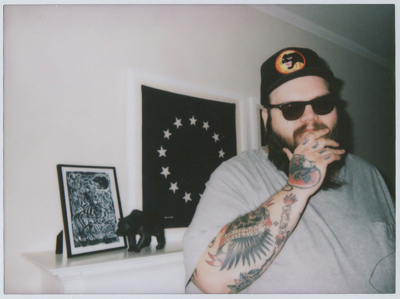


“I don’t like jamming.”
John Moreland is laughing on the phone with the Scene, but that doesn’t mean he isn’t serious. The Oklahoma songwriter is not a fan of, as he puts it, “extended eight-minute guitar solos,” and you probably shouldn’t come to one of his shows hoping for bells and whistles.
Moreland is all about economy. His most recent album, Big Bad Luv, released in May, is a master class in writing songs that tell universal stories through spare language and precise imagery. It follows similarly expert albums In the Throes (2013) and High on Tulsa Heat (2015), both of which contributed to Moreland’s gradual ascent from Tulsa favorite to a critical darling of national outlets like GQ and The New Yorker.
Just because Moreland isn’t interested in showing off on his guitar doesn’t mean that Big Bad Luv doesn’t rock. On the contrary, the album has plenty of edge to it, evident in the opening track, “Sallisaw Blue.” The rowdy shuffle flies directly in the face of common portrayals of Moreland as some kind of sad-sack songwriter, as does “Ain’t We Gold,” a bluesy rocker reminiscent of Steve Earle that bristles with hard-earned hopefulness in lines like, “Ain’t life hard / Ain’t love true.”
“I think there was always a little bit of hope and a little bit of light in my songs in the past, too, but it’s maybe amplified a little bit now,” Moreland explains. “I’m at a brighter place in life, I think. The career thing is starting to work out, and I got married and I have a real home for the first time. ... I don’t think I ever felt hopeless, but it’s easier to feel hopeful now than it was before.”
Both Moreland’s natural inclination to write with economy as well as his rough-hewn sound are influenced by folks like Earle, but also owe an enormous debt to the genre in which he first cut his teeth: hardcore. Moreland played in a handful of punk and DIY bands as a teenager before diving into the catalogs of roots luminaries like Earle and Guy Clark in the early 2000s.
“I want to get to the point, and I want to listen to stuff that gets to the point, whether that point is a lyrical statement that the song is making, or just the melody of the song itself is the point,” he says. “I like that economy. For hardcore [punk music], there might not be as much time spent on lyrics. It’s a little more direct. I’m really a fan of the one-minute hardcore song. I try to do the roots-music version of that.”
Moreland says time spent driving with his father helped him connect the dots between hardcore and early Earle records like Guitar Town and Copperhead Road. That would eventually lead him to artists like Clark, Townes Van Zandt, Neil Young and Tom Petty, who quickly became a favorite for the then-budding songwriter. Accordingly, Moreland says Petty’s unexpected death earlier this year was the first time he felt truly affected by the passing of a celebrity.
“I feel like I lost a family member,” he says. “When I heard the news, we were loading into a show in Kansas City, and I had to stop and cry a little bit. I’ve never done that with a celebrity death. With Tom Petty, I’ve been a Tom Petty fan since birth. I can’t remember a time when I didn’t know who Tom Petty was or didn’t know a hundred of his songs. Nobody’s really been the soundtrack to my life more than him.”
Like Petty, Moreland writes with warmth, humanity and a deep reverence for stories. Also like Petty, Moreland doesn’t need flashy solos or slick production to bring his songs to life. He just needs a guitar and a couple minutes of your time.
“My whole thing is that I just want the songs to be good,” says Moreland. “I mean, everybody does, but you hear songs sometimes where you can kind of tell that maybe the lyrics were compromised in order to fit into this melody or this phrasing. ... I try not to do that. I just want every piece to be really satisfying and where I feel like it needs to be.”
Email music@nashvillescene.com



