
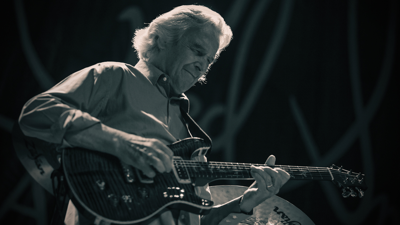


The first thing legendary guitarist, bandleader and composer John McLaughlin wants folks to know is that his current tour should not be seen as a “retirement” event.
“I think some folks may have gotten things a bit too literal,” McLaughlin says with a laugh, speaking to the Scene by phone from Paris. “I am 75 now, and the road has become rather unfriendly. This seemed like an ideal time to end that phase, the international touring part. But there are still many things musically I want to explore, and I’m sure not putting down my guitars.”
The three-set extravaganza coming to the Schermerhorn, called The Meeting of the Spirits, features McLaughlin’s current band The 4th Dimension, as well as longtime devotee Jimmy Herring and his group The Invisible Whip, and a collaboration between McLaughlin and Herring on material originally released by the former’s landmark band Mahavishnu Orchestra.
Few guitarists have ever operated in multiple contexts as masterfully as the England-born McLaughlin, who makes adventurous, innovative and thematically varied music. Dates from the late ’60s and early ’70s like Devotion and My Goal’s Beyond introduced American audiences to a player whose solos ranged from explosive arrays of notes and blazingly fast licks to serene accompaniment and beautiful interpretative ballads. He also exploded the prevailing myths that a European player couldn’t improvise or perform with the soul and fluidity of an American artist, or that acoustic sessions lacked the energy and flamboyance of electric ones. McLaughlin has since been involved in various historic groups and collaborations, and one can trace many developments in jazz solely by following McLaughlin’s path from the ’70s to The 4th Dimension.
McLaughlin’s exploits with the seminal trio The Tony Williams Lifetime, plus his recording sessions and performances with jazz maestro Miles Davis, helped establish a template for what was called jazz-rock — music that later unfortunately lost most of its edge and imaginative flair as it morphed into fusion and smooth jazz.
“I really got into jazz as a teenager with the music of John Coltrane,” McLaughlin recalls. “It had a power and authority that even as a young man I could hear. But I also played a lot of soul and blues and funk, so when I came to America to play with Tony, all that background came into play. Miles loved Tony, and he didn’t want to lose him, but he knew Tony wanted to do more than just be part of the rhythm team. Then when he heard the music we were doing together, the incredible things [organist Larry Young] was adding, and the fact we could go all across the board musically, he came to me and said, ‘Give me some of that stuff.’ ”
McLaughlin contributed to a host of immortal Davis LPs, including In a Silent Way, Bitches Brew and most prominently A Tribute to Jack Johnson. “But Miles knew I needed to get out and do my own thing, too,” says McLaughlin. “One day, we’re just sitting around, and he said to me, ‘Time for you to go.’ I knew he meant it was time for me to form my own band.”
That led to the original Mahavishnu Orchestra, arguably the finest jazz-rock ensemble ever. McLaughlin’s explosive leads propelled a relentless group sound that perfectly merged Jan Hammer’s magnificent electronic keyboards, drummer Billy Cobham’s dynamic and edgy rhythm textures, Jerry Goodman’s wily violin solos and Rick Laird’s propulsive bass underneath.
That one incredible period of activity was just a launching pad for McLaughlin. A few key moments in his frenetic career include a venture into both contemporary and traditional Indian music with the ensemble Shakti, as well as an amazing set of collaborations with Carlos Santana. McLaughlin also met equally amazing players like Duane Allman and Jimi Hendrix, though circumstances prevented him from recording with either of them. He at least got to play with Hendrix, and bootlegs of their jamming circulate, though most are of poor quality.
“You don’t forget something like that,” McLaughlin says. “Jimi was beyond amazing. I can’t even really compare him to anyone I ever heard. The things he was doing, his sense of time, his solos, just phenomenal. I learned so much from him. It was kind of the same way with Carlos, although we did the Love Devotion Surrender album. For us, the bond was Coltrane’s music. We both loved it, and we wanted to do a record that conveyed that, but one where we felt people who weren’t so knowledgeable about what Coltrane was doing could still understand our approach.”
While looking to the future has long been a McLaughlin trademark, The Meeting of the Spirits Tour is decidedly retrospective. The opening set features McLaughlin with The 4th Dimension — keyboardist Gary Husband, bassist Étienne M’Bappé and drummer Ranjit Barot — and the bulk of what they present on their recent album Live at Ronnie Scott’s is updated ’70s jazz-rock. Herring, who plays in the other two sets, has been playing McLaughlin’s music since he was a teenager, and he recorded a version of Mahavishnu Orchestra’s “Hope” on his 2012 album Subject to Change Without Notice.
“Jimmy is kind of the ideal guy for me to do this final U.S. tour with,” McLaughlin says. “Because he’s well-versed in my music, and also in the kinds of things I like to do, while having his own ideas and views on where he wants to go in his playing. He keeps you on your toes, and he keeps the music exciting and unpredictable. That’s really been the hallmark of all the things in my career that I’ve enjoyed, and it’s one thing Miles always talked about: taking what you think you know and doing something with it that you don’t.”
Email music@nashvillescene.com



Post a comment as anonymous
Report
Watch this discussion.
(0) comments
Welcome to the discussion.
Log In
Welcome to the discussion.
Keep it clean. Please avoid obscene, vulgar, lewd, racist or otherwise abusive language. Comments featuring hate speech or threatening or violent content will not be tolerated.
PLEASE TURN OFF YOUR CAPS LOCK.
Be truthful. Don't knowingly lie or mislead.
Be proactive. Use the “report” link on any comment that violates our comment policy.
Share with us. We'd love to hear your feedback.