
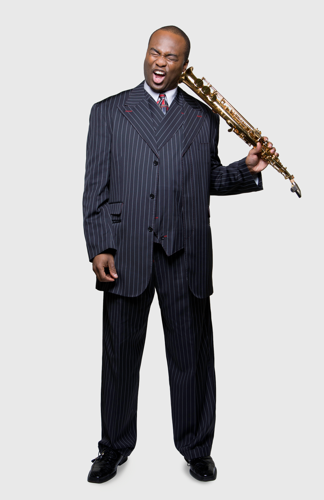


Since he was a teenager, touring Europe with the International Jazz Band and performing with trumpet legend Lester Bowie, saxophonist-bandleader James Carter’s trademark has been tremendous skill in a variety of contexts. He has embodied instrumental and idiomatic flexibility maybe more than any other jazz musician of his generation, running the gamut from funk to gypsy jazz to standards and beyond. His 2004 album Gold Sounds offers nuanced jazz arrangements of songs by the indie-rock band Pavement. Carter is a highly esteemed figure, heralded for his abilities on a host of saxophones as well as flute and clarinet, and he’s won multiple DownBeat Critics Poll and Readers Poll awards for his robust baritone sax skills. He’s excelled in numerous configurations, from big bands and small combos to duets and collaborations with jazz and opera singers.
But despite the awards and acclaim, the typically prolific Carter recently went through a long drought in his recorded output. His latest album with the James Carter Organ Trio is Live From Newport Jazz, recorded at the festival in 2018 and issued in August. The collection, featuring pieces associated with Django Reinhardt, is Carter’s debut for venerable jazz label Blue Note Records, and his first release since 2011. Carter’s Organ Trio will appear in Nashville for the first time Monday as part of an 80th anniversary celebration for Blue Note at City Winery, alongside Nashville native singer-songsmith-pianist Kandace Springs and pianist James Francies and his trio. Carter discussed the intriguing and complicated history of Live From Newport during a recent phone interview.
“This project actually took two years to complete,” says Carter. “We originally had planned to call it Django Unchained, kind of a play on Django Reinhardt and the whole gypsy-music vibe. We wanted to … kind of it update it without losing the flavor. But we had to take some time and kind of get it right. We wanted to get a soul groove down, and we also wanted to make sure that we were upholding the swing end. The most important thing — and it came through a change in personnel — was we got a new drummer [Alexander White] on it. He brought that trip-hop and hip-hop sensibility to it, but he could also bring the swing and the rhythmic intensity and energy that we needed. Then, it took us a long time from the time it was recorded to get it properly mixed and sequenced.”
Jazz is at its best when it feels spontaneous, and even with all the preparation that went into the record, it’s a sprawling, fiery effort. Carter offers spiraling, forceful and incisive solos atop Gerald Gibbs’ equally powerful organ accompaniment and White’s sturdy drumming. All six compositions were either written by or made famous by Reinhardt, and Carter says it’s the ideal merger of soul and jazz organ combo sounds, ’30s-style swing flamboyance and gypsy-jazz romanticism.
“We’re really exploring the full scope of the gypsy-jazz idiom,” he says. “We really wanted to show the connections between the gritty, hard-edged music we grew up hearing in Detroit with that flair and edge you get from Django’s music. I think we really got down what we wanted, and being on Blue Note with [label president Don Was] was ideal as well, because he’s been following me for a long time and knows what I can do.”
Since his remarkable 1994 debut as a leader, JC on the Set, Carter has routinely shown it’s possible to be a brilliant soloist without becoming too esoteric for anyone but musicians to enjoy, and to artfully balance repertory and contemporary material. Whether he’s playing on cutting-edge avant-garde projects or groove-oriented dates, he’s never concerned himself with controversies regarding whether what he was doing conformed to or fit within any rigid stylistic boundaries.
“What a lot of folks — who I guess consider themselves purists — don’t seem to understand is the guys they celebrate weren’t content to do the same thing all the time,” he adds. “You go back and listen to Charlie Parker or John Coltrane — they were always looking ahead. I enjoy all types of things, and that’s always been my goal, to do a lot of different things within the music. It’s never been a question for me of ‘which style’ or ‘which group,’ so much as, ‘Does it work,’ ‘How does it sound,’ and ‘What can we do with it?’ ”
All the same, Carter acknowledges that among the many horns he plays, he does have a favorite: He has a special relationship with the baritone sax.
“It was my band teacher’s favorite,” he says, “and he really taught me the possibilities of what you can do on it, both from a sonic perspective, and functionally. It’s very flexible too, and the range of things from the lowest notes to the highest — the extremes you can reach. The alto was my starting point, and it’s special to me as well, but the baritone would be my favorite.”
Carter has plenty of plans for future projects, an encouraging sign that the drought may be over for good. One he’d like to take on involves recording with a vintage tenor sax that belonged to the great Don Byas.
“I’ve got lots of ideas and things in the hopper,” says Carter. “It’s just a question of whether or not we can get them recorded and released. I’ll always be working on new things. That’s what keeps you fresh as a player and energized as a person.”



