
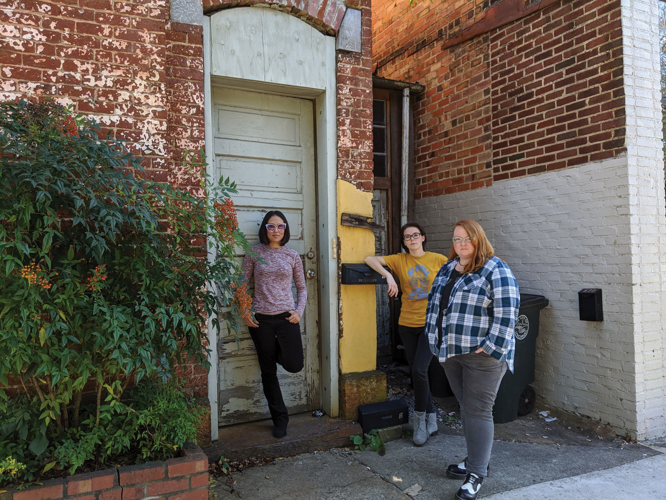


From the groundbreaking rockabilly band The Rock and Roll Trio to riot grrrl innovators Sleater-Kinney, the trio format has been foundational to rock ’n’ roll. Although guitarists like Jimi Hendrix brought boundary-breaking virtuosity to rock, the setup of drums, bass and guitar often works best when a guitarist plays functionally, sitting in the pocket the rhythm section creates. In the case of Nashville band Hungry Mother, the trio slides past mere functionality into a kind of virtuosity that has everything to do with great songwriting and — perhaps most importantly — the mysterious cohesion that the finest rock bands achieve. The group has pared its art down to essentials, but they mess with the rules of punk-inflected rock in ways that are truly musical.
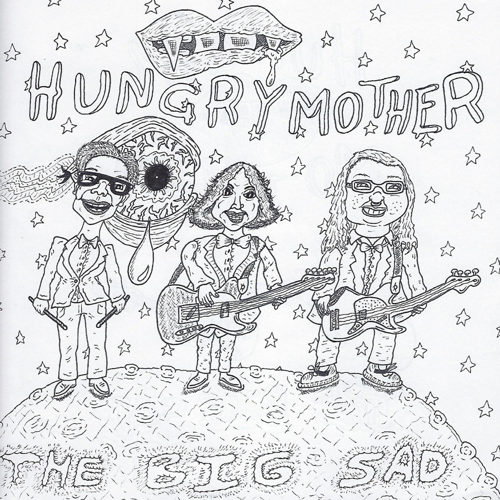
Saturday at The Basement, Hungry Mother will play a show marking the release of their debut album The Big Sad — one of their highest-profile gigs yet. For young musicians who are still finding their legs, they’ve come a long way since they played their first show at Music City venue Springwater in September 2018. The Big Sad translates their live sound onto a record that retains the group’s savor without sacrificing their power. The record is politicized humanism that avoids pontificating about the big issues it raises.
Hungry Mother formed when guitarist, songwriter and singer Chelsea Peebles — a native of Jamestown, N.Y., who had moved to Nashville in 2015 — met bassist Emily Jared, who grew up in Greenbrier, Tenn. Jared was playing with The Dangerous Method, a band she started with her husband Joseph Jared, and Peebles wanted to put together a new group. They found drummer Caila Singleton, a native of Lynchburg, Va., who had moved to town around the time Peebles did, and they began playing at Springwater and Betty’s Bar & Grill.
I caught the band early this year at Betty’s, and they were one of the standout groups at that venue’s three-night Local Fest, held in July. Peebles played highly effective minimalist guitar, while Jared locked into the deft, swinging grooves laid down by Singleton — an amazingly empathetic and never overbearing musician who also contributed guitar to the album. They cut The Big Sad over the summer with producer Josh Sullivan, who also plays in Nashville band Year of October.
“There was a large pull between us about whether the record was as authentic to our live sound as possible,” Peebles tells the Scene from a seat at a West Nashville bar. “As a band, we went in the direction of wanting to make it as genuine and authentic as possible. However, there’s always been a part of me that has wanted a lead guitarist involved.”

Singleton’s guitar work on The Big Sad adds color to the performances. In addition, she drums with a light touch and a slightly jazzy feel. Some of the band’s songs exploit the contrast between sections of 4/4 time and 6/8, and Singleton handles these transitions with the finesse of a far more experienced player.
“I do have a lot of influences,” Singleton says. “Matt Greiner, from August Burns Red, is probably my favorite drummer. He’s very dynamic in his playing. When Chelsea sent me the demos [of her songs] when I first started playing with the band, I just listened to them and played what came out, tweaked it, and went from there.”
Peebles’ songs further the tradition of punk that questions the validity of received notions about human behavior. In “Grass Fed,” Peebles meets a farm boy who says he’s pure because he doesn’t use pesticides. But he’s been away from the farm only twice, so his claim to enlightenment rings false. Still, Peebles finds him attractive, as she sings: “He’s free of gluten / Dairy / Vegan / So I think I’ll fuck him.”
Elsewhere, in “Plastic Straws,” Peebles questions what she sees as an unthinking liberal consensus. All she wants is a straw that will allow her to drink her smoothie, but the paper straw she’s given simply won’t work. Like the original punks of the 1970s, Peebles questions the assumptions of humanist thought by concentrating on the basics of human interaction. “Plastic Straws” and the other songs on The Big Sad are indirectly political, as Jared explains.
“You know, it’s popular not to use plastic straws, so they’re gonna give you this really terrible stand-in, instead of actually taking the time to find a good, sustainable replacement. That song, even more, is about false activism.”



