
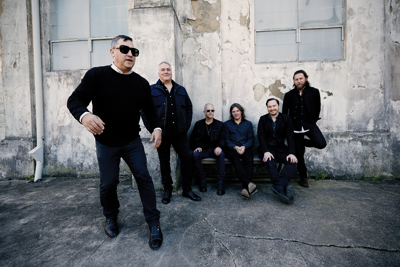

Lust, betrayal, pain, compulsion: If you imagine the entirety of Greg Dulli’s noirish lyrics for The Afghan Whigs as the narrative of a single character, that person would certainly be dead by now. As the 2017 iteration of the band tours in support of its latest album In Spades — which arrives 27 years after the Whigs’ Sub Pop debut Up in It — Dulli can’t help but laugh at that idea.
“I’d remind you I’ve always had a very verdant imagination and can exist inside of characters,” Dulli says on a call from Minneapolis. “No one person’s life is so absolutely fascinating that they can only write about themselves over and over. I’m certainly not.”
Dulli has made a career out of mining the idea of bad things done by people trying to be good. Yet when asked in another recent interview to name which of his songs fits his state of mind the most today, Dulli selected “Toy Automatic,” a lilting tune from In Spades that rings almost hopeful.
“When I put the words down to it, I was attempting to say goodbye to someone I had not seen before they’d passed away,” Dulli says. “I think it was maybe the things I would’ve said to her, had I seen her before she passed. It was my attempt to say goodbye in the most beautiful way possible, so that’s probably where the hopefulness came from.
“That song was born from the outro of another [In Spades] song, ‘Oriole,’ ” he continues. “It was a chord progression that I really liked, just a short chord progression I thought was just a shame to only live there in the outro. So I went back to L.A. and played it over and over for days until I unlocked a progression that was different from ‘Oriole’ [that] I liked. I spent a lot of time figuring out ‘Toy Automatic.’ That riff almost became a companion to me. I’d play it outside, I’d play it in the kitchen, I’d play it watching TV — it just became like a little friend.”
If you love The Afghan Whigs without fail, In Spades is here to justify that. If you’ve never heard Dulli’s music, the record is the perfect table setting. It’s equally reflective of his decade-long break from the band — 2001 to 2011, when he experimented with side projects The Twilight Singers and The Gutter Twins — as it is of the strongest, loudest elements of AW’s Gentlemen or Black Love.
Before breaking up, The Afghan Whigs thrived in spite of bucking the genre tropes that run through a considerable portion of 1990s rock. This self-declared “American rock and roll band from Cincinnati” fused R&B, pulp fiction and existential dread across a string of seminal albums. While a cloud of ambiguous depression and despair darkened much of the ’90s alternative scene, The Afghan Whigs put their guitars right up against the sharp edges of sin and guilt, with enough Motown to work as antiseptic to the mopiness of the day.
“Obviously I was listening to a lot of Motown growing up,” says Dulli. “You’ve got Detroit that’s just up I-75, then there was the big funk scene in Dayton. But my relatives lived in West Virginia, which wasn’t far away, and I had other relatives in Kentucky just across the river. So I identified a lot as a Southern kid.”
Dulli became famous for music about places like Los Angeles, his current home, but The Afghan Whigs’ 1998 pre-breakup crescendo 1965 was recorded in New Orleans, now his second place of residence. Accordingly, 1965 is a confessional disguised as a party record, a jazz funeral for destructive impulses. As The Afghan Whigs visit Nashville for the first time since touring in support of the 2014 reunion album Do to the Beast, Dulli is noticeably proud of how Southern the Whigs can claim to be.
“[1965] was immersion to the highest extent,” he says. “We moved in, and that record was completely built from the ground up in New Orleans. Combined with our experiences making other records in Memphis [including “Birdland,” the opening track of In Spades], I’ve largely recorded in the South. It’s just kind of dawning on me now that’s the case.”
As a touring band, The Afghan Whigs are at the sharpest point of their career, with a full command of their catalog, plus particular selections from Dulli’s Twilight Singers albums and a mix of impressively reworked covers. After the band’s 2011 reunion, Dulli’s interest in R&B phenom Frank Ocean gave birth to a cover of “Lovecrimes” that has stayed in their repertoire.
“I make sure to the best of my ability that all of the albums are represented in reason,” says Dulli, regarding the composition of tour set lists. “Nobody will leave unhappy. I’m very aware of the history of the group and that people want to go back. We have, and do, go back to Up in It.”
Email music@nashvillescene.com



