
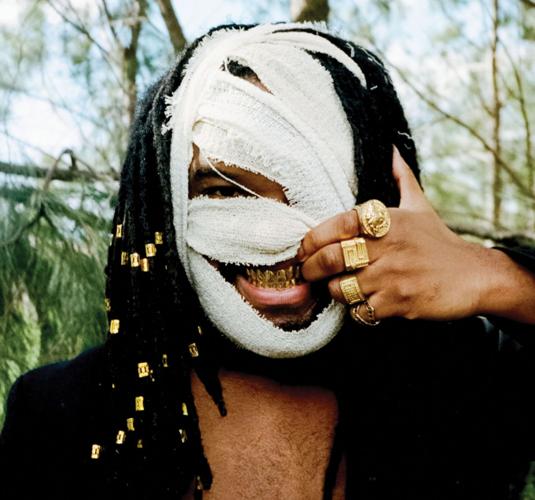
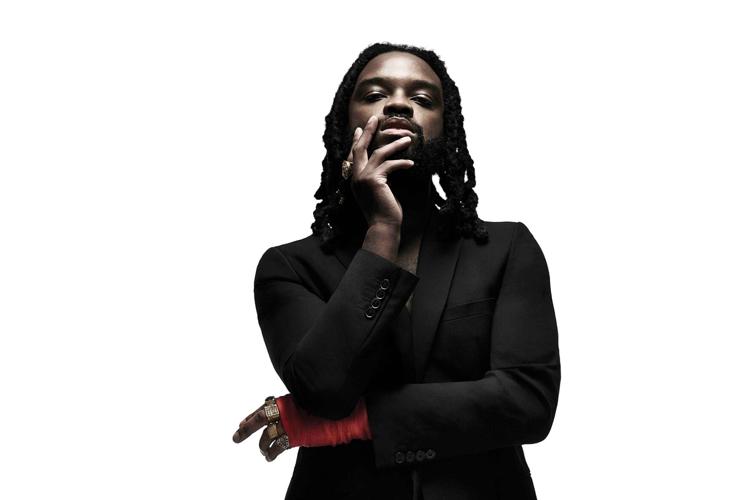

Kofi Owusu-Ansah, born in Ghana in 1998 and raised in Australia’s capital city of Canberra, had no interest in making music as a youngster. His older brother Kojo, who rechristened Kofi as “Genesis” when the two were in primary school, was fiercely determined to pursue a career as a rock artist. When the boys were teens, Kojo turned the family living room into a recording studio. Genesis wanted to stake out his own lane, and channeled his creativity into writing short stories. As brothers will do, Kojo conscripted Genesis to rhyme on his tracks, and soon enough the pair was performing and recording as a rap duo called The Ansah Brothers.
Watching old Ansah Brothers videos, you can hear that the artist now known as Genesis Owusu’s flow is a bit rough around the edges. But even then, the way Owusu carried himself — with an air of confident sophistication and a flair for eye-catching hats and bow ties — stood out. Today he’s far more polished, an international touring artist who took home multiple ARIA Music Awards (Australia’s equivalent to the Grammys) for Smiling With No Teeth, the full-length debut he released last year.
Between The Ansah Brothers’ recordings circa 2015 and Smiling With No Teeth, Owusu released a solo EP called Cardrive and a stream of singles, across which he gradually expanded his palette. Though he’s still broadly identified as a hip-hop artist, Owusu effectively blurs the lines dividing a host of genres. Just skimming the first few tracks of Smiling, Owusu and his backing band The Black Dogs rifle through hard-charging glitchy hip-hop in “On the Move!,” put a contemporary twist on New Wave with “The Other Black Dog,” dive into richly melodic futuristic R&B in “Centrefold” and draw on vintage ’70s soul music in “Waitin’ on Ya.” Owusu shifts effortlessly between a gruff bark, a falsetto croon and a punk-like sneer, his energy and conviction beaming through regardless of his vocal guise.
The larger-than-life MC and post-punk R&B experimentalist holds everything together. But there’s a sense of never knowing exactly where you are, stylistically or within a narrative, which is important.
“I love disorientation,” Owusu tells the Scene. “That’s my favorite kind of art, like when I watch a movie and it just messes with me. The stuff I’m talking about on the album — to me that’s how it feels in real life. Like, when you’re going through a depressive slump, or feeling paranoid because all these people are watching you because of the color of your skin. It feels disorienting and woozy, like a nightmare state. I wanted to put that into the music for conceptual reasons, but I also just like making people feel confused. More than I like hearing that people enjoy the album, I like hearing that they’re confused by it.”
That said, Smiling With No Teeth isn’t haphazard. Owusu, his band and co-producer David Hammer culled the album from some 60 hours of recorded jams. Owusu was very deliberate in his attempt to craft the album as a complete listen. In the process of sifting through raw material, he began to notice contrasts between his perspective as a listener and as someone who makes music.
“As a music consumer, I was like, ‘Yeah, it needs to be a 40-minute album of bangers and hits,’ ” says Owusu. “But I’ve been a writer for longer than I’ve been a musician, and there were narrative elements — plot points, you could say — that I put the highest priority on that I felt needed to get in there. The creator version of me won out.”

While Owusu is open about how the story arc charts his mental health struggles and his pervasive sense of alienation growing up in predominantly white Canberra, he prefers not to spoonfeed the audience regarding how the dots connect within the music. The image of a black dog reappears periodically throughout the record. Sometimes it can scan as a representation of mental illness, and other times as a way to explore the pressure of discrimination. When we speak, Owusu prefers not to elaborate on the meaning or meanings of the metaphor, leaving the audience to explore it for ourselves.
“Being part of the diaspora is like a culture in itself,” he says. “I was exposed to Ghanaian music quite a bit, thanks to my parents blasting it throughout the house. But I wasn’t raised there culturally, and I’m not super fluent in Twi, the main language. In Australia, I’ll get asked where I’m from. And it’s kind of the same thing in Ghana. So it’s something that I’m making an effort to delve into and get the most out of both cultures.”
Though Owusu’s stateside tour was delayed by the Omicron wave, U.S. fans are getting the full experience of his art this spring on a tour that hits The Basement East on Tuesday. Instead of The Black Dogs, who appear on the album, he’ll perform with The Goons, who he describes “not as a band but almost a theatrical [troupe made up of] the guys I’ve been around since 2014 — they’re hype men, backup dancers, sometimes backup vocalists and to a very loose degree, actors. We’re elevating the visual side of the album. We get to express motifs and metaphors visually.”
So is it safe to say that the show lands somewhere between experimental theater, a musical revue and a fashion runway?
“Something like that,” he says with a laugh. “It’s a lot easier just to come and see it.”



Post a comment as anonymous
Report
Watch this discussion.
(0) comments
Welcome to the discussion.
Log In
Welcome to the discussion.
Keep it clean. Please avoid obscene, vulgar, lewd, racist or otherwise abusive language. Comments featuring hate speech or threatening or violent content will not be tolerated.
PLEASE TURN OFF YOUR CAPS LOCK.
Be truthful. Don't knowingly lie or mislead.
Be proactive. Use the “report” link on any comment that violates our comment policy.
Share with us. We'd love to hear your feedback.