
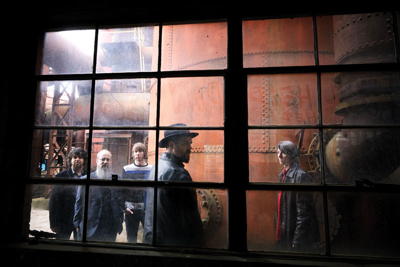


My father, a Tennessean and a wise man, advised me to beware the blandishments of the men and women he called Professional Southerners. I almost used the term when I talked to Drive-By Truckers frontman Patterson Hood late last year about his group’s latest record, American Band. But I didn’t utter it, because I don’t think Hood, an Alabamian who now lives in Oregon, is one of that class of interpreters of a notoriously intractable region of the United States. American Band is inspired music and universal literature — Hood and his fellow Truckers compassionately describe a fucked-up country and rock out in the process.
American Band struggles to understand the machinations Americans use to live in a corrupted body politic, where racism pervades the atmosphere and urbanites misunderstand rural dwellers. A Professional Southerner would offer platitudes about cultural resilience, but Hood and his songwriting foil Mike Cooley suggest that Southerners cling to obsolete practices at their peril. As did their 2014 full-length English Oceans, the Truckers’ latest music cuts the politics with a conflation of punk, The Rolling Stones, Tom Petty and various forms of Southern rock.
For Hood, who was born in Muscle Shoals in 1964 — his father is famed bassist and record producer David Hood — American Band pokes at the tatters of national identity with a stick whittled from local materials.
“I spent 51 years living there and spent a pretty good amount of time writing about where I grew up,” Hood tells the Scene from his home in Portland, where he’s lived since summer 2015. “At the same time, you know, on the latest record, it’s called American Band — [it’s] not just about the South. There’s also at least three songs that are based specifically in the Northwest. I mean, it’s all things that are happening all over.”
Hood and Cooley inject their politics into American Band — subjects include school shootings, mass-marketed religion and the dislocation of being a Southerner adrift in an America where your accent marks you as an outsider. The record’s version of classic rock matches its subject, and the result is music that operates in the same zone as modern country, complete with boss riffs worthy of Petty, Mott the Hoople, Big Star and the Stones.
For all its forthrightness, American Band could have been more corrosive, as Hood says.
“I listen to the record now and I think, ‘God, we were way too nice about it.’ If we were making our record right now, it would be some nasty, pissed-off, punk rock shit. I know that some of the shows we’ve played in the last two weeks of the tour were some of the most ferocious punk rock shows that this band has ever played.”
Whatever the overt inspiration for the style the group uses on American Band and English Oceans, the Truckers’ latest music references post-1980 rock while updating the sound of Exile on Main St. Guitarist and keyboardist Jay Gonzalez contributes fluid licks to every song on these two remarkable full-lengths, and the English Oceans tune “Hanging On” rewrites Chris Bell and Alex Chilton’s 1972 Big Star tune “The Ballad of El Goodo” for an even more insecure era.
“I guess, when in doubt, there’s worse people you can look up to and think, ‘What would they do?’ than The Clash,” Hood says. “They were kind of a touchstone when we were making the record on how to handle certain situations and certain things.” You can hear that Clash influence on American Band’s opening track, “Ramon Casiano,” a tale of a corrupt border agent. The song begins with a bone-simple guitar riff; Brad Morgan lays down a tactful groove, and Gonzalez bites off a Chilton-style solo near the end.
American Band dispenses Hood and Cooley’s reportage about the grave state of the American experiment, but the record’s greatest moment is its most subtle and pensive. Hood’s “Ever South” explores his role as a world citizen who is also a Southerner. “We prayed to what would have us, every doubting John Thomas / Spread through Appalachia ever south,” Hood sings about his ambitious ancestors.
Like, say, a track from Pavement’s 1999 Terror Twilight — a record American Band somewhat resembles thematically and musically, though Pavement was never political — “Ever South” communicates a combination of dread and optimism. The line of Southerners spreads over the land and produces Hood, who marries, moves west and notes the way his brethren back home continue to tangle themselves up in Christianity and racism. American Band is the Truckers and the South caught in the world’s tangle, and that’s a state of being that Professional Southerners generally avoid with all their might.
Email music@nashvillescene.com



Post a comment as anonymous
Report
Watch this discussion.
(0) comments
Welcome to the discussion.
Log In
Welcome to the discussion.
Keep it clean. Please avoid obscene, vulgar, lewd, racist or otherwise abusive language. Comments featuring hate speech or threatening or violent content will not be tolerated.
PLEASE TURN OFF YOUR CAPS LOCK.
Be truthful. Don't knowingly lie or mislead.
Be proactive. Use the “report” link on any comment that violates our comment policy.
Share with us. We'd love to hear your feedback.