
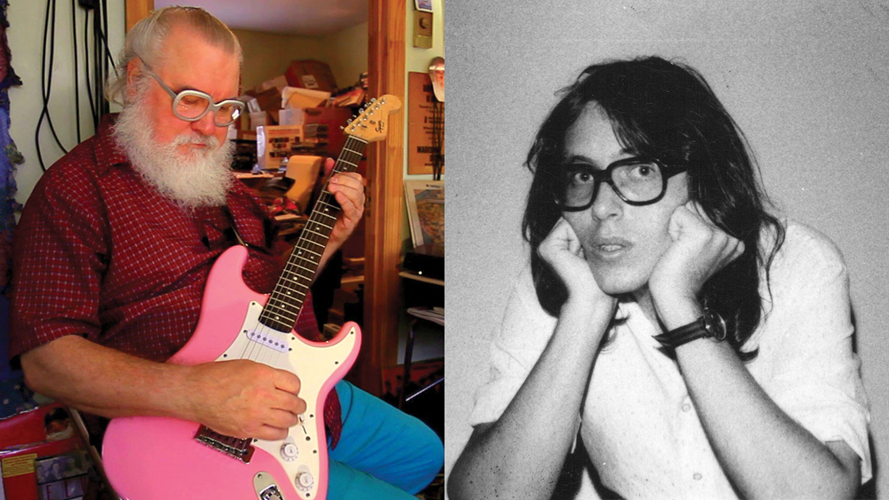
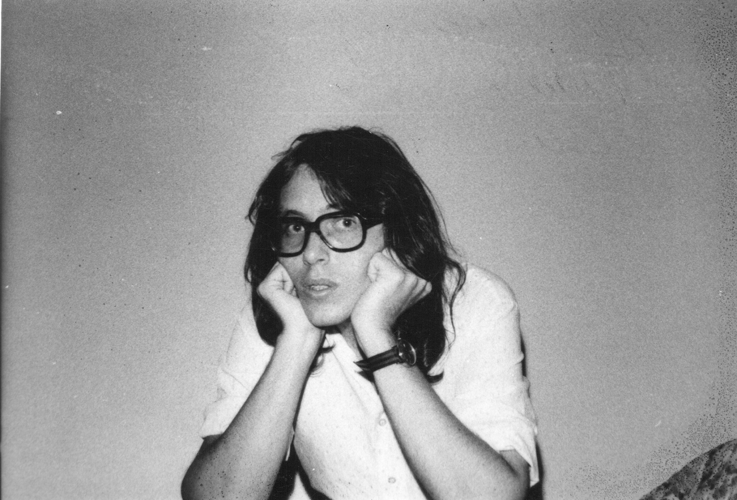



Van Duren, 1977
Forty years ago in Knoxville, when I was a student at the University of Tennessee, I discovered a cassette tape with some interesting music on it. My music-loving friends and I, already fans of the Memphis pop-rock band Big Star, quickly figured out the tape contained tracks that Big Star founder Chris Bell — who had died in December 1978 — cut in the mid-’70s. There were also unreleased songs recorded by Big Star’s Alex Chilton in 1969. Listening through the hiss, we had no idea where the rest of the music came from. It had the eccentricity of Big Star, but it reminded us of Todd Rundgren. It wasn’t until around 1980, when a friend found a copy of a 1978 album titled Are You Serious? by Memphis singer and songwriter Van Duren, that we found out that we had been listening to tracks Duren had cut in Memphis in 1975, before he recorded Are You Serious?
For us, that was a typical pre-internet journey of discovery. This week at the Nashville Film Festival (see our complete guide to the fest for more picks), two documentary films making their Nashville premieres travel down a similar road, but with better technology. Australian filmmakers Greg Carey and Wade Jackson’s Waiting: The Van Duren Story takes Duren’s career struggles as its subject. Meanwhile, Imogen Putler and Monika Baran’s Cool Daddio: The Second Youth of R. Stevie Moore plumbs the psychological depths of Nashville avant-popster R. Stevie Moore’s uneasy relationship with the music business. Both movies are about the process of discovery as much as they are about music, but the filmmakers don’t intrude upon their subjects.
Jackson, a Sydney musician, chanced upon Duren’s music in 2016. He discovered that Duren had played with Bell and Big Star drummer Jody Stephens in Memphis in the 1970s before recording Are You Serious? and Idiot Optimism, the latter finished in 1979 but not released until 1999. Neither Jackson nor Carey had made a film before, and Waiting finds them traveling to Connecticut, where Duren cut the albums, and to Memphis, where they meet Duren, who had been playing local gigs for decades.
Although Jackson and Carey put forth the notion that Duren was completely unknown, he had gained a reputation as one of the great Memphis power-poppers of the 1970s, along with Big Star, Tommy Hoehn and The Scruffs. Are You Serious? was reissued on CD in 2008 by the Water label. Meanwhile, Idiot Optimism first saw the light of day via Japanese label Air Mail Recordings. It was reissued a second time, in 2003, by Lucky Seven Records, which was started by Terry Manning, a Memphis producer who had worked on the Big Star albums.
Waiting details Jackson and Carey’s efforts to get back Duren’s publishing rights and the master tapes of his ’70s albums. The film is ultimately positive in tone, but still, Duren endured music-business travails that curtailed his career for decades. He recorded Are You Serious? and Idiot Optimism at Connecticut’s Trod Nossel Studios, but Duren signed a contract that proved less than optimum.
“I signed the contract in early 1978, before the first record was released,” Duren tells me from his home in Memphis. “They told me I was getting 50 percent of the publishing. When it all shook out, I found out that was not the case — they had 100 percent.”
Duren went on the road in 2019 with the film, playing to appreciative audiences in Australia, and he says there are plans afoot to reissue his albums on vinyl. His songs — especially the exquisite “Grow Yourself Up” and “Tennessee, I’m Trying” — deserve a much wider audience.

R. Stevie Moore in Cool Daddio: The Second Youth of R. Stevie Moore
Cool Daddio, meanwhile, takes a look at the anti-career of Moore, a musician who made his reputation as a hermetic exponent of home recording techniques. While Duren has continued to record at a modest pace, Moore has released music at an unprecedented rate, creating an oeuvre that runs to hundreds of albums. Like Duren, Moore comes from the vicinity of power pop, but his obsessions with the British Invasion and Frank Zappa have manifested themselves in ways that defy categorization.
Putler and Baran catch Moore at home in Madison, Tenn., the suburb where he grew up and returned to in 2010 after three decades living in New Jersey. Cool Daddio makes its case for a neglected figure whose music is almost impossibly complex. Still, there’s something rueful about Moore’s current status as an elder statesman of indie rock.
“My joke is, there is not gonna be a third youth of R. Stevie Moore,” he says, sitting in his living room. He mimics a comedian’s rim shot, and finishes his thought: “The lights come up, and the curtain closes.”



