
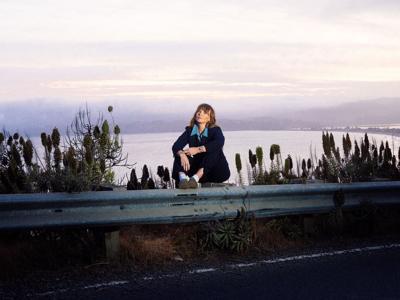


Courtney Marie Andrews
In January, singer-songwriter Courtney Marie Andrews released her seventh studio album Valentine. The title is a word that can mean something different to just about every listener. For Andrews, it partly reflects the location where she co-produced much of the record — using the tape machines at Los Angeles’ historic Valentine Recording Studios to cultivate a warm, enveloping full-band sound that’s also inspired by creative techniques Lindsey Buckingham used on Fleetwood Mac’s underrated 1979 album Tusk. (Andrews finished making Valentine in Madison, where she made her home a few years ago. During our talk, she shouts out the tacos at Garden Fresh Food Market, no small praise from someone who grew up in Arizona.)
But the title of Valentine also evokes the complex nature of love — specifically how all the symbols we associate with Valentine’s Day have so little to do with real love. The record, Andrews explains, grew out of exploring the space between love and the illusion of it. The Scene caught up with her between stops on a tour that will bring her to The Blue Room at Third Man Records for a hometown show on Friday. Our conversation has been edited for length and clarity.
It can be so difficult in 2026 to have an original take on anything. “Keeper” may or may not be “a love song,” but it has a perspective on a relationship that I haven’t heard before.
It’s funny because it’s almost like a mantra. … I wasn’t sure that I was a keeper when I wrote that song — that was how it was born. … I wrote it with a friend at dinner. It’s the only co-write on the record. And it was literally born out of a conversation with her, and not me asking her that question.
It’s kind of a funny song where I’m stating I’m a keeper, but I’m actually not sure if I am, and so it lies in that place of uncertainty. It’s a person who presents as perfect, but they’re not at all — they’re actually dying inside. … I think a lot of us have that: We’re presenting like we’re doing a lot better than we are, especially in America. I think that’s like a very innately American thing. I was just in Europe and I was like, “Europeans just sort of are very blunt, you know?” Especially in the Western European countries, like the Netherlands and Germany. And we’re not at all — we sort of put on airs a lot.
Butterflies are a recurring motif on Valentine. They can have a lot of different meanings in art and literature. Do they mean anything special to you, in your life or in the context of the album?
I’ve got sort of this symbolism and the reoccurring feeling of seeing them in my life, and they’ve carried from my first collection of poems [Old Monarch] all the way to this record. I like the representation of transformation and change that they represent to me. It’s like the unexpected, chaotic nature of life and how it can form you into something very beautiful — get you out of your cocoon and change. It’s like accepting that things change and transform, and it’s usually for the best. I often think that I gravitate toward these very cliché things, but I think things are cliché because there’s a truth to them.
An underlying theme of Valentine is the cyclical nature of life — the ups and the downs and back and forth, the “Pendulum Swing” as in the song.
Life is a series of seasons, and nothing is permanent. [We took a long time to sequence this record], and I think ultimately the way it was sequenced is that there’s really a story and a journey, and there’s different seasons of the record. It sort of starts with [knowing] that things are going to go dark or light, as they do in everyone’s life. And that’s the pendulum. You sort of fall in love and ask a lot of questions, and you go through heartbreak. And then you reflect on your path and that’s Side B, which is “Outsider,” and “Best Friend” and “Only the Best for Baby.” You start to reflect on your patterns and how you got to this place, and then it ends with [“Hangman”], this resolution, this statement. But as we learned from the beginning, it’s nothing sure.
I wanted to ask about “Everyone Wants to Feel Like You Do.” It’s not often we hear discussions of envy, at least in American culture. Which is weird because that is something else that is so deeply American in my mind — there’s so much envy running through all of us in our desire for status.
It’s one of those songs that sort of just happened, and then I reflected back on what it meant in my subconscious. It’s like the opposite of “Cons and Clowns,” where you’re speaking to somebody who’s constantly making themselves small, turning away from the audience, doing things that sort of self-sabotage them, and you just want to see them shine. [“Everyone” is speaking to] that person who is taking up so much space, and has so much confidence, and the world revolves around them.
When I took a step back enough, I was like, “Oh, it’s, it’s that male ego thing.” … Though it’s annoying, you kind of envy that confidence. Everyone wants that confidence. Everyone wants to be able to float through the world without anxiety, or without fear of judgment and that sort of thing. And this person doesn’t care about those things.




Post a comment as anonymous
Report
Watch this discussion.
(0) comments
Welcome to the discussion.
Log In
Welcome to the discussion.
Keep it clean. Please avoid obscene, vulgar, lewd, racist or otherwise abusive language. Comments featuring hate speech or threatening or violent content will not be tolerated.
PLEASE TURN OFF YOUR CAPS LOCK.
Be truthful. Don't knowingly lie or mislead.
Be proactive. Use the “report” link on any comment that violates our comment policy.
Share with us. We'd love to hear your feedback.