
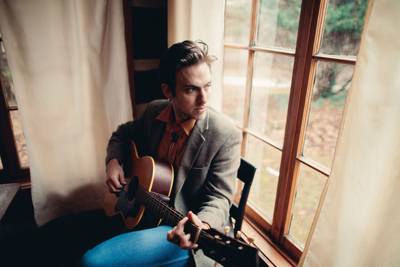


On April 7, Andrew Combs released Canyons of My Mind, his third full-length album and his first for New West Records. While the LP is chock-full of the wry observations and subtle vocal acrobatics for which the formidable songwriter has come to be known — his thoughtful sophomore full-length, 2015’s All These Dreams, earned him widespread critical acclaim and comparisons to giants like Guy Clark and Mickey Newbury — it’s far more expansive, drawn in richer, darker colors than anything the 30-year-old has released to date. In what might sound like a contradiction, Combs was able create a more complex sonic landscape by stripping down his outside influences and focusing inward.
“I did a lot of co-writing for All These Dreams, and [Canyons] has only a few co-written songs,” Combs tells the Scene. “There’s nothing against co-writing, I just lost interest in it for the time being. I’m sure I’ll be inspired by it again, but it’s just not something I’ve been into much these days.”
Instead, Combs mined his own experiences and found songs that blur the personal with the political. The tracks, which he began writing as soon as All These Dreams made its way into the world, come across like the meticulously hewn works of a master sculptor, with each tap of the chisel revealing something richer and more precise.
“I’ve heard some people say it’s darker,” Combs says. “I don’t know if it’s darker in my mind. I think it’s just kind of more realistic. I have been writing … stuff that’s more and more personal to me, so it feels a bit more real. I guess if it comes off as dark, I should investigate [laughs]. The world is taking some scary turns right now, so it got very real.”
Combs addresses those scary turns throughout the album, most pointedly on “Bourgeois King.” A swaggering rocker of a song, it has a lurching beat and ominous bass line that create an air of desperate dystopia. It begins with a macro look at a nation hypnotized by “holographic talking people coming from [their] TV screen,” before turning its crosshairs on the “king” himself and his infamous wall.
“The first sections of the verse are just an observation of how ridiculous the whole election season was seeming to me,” says Combs. “Then [Trump] ended up winning, and I put the ‘build a wall’ line in there closer to that time. ... It was more of an observation in the beginning, and then it became about him.”
“Bourgeois King” isn’t Canyons’ only piece of sociopolitical commentary, either. The single “Dirty Rain” addresses Combs’ constant state of revulsion at “how we treat our planet,” and his concern “about the future and our children’s future.” This is new territory for Combs, who, up until the 2016 election, had never felt particularly compelled to mix politics and art.
“I’d never really identified with the protest songs of the ’60s and whatnot, the Pete Seeger kind of thing,” he explains. “I think I figured out that the reason was that I wasn’t there — it wasn’t in my face. These days ... for me at least, it feels impossible not to write about it.”
While other tracks on the album turn away from politics, they don’t lack passionate expression or attention to detail. “Rose Colored Blues” is a shuffling, bittersweet ode to the archetypal “rambling man,” weary of his constant restlessness. The foreboding “Blood Hunters” boasts one of the singer-songwriter’s most radical departures yet: a dramatic, Stranger Things-nodding music video in which a town is menaced by a massive monster.
“I wrote [‘Blood Hunters’] about kind of losing your mind, everyday depression, or whatever you want to call it,” he says. “It’s about feeling like everybody’s out to get you. To be honest, I was a little apprehensive about it all, having a CGI monster in your music video. I ended up really liking it. I’m very new to the [music video] game. Before this record, I didn’t have a whole lot of funding behind me and just did a low-budget video.”
While Combs may have access to bigger budgets these days, for him, the song is still king. No amount of CGI can make him anything other than what he is: a songwriter, and a damn good one.
“As cliché — in Nashville — as it sounds, I do think the song always comes first, and that’s really what people identify with,” he says. “It’s near and dear to me, the writing process, so I’m always working at it.”
Email music@nashvillescene.com



