
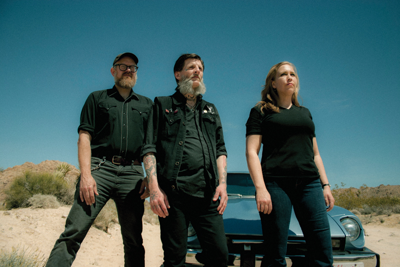

In the superb Sundance television drama Rectify, protagonist Daniel Holden is a man who, after spending 19 years on death row, is released after some newly discovered DNA evidence nullifies his conviction. Early in the first season, Holden describes his life in a cell as "the time between the seconds." In other words, an existence that isn't framed by seasons, years or cycles of nature but moments in his own mind. It's possible that if you're a fan of slow music, you can relate. I speak not of R&B slow jams or obligatory pop and rock ballads placed strategically on otherwise efficiently paced records. I'm talking about bands like Earth.
Often labeled under the blanket "drone" (which does not involve a camera attached to a tiny helicopter), it's a genre where tempo is practically non-existent, runtimes are inconsequential and, for that matter, often so are songs. Pacific Northwestern mainstays Earth are regarded as the godfathers of lumbering, pastoral guitar music and one of the most influential bands of its kind. While its founder and only consistent member, Dylan Carlson, is best known in the realm of pop culture for having purchased the shotgun close friend Kurt Cobain used to kill himself in 1994, he's more importantly credited with having invented drone metal back around the time Nirvana's considerably more dynamic "Smells Like Teen Spirit" was revolutionizing the airwaves.
Nirvana's former label Sub Pop released the unfashionably minimal Earth 2: Special Low Frequency Version at the peak of the Seattle grunge boom in 1993. While most bands in the region were famous for jumping from loud to quiet throughout a single song, Earth was doing both at once. Their drummerless, hourlong instrumental opus was an ambient blast of feedback and brutal, fuzz-drowned guitar drones that positioned the amplifier not only as an instrument, but as another member of the band.
At the time, it was either an introspective revelation or a nightmarish snooze fest, depending on who was listening. Though most listeners weren't quite ready for "ambient metal" at the time, those who were would eventually spur an entire genre based on the album's slow-churned, grimy, plodding riffs turned out at top volume. Followers like Seattle feedback fetishists Sunn O))) actually started life as an Earth tribute band, and not only based their sound on Earth 2's monolithic soundscapes, but like Earth, borrowed their name from the make of amplifier they were using.
Throughout the mid '90s, Earth's minimal approach got increasingly more elaborate; the band eventually added a drummer before breaking up in 1997. Encumbered by heroin addiction, incarceration and the emotional toll of his inadvertent involvement in Cobain's death, Carlson stopped playing music altogether. By 2005, he'd successfully rehabilitated, returned to music, relaunched Earth and recorded the album Hex; Or Printing in the Infernal Method. The new sound was a measured and clean-toned cosmic country noir that, though stripped of distortion and often centered on piano chords, was close enough to Earth's original vision to justify keeping the name.
Most of Earth's eight studio albums since follow directly in the footsteps of Hex — like soundtracks to an imaginary franchise of surrealist Westerns — a sound spawned in no small part due to Carlson's love of Cormac McCarthy novels. Their latest, 2014's Primitive and Deadly, seamlessly coalesces the primal, abstract dirges of their early works with this quieter, post-reboot sound to craft a steady and deliberate slab of heavy bliss and blistering tranquility, with varying degrees of success.
It's also their first record since the '90s to feature any vocals at all, with former Screaming Trees singer Mark Lanegan lending his soulful rasp on "There Is a Serpent Coming" and "Rooks Across the Gate." While there are certainly moments where Carlson and band lock into transcendent flashes of euphoria on those tracks, they mostly clash with Lanegan, who sounds like he's singing over the band as opposed to with them. But the addition of vocals works in the band's favor on the album's centerpiece "From the Zodiacal Light," which features guest singing from Rabia Shaheen Qazi of the sprawling Seattle post-rock act Rose Windows. Her melodic howl flows perfectly with the ominous layers of post-psych guitar swirling around her in an 11-minute saga that still feels too short.
Again, what most would objectively describe as a glacial, serpentine listen could also very well be spun as a shambling, monotonous journey to nowhere. But to those who've seen, or would like to see, the time in between the seconds, Earth's directionless exploration of ecstasy in the heart of darkness is a lumbering, unwieldy gift. While it doesn't give us anywhere to go, it also means we don't have any particular place we have to be. Considering all the fast and loud music created in the spirit of living in the moment, bands like Earth do exactly the same thing — they're just not in any hurry to leave.
Email music@nashvillescene.com



