
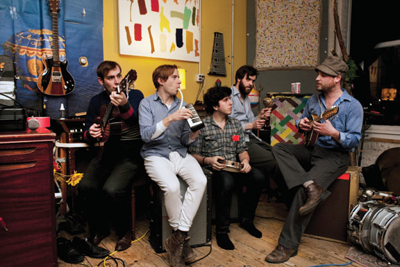

In the decade since their inception, Philadelphia's Dr. Dog have reached about as wide an audience as any indie-rock outfit could aspire to reach — however flexible the term "indie rock" may have grown in the 21st century. They wowed critics with 2005's DIY-pop collection Easy Beat, which featured enough stunning hooks, brilliant vocal melodies and quirky production techniques to earn innumerable comparisons to The Beatles and The Beach Boys. Their follow-up, 2007's We All Belong, utilized slightly fancier production and more fleshed-out instrumentation, but the ramshackle charm remained. Though still quirky and rife with lush melodies and arrangements, 2008's Fate found a more tepid reception among some critics: Perhaps, the harshest observers suggested, Dr. Dog had run out of ideas.
But with this year's Shame, Shame, the boys from Philly decided to do something they'd never done before: They hired a producer. The man they looked to, Rob Schnapf, has worked with Beck and The Vines, and co-produced four of Elliott Smith's records, including the posthumously released From a Basement on the Hill. Dr. Dog co-frontman Scott McMicken explains that in working with Schnapf, he and his bandmates wanted to better translate their live performances on record, rather than producing another series of intricate studio capsules.
"I feel like we reached our highest point of awareness of what it was we're all about live somewhere in the touring for Fate," says McMicken. "So leading to the next album, it was really the influence of ourselves for the first time — not going into the studio and leaving everything we know about playing music together at the door."
McMicken goes on to explain that the month they'd slated to record with Schnapf was nowhere near enough — they ultimately spent twice as long tracking and mixing on their own after the fact. But their time with Schnapf wasn't a loss. "We basically went way out on a limb and tested the waters," says McMicken. "As much as we learned that was positive, we also learned what is unacceptable for us in a recording environment."
So the band that had made a name for themselves in the studio — and cemented critics' affections with their incomparable live show — went to work with both their producers' and their performers' fedoras on. And it paid off. Shame, Shame features far fewer studio indulgences than past releases. Gone are the sampled train whistles of Fate, the gorgeous, if somewhat decadent, walls of sound of We All Belong and the rough-edged but unmistakably intimate moments of Easy Beat. Shame, Shame doesn't sound like a collection of soundscapes concocted by a team of studio rats; it sounds like a collection of smartly crafted pop songs that owe their sharpest moments to the bandmates' live chemistry.
Sure, McMicken and fellow songwriter Toby Leaman have never had a hard time creating compelling melodies and concisely wistful lyrics. But now, past choosing the right guitar tones and organ settings, it seems to all be about allowing the songs to speak for themselves — songs like the mid-tempo, reflective "Where'd All the Time Go?" which is imbued with '70s soul, and features a big, heartstring-tugging chorus. The leadoff track and first single, "Stranger," bobs with a familiar, sing-along urgency that nearly masks the narrator's cynical fatigue.
The relationship between dark, introspective lyrics and exuberant, upbeat arrangements isn't new to McMicken and Leaman, but on Shame, Shame, the relationship is perhaps more symbiotic than ever before. "When I think about it, the lyrics on the album aren't really any darker or any more literal than any of our other albums," admits McMicken. "I feel like typically we're a pretty lyrically dark band, with a few obvious exceptions. The real shift has been musically ... I feel like, just because we've grown as musicians and played live so much, we are aware that we can create and embellish certain moods musically that line up more with the lyrics."
It only makes sense that a batch of songs concocted with live performance in mind would make for what is possibly Dr. Dog's strongest set to date. With the addition of drummer Eric Slick, who McMicken claims, "technically speaking," is "a far superior musician to any of us," it's clear that they've hit their stride. Here they are, a decade and over a half-dozen albums in; a point at which any hard-touring rock 'n' roll band would be well within their rights to pack it in. Instead, they've overhauled their recording process and come out on the other side with what is perhaps their most original batch of songs since their breakthrough, Easy Beat.
Email music@nashvillescene.com.



