
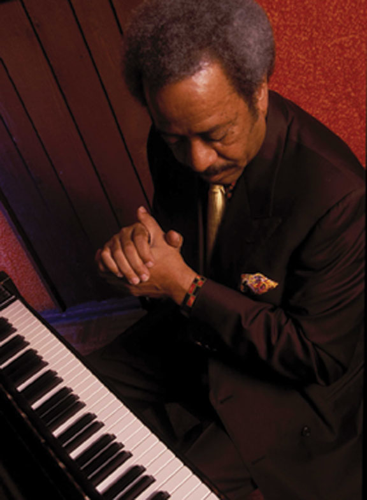
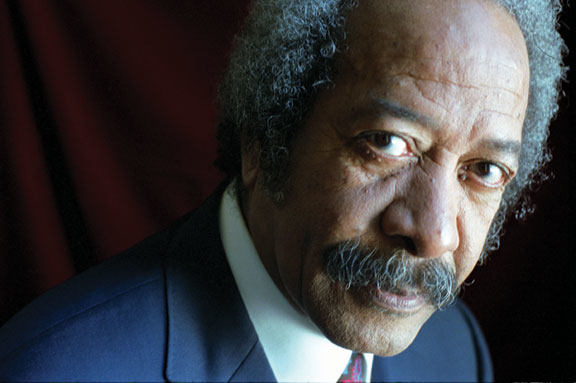

His extraordinary career as singer-songwriter, keyboardist, bandleader and producer spans four decades and countless albums and songwriting credits, but Allen Toussaint still has some surprises left. Case in point: last year's brilliant The Bright Mississippi, his first jazz album. Besides earning a Grammy nomination, Toussaint's harmonic sophistication, rhythmic flamboyance and sheer mastery of the piano had even hardcore jazz purists — always eager to rip those they deem novices — singing his praises.
But Toussaint, who'll be appearing next week at The Belcourt, credits producer Joe Henry. "He's the one who brought me those songs and had the idea for this disc," Toussaint says. "I knew a few of them, but there were some he brought in that really tested me. I was glad to do it because I've always been a jazz fan, and I've played jazz live, but never really thought about making that type of album."
Still, fans will recognize the Toussaint style in his treatments of such classics as Sidney Bechet's "Egyptian Fantasy," Jelly Roll Morton's "Winin' Boy Blues," Django Reinhardt's "Blue Drag," the impressionistic Ellington/Strayhorn gem "Daydream" and the Thelonious Monk treasure that serves as the album's title track. The licks, turnarounds, octave leaps and blues feel — long signatures of the Toussaint compositional process — are all out in force.
His amazing keyboard skills notwithstanding, it's as a songwriter that Allen Toussaint achieved his greatest fame. The long line of top vocalists who've had big hits with his work includes Lee Dorsey, Benny Spellman, Irma Thomas, The Meters, Dr. John and The Neville Brothers (both as a group and individually) — not to mention Glen Campbell, whose 1977 version of Toussaint's rollicking "Southern Nights" topped the country, pop and AC charts.
Toussaint says he began writing around the age of 12, though he started playing as a 7-year-old. The event that transformed his life, though, came as a teenager, when he saw the legendary pianist Professor Longhair, a kind of medicine man of New Orleans music.
"Up to that point I was really a boogie-woogie and blues player, and I still love those sounds," Toussaint says. "But then I saw Professor Longhair and he was just adding all these other rhythms. He was doing some rumba, some mambo, some island sounds, just working all those into his playing and it was funky, natural and incredible. He played so easily, yet he was creating all those rhythms and getting all these other things into his music.
"When I heard that, it turned me right around, because I started thinking about these other influences, the Latin beat, getting that feeling into the playing and the writing. Yet he also had all that blues feel, those inflections. And he clearly had a lot of soul. It was just a laboratory for me, seeing him live."
For the five decades since, Toussaint has been a prime architect of the New Orleans sound and a stellar songwriter, starting with early instrumental hits like Al Hirt's "Java" and Herb Alpert's "Whipped Cream." While he's worked with and admires numerous musicians, Toussaint cites two particular favorites, Lee Dorsey and Irma Thomas.
"Lee Dorsey was the happiest person that I've ever known and someone who I really loved hanging out with," Toussaint says. "He always had a smile on his face, and he loved working on those junker cars when he wasn't in the studio. In terms of female musicians there's nobody like Irma Thomas. The way she sings and phrases, the way she tells a story, it's a special thing. I've written a lot of songs for other women singers with Irma's voice in my head. She's the standard as far as I'm concerned."
He also fondly recalls the landmark Labelle session he produced that yielded the heralded Nightbirds LP and its No. 1 hit "Lady Marmalade."
"They brought that Philly diva thing down to New Orleans and some people really weren't ready for it," Toussaint says, laughing. "That was something, the look and the flair they had. But when we got in the studio they were fantastic, divas and all."
Amazingly, Toussaint says in all his years as a songwriter only once did he consciously try to write a hit. "When I got out of the Army I thought everyone was a step ahead of me," he says. "So I put 'Ride Your Pony' together quickly and put some things in there rhythmically that I thought would get it on the radio and played because I wanted a hit. But that's the only time."
Compare that to one of Toussaint's all-time biggest records, "Fortune Teller," which he says was basically an afterthought. "Benny [Spellman] wanted another tune where he could use a similar vocal line and inflection like the one in 'Mother-in-Law,' " Toussaint recalls. "So I wrote this tune called 'Lipstick Traces (On a Cigarette)' and put in this phrase where he could repeat that same pattern. But the DJs turned it over and started playing 'Fortune Teller.' There was absolutely no way I thought that would be a big hit, because it was a B-side."
Instead, "Fortune Teller" became a '60s staple with The Rolling Stones, The Nashville Teens, The Who and The Hollies all doing versions. It was even revived by Robert Plant and Alison Krauss for their blockbuster 2007 album Raising Sand.
Toussaint's own career has undergone a mighty resurgence in the 21st century. Before The Bright Mississippi, he received widespread praise and extensive recognition for The River in Reverse, his 2006 collaboration with Elvis Costello, notable as the first major recording session in New Orleans (again with producer Henry) after the devastation of Hurricane Katrina. Toussaint and Costello made many appearances together throughout that year, including one at Bonnaroo, and they both appear in David Simon's highly touted new series Treme, premiering Sunday on HBO. Toussaint ranks Costello among the most talented people he's ever encountered.
"This guy is one of the most knowledgeable musicians around, and I mean about everything," Toussaint says. "He can sit down and talk about lowdown blues and opera, jazz, Motown, country, folk, and he doesn't just know the hits, he knows the misses. It's amazing how much music he knows and how great he is as an entertainer. Doing that album and tour was a highlight for me."
Now that's he displayed his prowess with jazz, Toussaint acknowledges there's still one remaining musical frontier he hasn't attempted as an artist.
"I've never made a country record before, although I've had some country hits," Toussaint says. "Glen Campbell did a fantastic job with 'Southern Nights,' and he showed me a direction on that song I never had thought about when I wrote it. I did 'All These Things' for Art Neville, and Joe Stampley later did a country version that was successful. I've written things I thought would work in country, but I've never really done a whole country record. ... Maybe Joe [Henry] will want to try that next time."
Email music@nashvillescene.com.



Post a comment as anonymous
Report
Watch this discussion.
(0) comments
Welcome to the discussion.
Log In
Welcome to the discussion.
Keep it clean. Please avoid obscene, vulgar, lewd, racist or otherwise abusive language. Comments featuring hate speech or threatening or violent content will not be tolerated.
PLEASE TURN OFF YOUR CAPS LOCK.
Be truthful. Don't knowingly lie or mislead.
Be proactive. Use the “report” link on any comment that violates our comment policy.
Share with us. We'd love to hear your feedback.