
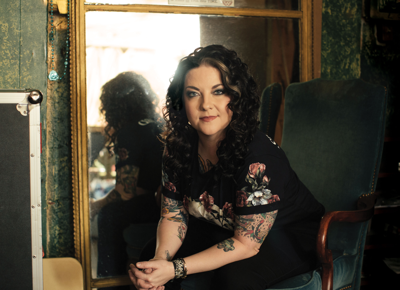


Ashley McBryde
Ashley McBryde has often told the story behind the title song of her Grammy-nominated 2018 debut album, Girl Going Nowhere — how an algebra teacher at her rural Arkansas high school asked each student what they were going to be when they grew up. “I’m going to move to Nashville and write songs,” the young McBryde said, “and they’re going to be on the radio.” The teacher snapped: “That won’t happen. You’d better have a good backup plan.”
McBryde did ultimately move to Nashville, write songs and hear them on the radio. And now she has been voted 2018’s Best New Act by respondents to the Scene’s Country Music Critics Poll. Her debut was voted the third-best album; she placed two singles in the poll’s top 20; and she finished in the top 10 of the Best Female Vocalist, Best Songwriter and Artist of the Year categories. But, McBryde admits, the naysaying didn’t stop when she left the Ozarks for Music City.
“When I talk about that song,” McBryde says, “that educator is the easiest story to recall, but she wasn’t the only one. I had friends and family who did the same thing. I’d say, ‘I’m moving to Nashville to write songs,’ and they’d roll their eyes. Before we wrote that song, Jeremy Bussey and I told similar stories for 40 minutes. Even when I got to Nashville and had my first whack at a record contract, there was more resistance. They wanted me to follow the rules: lose 30 pounds, straighten my hair, do more pop, use tracks at my shows. But I’m not that girl. I tried to do it, but I missed the mark.”
She went back to being herself: a not-tall, not-skinny woman with tattoos and wild curly hair fronting a tight, muscular country-rock band. McBryde and her band built such a strong reputation as a live act that she could honestly say the following in her debut’s title track: “I look around, and I can’t find an empty chair / Not bad for a girl going nowhere.” At the same time, she also joined an informal group of fellow “goin’ nowhere” Nashville songwriters.
“All the co-writers on my album but one I met at The Rusty Nail or Blue Bar,” she says. “Once I found my tribe, I knew I was going to make it. We wound up being called The Freaks, because we were a sideshow, the shit-show deluxe. We started the Music Row Freakshow on Wednesdays at Winners [bar]. We wrote together all the time and showed each other stuff. If you came up with a really stellar line, they’d flip you off, not because they hated you, but because they wished they’d written it. That was the stamp of approval.”
Her song “Radioland” manages to mention both mama in the kitchen and daddy on the tractor in its first stanza. But just when you think you know where it’s going, the song discloses that the father is listening to Townes Van Zandt as he plows the fields. It’s a clue why her debut is marked by such subtlety and sharp description.
“I was lucky enough to grow up listening to songwriters like Townes, Guy and Kris,” McBryde says of Van Zandt, Clark and Kristofferson, “thanks to my dad and one of my uncles, who gave me a Guy record at 14. Townes was unapologetically himself, and I’m drawn to people like that. Hell, ‘Pancho and Lefty’ came out of that guy, and ‘Waiting Around to Die’ was one of my favorite songs. It got into the cracks when I was growing up and comes back out when I write.”
Just as unpredictable as “Radioland” is “Livin’ Next to Leroy,” the portrait of a man down the street who provides local teenagers with colorful stories and a place to crash. But Leroy is also a junkie and a thief, and McBryde and her co-writer Nicolette Hayford skillfully avoid the temptations to either lionize him or demonize him, allowing his good qualities and bad to stand side by side. As such, it’s a most unusual modern country song.
“That is a little bit dark, because we’re not romanticizing anything at all,” McBryde says. “But it’s OK to get dark. I don’t think there’s anything wrong with the truth. The monster of addiction keeps growing if we don’t talk about it, but if we do talk about it, the monster shrinks. It’s important to remember that addicts are real people with families and friends. Leroy was a regular dude who lived three trailers down from Nicolette.”
“Girl Goin’ Nowhere” was written as a revenge song from the woman who was put down back home in Arkansas but now finds herself onstage in front of a cheering, capacity crowd. It’s the kind of song that most country-radio acts would deliver with an “I told you so” swagger over a pounding rock ’n’ roll beat. But McBryde sings it slowly and softly over acoustic guitar and drum brushes. It’s as if the attempted crushing of a young girl’s hopes is a cause not so much for anger as sadness. It’s far more powerful as a lament than it ever would have been as a revenge song.
But McBryde has paid a price for repeatedly refusing the obvious approach. Her debut single “A Little Dive Bar in Dahlonega,” released in 2017 before the album, made it to No. 30 on Billboard’s Hot Country Songs chart, but her next two singles, “Radioland” and “Girl Goin’ Nowhere,” didn’t make it into the Top 50. The fact that songs this good couldn’t find a place on country radio says something damning about the format’s resistance to both women and understatement.
“When I started out, I thought, ‘Surely, it’s not that bad at radio,’ ” McBryde says. “But it was that bad. I’m not so butt-hurt about it now. That’s the way things are. If you have a neighbor with a loud dog and you’re not going to move, you have to learn how to live with it. It’s not like there aren’t a lot of women out there doing great work.”
It’s that great work that eases McBryde’s frustration with radio. Once you’re no longer afraid of losing airplay, she says, you can do whatever you want — and that leads to your best songs. As proof, she points to records by her fellow Country Music Critics’ Poll champions Kacey Musgraves and the Pistol Annies.
“I don’t know why people think chicks won’t get along,” McBryde says. “I was over at Miranda Lambert’s house recently to write, and she is the coolest person on earth. The honesty of the Pistol Annies connects those girls to me. When they sing, ‘One’s drinking, one’s smoking, one’s taking pills,’ they’re not kidding. I’m not kidding either. I’m not going to sing anything I don’t believe. Kacey’s album is so good, the way she views the world. Brandy Clark’s ‘This Would Be a Real Good Time to Hold My Hand’ is such a good song I would have flipped her off at a writer’s night.”



