
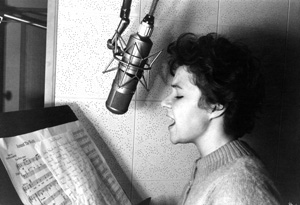

Whether or not she operated out of the same compulsions as the country singers and rock 'n' rollers in whose company she belongs, Brenda Lee was a star by the time she was a teenager. Yet she remains something of a mystery—one that isn't entirely dispelled by the Country Music Hall of Fame and Museum's new Brenda Lee: Dynamite exhibit, which traces her evolution from child prodigy to settled middle age. Lee seems blissfully untroubled by the commercial calculation that characterized her great hits. You have to step back and listen to her voice, which contains all the compulsiveness missing in her public image.
Born Brenda Mae Tarpley in Atlanta, Ga., in 1944, Brenda Lee grew up poor and looked to show business as a way out. "I didn't have an agenda, and wasn't thinking about million-selling records or making a lot of money," she says from her Nashville home. "But as I grew older and took a look around at my circumstance—my dad died when I was 8—I knew I needed to help my mom and my siblings."
Like Elvis Presley, Lee was a musical omnivore in a culture shaped by two forces: the far-away world of big-time pop music and the bedrock verities of down-home country and blues. "A lot of my roots were garnered from the church, and there used to be an elderly black gentleman who played up at the little store on the corner I used to go to," she remembers. "He was playing the guitar and singing what I now know is the blues."
Appearing on the television show Ozark Jubilee in the early 1950s, Lee (who had changed her name a few years previously) honed her chops. By 1956 she had signed to Decca Records, where she soon began recording with Nashville producer Owen Bradley. Her early repertoire was a mixture of pop and country material such as Hank Williams' "Jambalaya."
Her real break came in 1960, with massive hits on the order of "Sweet Nothin's," "I'm Sorry" and "Rockin' Around the Christmas Tree." An actual teenager singing teenaged music palatable to adults, Lee had learned her early lessons well. "I saw all those people I used to work with as a little girl—Kitty Wells, Faron Young, the George Joneses—and I gleaned from them the importance of discipline," she says. "Some had more discipline than others."
Dynamite documents this heady era of stardom. With Steve Allen in 1957, she seems unflappable and, if anything, older than Allen. On the television show Junior Jubilee in 1956 she does a passable imitation of Elvis Presley's version of "Hound Dog." Her voice was a raucous wonder, and she seemed far more knowing than she had any right to be.
Her manager, Dub Allbritten, had encouraged her to educate herself in the art of popular singing. "He had me listening to Bessie Smith and Sophie Tucker, Edith Piaf and Judy Garland, and Ella Fitzgerald and Sarah Vaughan," she says. "I had a great wealth of music to draw on when I was a little bitty girl. I knew there were other vistas for me to get over."
In his 1969 book Rock From the Beginning, Nik Cohn caught the adult flavor of Lee's performances. "She conjured up real three-in-the-morning visions: ashtrays full of butts and lipstick smears on the coffee cups, small rancid rooms, real desperation," he wrote. "Then she'd come out and she'd be like some kewpie doll, all sheen and varnish and eyes that really roll."
She was a rocker who appeared with the likes of The Shirelles and Jerry Lee Lewis on an early-'60s Allen Freed package show. But she was also a teenage celebrity whose likeness appeared in comic books such as the 1962 The Life Story of Brenda Lee. She even had her own cut-out doll book.
As the 1960s wore on, Lee faced a changing pop-music scene, although the hits took a while to dry up. She toured Japan 30 times and scored with the strange "One Rainy Night in Tokyo," which Bradley had her record half in English and half in Japanese. She cut an interesting album with the same musicians who had backed Dusty Springfield on 1969's Dusty in Memphis, but her future lay in country music.
Happy today with her children, grandchildren and husband, Lee seems at peace with her legacy, and she summarizes her achievement like the pop-music icon that she is. "I was raised around good people who drilled into me, be who you are. Do what you believe in, and throw it out to the masses. Like Owen [Bradley] would say, if it's good it'll be everything—it'll be pop, rock, country, and it'll cross the board."
Email music@nashvillescene.com.



