
In the annals of American independent music there are few labels that can match the reputation of Amphetamine Reptile Records. From the late '80s through the late '90s, AmRep released some of the most challenging, engaging and aggressive records known to man, some of the most confrontational art and music to ever emerge from the American Underground. Under the leadership of Tom Hazelmyer — visual artist, Halo of Flies guitarist and former Marine — AmRep became one of the most respected outfits of the era, bringing the world a brand aggro-outsider art that pushed the boundaries of what rock could be.
From the first Mudhoney single to Helmet's classic debut Strap It On, the heavy psych of Helios Creed to the alien pop punk of Supernova — not to mention signing Nashville's Today Is the Day long before "It City" madness swept into town — AmRep delivered the goods. Neither a punk label nor metal label nor experimental label, Amrep was all three and the music, as wild and unruly as it was, was matched only by the visual aesthetic cultivated Hazelmyer. AmRep was information overload pressed on vinyl and jammed in your earhole, equal parts beautiful and ugly, the essence of American life over-cranked and exploding in your wigdome. In short, a life-changing experience for those of us who were lucky enough to catch it as it was happening.
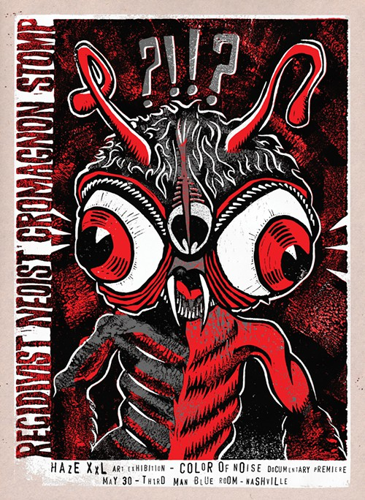
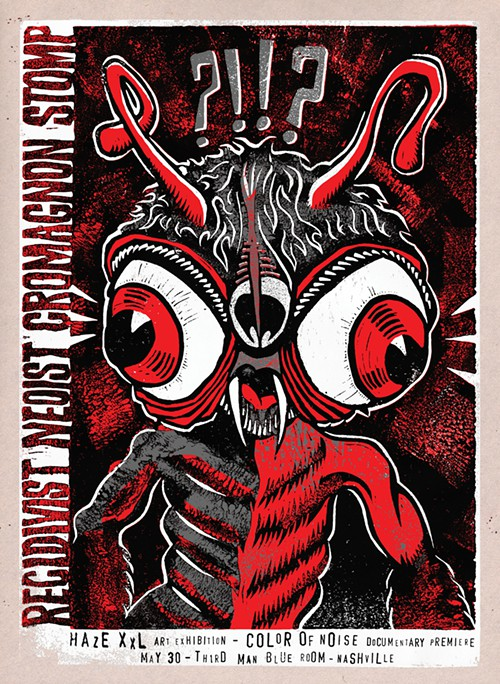
Hazelmyer is making art now — his Recidivist Neoist Cromagnon Stomp show opens at Third Man Records tomorrow, alongside the world premiere of the excellent Color of Noise documentary — and I caught up with him to talk art, music and the genius of Jack Kirby.
What are you going to be displaying at Third Man?
Basically I've been doing linocuts for the past, I don't know, three or four years. So it's basically all linocuts; a lot of the work has been used for Melvins and a few odd ball things here and there.
How did you get into linocuts? That's kind of an obscure medium these days.
It's actually kind of bizarre. When did it happen, four years ago, five years ago? Basically what happened was I was in a coma for about a month, through meningitis and a whole slew of other things, and when I came out they wanted me to do a bunch of rehab. And I went into one rehab and figured out pretty quickly that everything they wanted me to do was bullshit. One of the things was, "Sit here and do Sudoku puzzles," and it was like, "Oh go fuck yourself."
At that same time my daughter was in art school. One of her projects was to do a linocut, and we had to go get some linoleum. And I sat down, and I was working with her and it literally caught fire right there. I was working on an art show in Minneapolis that included 50 record covers that were all hand-made, and I wanted something on them other than just a collage, something like literal art from me, physical.
I realize that these days the definition of art encompasses everything and anything, but this was something from scratch, created by my hands, kind of art. So I did one piece off that and I really got into and took off running from there it was kind of the perfect thing at the perfect time. Part of it was that my brain had been so scrambled that thinking in reverse and doing lettering backwards came a lot easier than it would have if my brain hadn't been so malleable.
The other thing too was just being tired of having spent years on the computer doing lots of graphics for AmRep. I started off originally doing cartoons and as a painter when I was a teenager, and then through the graphic design thing from the late '80s on swung over to the computer and spent all my time there. And I was just really needing something dirty and visceral — at first I was trying to get it on the computer, which is just stupid.
The linocut thing, I didn't have a lot of knowledge of it, I just started jumping on it, and as I was doing it then went back and saw the German stuff from the turn of the century, Otto Dix and people like that that really launched the whole thing. It just kind of tied into the whole punk-rock aesthetic, kind of scummy, almost Xeroxed quality; I guess it's a prehistoric Xerox.
All of that negative imaging stuff, even mimeographs, all kind of influenced the birth of punk design.
You know, it's funny, a lot of people were citing those German expressionists and were like, "Oh, you're into that?" And I was like, "No, I'm really just ripping off Jack Kirby, but yeah that's it."
You can't go wrong with ripping off Jack Kirby.
That was a fucking genius place to start in hindsight, because it's an instantaneous school of light, just the way he did everything. If you mimic it enough and pick up a few of his tricks, it is a great place to start.
What's been inspiring your artwork lately?
Oh boy, it's all the things that have always got me off to a certain extent. Always an appreciation of previous movements, art forms, pop culture that I've always had since I was a kid. I'll bounce back between '50s and '60s and '70s, early punk and hardcore. I always try to put my own spin on stuff but I've never been one to deny the roots of what influenced me, if that makes sense. A lot of people go out of their way to bury to it: “Jack Kirby? I never heard of him. Otto Dix? I came out of a vacuum!” And I'm not that, I'll just be like “Oh, I ripped that off of page 62 of such-and-such.”
But it bounces all over the place. I bring up the Kirby thing, but there's lots of stuff. There's a series of clowns that I did for Melvins that will be at the show that were all done off old photos, based on photos from The Depression. Obviously it's going to completely transform in the translation to becoming a carve. But the Kirby thing was the start of it a few years ago, and now it's branching out into all sorts of different, weird things.
Sometimes it's utilitarian, like one of the things is a carve for a Melvins project we're working on the reissue of "Night Goat." If you're on Facebook at all, I posted that pretty recently, but that's a utilitarian thing where I'm able to bring in the design thing I spent 30 years doing but as pure art. There's no computer manipulation, it's all — the whole thing, the lettering — it's all done by hand.
What do you think of the state of contemporary art?
Man, you gotta few hours? I can sum it up pretty easy: The state of contemporary art is shit. And when I say that, I mean the accepted museum, high-end galleries, the stuff that caviar-and-champagne crowd calls art. The best comparison is to punk rock, the whole Juxtapoz movement for the last 15 years has so many direct comparisons to how punk-slash-indie brewed underneath the surface, had nothing to do with Billboard Top 40. They were two separate worlds.
You see the same exact thing happening. All the arts that are funded is the kind of crap that can't hold its own. It's supported, it has no visceral appeal, it's a bunch of college professors and bankers determining what art is, whereas a lot of people on an independent level — the last people in the world to actually get funded, to get any of the quote-unquote arts money — have been doing it on their own, setting up their own galleries, doing their own shows, putting out their own books. Figuring out ways to get by, which if that means doing print and toys and weird shit, so be it.
Yeah, it's a whole different world. I don't know how familiar you are with those artists, whether it's Jeff Cyril, or the king of it, who kind of started it, was Robert Williams, who was kind of the breaking point where to this day he still hasn't gotten a proper nod from the quote-unquote art world. It's gotten to a ridiculous extent, the same way it did with independent music, where you had a Sub Pop or a Touch & Go, able to sell literally some projects 100,000 copies because the major labels turned their noses up and couldn't be bothered. And it's the same thing where you've got a Mark Ryden or a Robert Williams be able to sell pieces for large amounts and have a huge following but they couldn't arrested at inside a gallery in the country, the mainstream stuff.
Do you think that's ever gonna change? Do you think we'll be able to over throw the shitheads?
It's a hard call. Over the years I've seen some insane things. I remember talking to my friend Jack, and he was doing a book signing with Shepard Fairey and Gary Bassman. So there's these three sort of Juxtapoz artists, and they're at the Los Angeles Museum of Modern Art and there was a line two blocks long for these guys. And the museum was freaking out, because they had never seen anything like that, that kind of public response. And that was 10 years ago; you'd think that the museum would have scratched their head and said, "Hmmm, maybe there's something going on here."
But they're so married to the paradigm and the system that funds it, to the public funding and corporate sponsorship, that what people want to see doesn't matter to them anymore. It's up to that panel, up to that board that's authorizing the grant and that funding, who makes the rules in that world. All the artists I know can't be bothered, they'd rather just get their shit together and do stuff themselves without having to go through that process which is, you know, soul-crushing [laughs]. You have to be half bureaucrat to get through it anyhow. I've had some friends attempt to go through that process, but they just end up feeling broken and dismayed by the end of it.
We could go on for hours; it's a gang. And at the end of it you go to the museum and you see a rock hanging on a string and that's the end result of that whole process. And it's bullshit. Part of the reason we've been doing stuff the way we've been doing it is because that is not an option. So it's figuring out way to do shows and putting together events that are not just a bunch of people standing in a cold sterile room eating cheese and wine.
That's a terrible way to experience art.
And I think to a certain extent that same crowd I was discussing like it that way. It keeps it elitist, it keeps it incomprehensible to the average person and it shouldn't be that way. If you look at some of the masters before there was that break, any one can get into Salvador Dali, you don't need to read a thesis to understand what the fuck's going on there on the wall. You just stand there and it pops you in the face, like damn. That's part of it too.
How do you feel about the state of independent music? It's kind of in the same boat, isn't it?
That's a weird one, that's really bizarre — I haven't really wrapped my head entirely around it. There's a lot of aspects of the new model that — it's still kind of creating itself, I don't think its all hashed out where it's going to end up with all the new technology that's involved. On one level it's genius: You can get out there and post things on YouTube and you can have a Bandcamp. You can literally hit the streets in two days.
The ease of recording is mind-blowing, you can literally sit there if you got a couple of nice mics and with a laptop you can get the same quality that you used to pay $50 to $100 an hour to get 20 years ago. That was always the struggle back in the old punk-rock and indie days, getting in the studio, even if it was the sub-par one in the dude's basement, was never cheap. This ease and access to all these tools make all the old challenges subside to damn near nothing. And yet on the other hand it seems like there's not a whole lot going on even though it is easier than ever.
That's a thing that befuddles me: The accessibility has kind of flattened everything. The music going in and the music coming out ...
Has the ease of creation flattened out the end-experience?
I don't know if the ease flattened things. One of the missing elements though with the Internet seems to be the fact that 25 years ago you had to search shit out. There weren't that many magazines that were going to point out the things you were looking for, especially if you were looking for fucked up, non-mainstream, whatever — you had to search it out. You had to talk to people at the record store, you had to find friends that were as mutant as you were and collectively work together. You knew the resources: "Well, this magazine points out really good stuff, that guy over at that record store knows his shit, and that guy in that band seems to have access."
You had to work at it and that seemed to motivate people more. Where now I can go to YouTube and pick a genre, obscure' 60s or all-women Japanese hardcore and bounce from video to video and you can find anything you want. Everything is at your fingertips, 24/7 and relatively quickly, and that seems like it's taken the drive out of it. If you can get everything you want whenever you want it, you tend not to be too motivated to get off your ass and find that weird hole in the wall club or that bizarre record store and unify.
I remember finding my first AmRep record, because they didn't make it to my suburb and being like, "Whoa, cool these actually exist."
And the cool part about was that you had more cross-pollinization of different groups. If you look, musically, at every movement and you start digging in and start finding out about the players, whether it's No Wave or '75 New York or '77 London or Austin Texas in the '80s, Minneapolis, what ever certain point in time, you always have this weird mix of mutants coming together. There was always the alienated, there was always the underground gay element, you know the bathhouses, the art-school kids meeting up with skaters.
You had this really bizarre mixing that was awesome, and you would get that cross-pollinization of different things, whereas these days it seems like everyone niches up instantaneously. You know, "I'm a skater into Japanese porno with squid meat. I found a group and we sit there and we love exactly 98 percent of the same thing." So all of a sudden now I've just cut myself off from the weirdo skinhead scene in Winnipeg. They've got their own group, so now there's not this bizarre crossover.
I don't no how to describe it, I guess cross-pollinization is the best way I can say it, where weird ideas get into different groups because they weren't isolated. You couldn't isolate yourself before because you were stuck in whatever suburb or whatever town, you didn't have a huge pick. There weren't 500 of you who liked watching puppy videos while the Buzzcocks are playing. It's so specific. There were only 50 of you at the Black Flag show in 1981; you had to be tolerant of a lot more things because it was like, "The closest I'm going to get to any sort of community are these 50 people right here. And that guy is a weirdo from art school and that guy hangs out with the bikers but we all came together for this show." That's when the creativity happens, when there is this bizarre mixing of stuff so it isn't so uniform. To my mind any movement becomes too uniform because the rules get written.



