
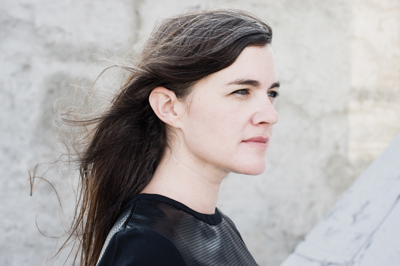
Convention be damned — Julianna Barwick is a songwriter. No, her music doesn't live up to the somewhat hypocritical standard so often used in granting that distinction. It's a term that subjugates a song's sound to its lyrics, favoring poetry over resonance, cleverness over catharsis; it's a notion that ignores much of what this music thing is really all about.
Barwick won't likely please listeners who adhere to the conventional tenants of songwriterdom. Her creations could be loosely termed tone poems, building lush and reverberant vocal snippets into a swell of interwoven loops that are occasionally — and often in the case of last year's beautiful Nepenthe LP — buttressed by earnest strings, elegant keys and other sparse instrumentation. Her last record includes just two couplets of actual lyrics. Otherwise, Barwick coos and cries, relying on her skill as an arranger and a singer to convey powerful emotions.
"All of the music that I've ever made starts out just spontaneous," Barwick tells the Scene via phone, speaking from her car as she makes the long drive from New York to Indiana to start her current tour. "It's just pure emotion, not really thinking about it or meditating on anything. [It's] definitely super personal, and it's just what I like to hear. I like to hear layers and layers of voices. It's so beautiful to me. I always loved listening to groups of people singing."
For much of Barwick's unlikely career, creating this personal music has meant working on her own. She's used to long, lonely drives, playing most of her shows with just a few instruments, a loop station and her luminous voice. Her music was born in large part from a solitary fascination that she nurtured during childhood: singing loudly in the middle of pastures in Louisiana and Missouri, where she grew up before moving to Brooklyn — or more famously, discovering reverb by practicing inside a hollowed tree trunk. Her love for the human voice funneled into formal compositions when she acquired a guitar pedal with a looping feature, using it and a four-track to record her 2006 debut, the fuzzy and fragile Sanguine.
Barwick has indulged in a few collaborative releases, creating new material with Ikue Mori and Helado Negro and opening up her own music to reinterpretation on 2011's Matrimony Remixes, but her solo records have been made largely alone and at home in a bedroom studio.
"I followed my nose through all of it," Barwick says. "I made my first record with that guitar pedal. I don't even think I had a computer then. Then I got a computer, and it had GarageBand on it. Then I got the loop station. I can make three loops that I can kind of weave in and out of each other at the same time. I had to read manuals. I went to GarageBand workshops at the Apple Store in Manhattan. I just kind of learned as I went."
Nepenthe is Barwick's first attempt at integrating other people into her solo works. Recorded with Alex Somers (most famous for his work with ethereal post-rock masters Sigur Rós) at Iceland's revered Sundlaugin (a studio the band had built in an abandoned swimming pool), the album benefits from a similarly delicate grandeur. Strings from the Icelandic ensemble Amiina along with cozy keys and billowing distortion expand during the record's bigger moments — the fleeting mantra of "One Half," the light-to-dark sprawl of "Pyrrhic."
But despite its sonic breadth, Nepenthe is still an intimate record. It's a transition much akin to the one Justin Vernon made between 2007's haunted and insular For Emma, Forever Ago and 2011's towering Bon Iver, growing his sound without forsaking his piercing emotionalism.
Take "One Half." It might be the best song in Barwick's catalog, and that's not because it has lyrics. The pensive opening is quiet and close in the way of her early work, spectral vocals swirling before pianos and strings cut through. The sound builds slowly, and her words come into focus — "I guess I was asleep that night / Was waiting far." Her yearning continues to increase, but the entity she awaits never appears. It's poignant and relatable — the mark of a gifted songwriter, no matter her chosen tools.
"I just know that as long as I keep working, the world is full of possibilities, and I feel so positive about what will happen in the future," Barwick says. "There is no end to what can be done and experimented with."
Email Music@nashvillescene.com.



