
by Ben Westhoff
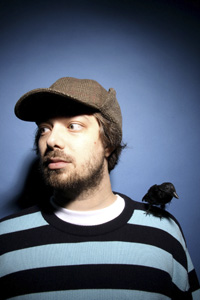
If Aesop Rock’s latest CD, None Shall Pass, sounds different from the rest of his catalog, it’s because his life has changed dramatically of late. In the past two years, the hip-hop MC moved from his beloved New York to San Francisco, got married and turned 30. “So, those were the three punches in the face I took,” he says with a chuckle during a recent phone interview.
Rock flung himself across the country to be with his wife, Allyson Baker, guitarist for Bay Area band Parchman Farm. “It was kind of a blessing in disguise,” he says. “I probably needed to get out of New York and didn’t really realize it until I got out.”
But it was a New York-centric, street-poet sound that informed his 2001 Labor Days, the disc that shot Rock to underground fame upon its release. The album showcased his dense, hyperarticulate lyricism; when listeners could penetrate Rock’s meaning, they found him mixing cocky rhymes with vivid imagery. His sonic innovation and fan base continued to grow with 2003’s Bazooka Tooth, as well as various EPs over the years.
The gentler, more narrative-heavy None Shall Pass shows a lyrical leap forward for Rock, showcasing his storytelling abilities in the form of semiautobiographical tales. On “Catacomb Kids,” he spits, “I was a dark, dumb student, no hokey rookie daytrippin’ on visions of chickens that looked like R. Crumb drew ’em.” On the album’s most compelling songs—the title track, “Fumes,” and “The Harbor Is Yours”—Rock’s tales evoke fear, nostalgia and the horrible ecstasy that is youth.
“Without sounding corny, it was more me kind of trying to be reflective, and picking songs in which I could tell a story or explain a time and setting,” he says.
Musically, None Shall Pass is a mixed bag, blending solid beats from longtime collaborator Blockhead with often-grating tracks produced by Rock himself. The Mountain Goats’ iconoclastic John Darnielle is a standout guest, and the disc features more live instrumentation than other Rock efforts.
Some of this instrumentation was originally unintended. This summer, with the record already finished, Def Jux called with some unfortunate news.
“The label said they were cracking down on us for samples more than ever before, and that we couldn’t use five of the songs,” Rock remembers. “I kind of had a nervous breakdown, because we were basically done with the record. I’d never been busted for a sample before, and all of the ones we’d used were pretty obscure. I was almost like, ‘Fuck it—take it or leave it. I’ll give it to someone else or I’ll give it away for free.’ It was that frustrating. But we went in with people who could play the instruments and basically reworked stuff.... I ended up thinking that most of them turned out.”
Critics largely agreed, although Rock was panned in some reviews for continuing to bury his message beneath heaps of metaphors and half-formed ideas.
Village Voice critic Garrett Kamps added this line to a mostly positive review: “[Y]ou can’t decipher most of what he’s saying, and sometimes you’re better off.”
“I don’t really care,” Rock says with a nervously defiant laugh, of the critique. “I’ve been hearing that exact criticism for the past 12 years or so. I’ve come to the conclusion that not everyone’s going to understand what I’m saying.”
Ironically, while critics were accusing him of being too obscure, some longtime fans accused him of pandering to the masses. Upon its August release, None Shall Pass sold 13,200 copies in its first week—more than any previous Rock album—and debuted at No. 50 on the Billboard 200. In its third week, it got a bump when Rock was chosen as MTV’s Artist of the Week. Indie-mentality fans peppered the comments section on Rock’s MySpace page with quips such as “That sucks you had to sell out for MTV.”
“I can’t really pretend that I understand that,” Rock responds. “It was funny, and somewhat to be expected, but it made zero sense. You think [MTV] paid me? Of course they didn’t. [But] we’re not going to turn down that much free promotion. I still have some old bills at home.”
Whether it’s stepping gently into the mainstream or moving across the country, a more apt phrase to describe Rock’s behavior might be growing up. This applies to the future of his songwriting as well. “I want to try to do rap songs about things that have never even been discussed in the world of hip-hop,” he says, mapping out plans for possible projects down the line. “I had this vision of songs that feel like they should be told around a campfire—ghost stories or tall tales kind of things.”
There are subjects even scarier than turning 30 and getting married, it seems.



