
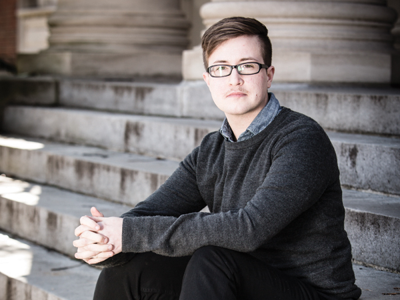


"I'm probably an odd duck," says Kale Edmiston, "but that's OK." He's a fifth-year Ph.D. student in Vanderbilt's neuroscience program, a responsibility he carries alongside his punk tendencies and trans identity. Edmiston is also the assistant director of Vanderbilt's Program for LGBTI Health, studies the relationship between stress and autism in teenagers, and is attempting to teach himself Mandarin in preparation for postdoctoral studies in China, where he'll research first-time psychosis in young adult schizophrenics. On top of all that, he helms the queer punk record label Nervous Nelly with his partner, Shannon. We talked about his accomplishments at his office in Vanderbilt's Kennedy Center.
You're studying autism in adolescents — why autism?
I didn't initially start this because of an interest in autism, but because of my interest in adolescent stress. And so in the past I've looked at bipolar disorder and depression and anxiety, but always from this angle of being interested in stress. And one of the things that our lab does is look at stress profiles. We do that by collecting saliva and we measure cortisol, which is a hormone in saliva that's released in response to stress.
That's a great way to measure something with hard science, as opposed to behavioral analysis. What have you found?
We look at behavior too. We've developed really specific coding rubrics for looking at behavior. So we can look at different things that people do. For example, in my dissertation, we're actually asking teenagers to give a small speech, like a public speaking task, as a way to elicit a stress response.
That's a big ask.
It is! We collect saliva, and I also look at heart rate and behavior. We look at things that we know are indicative of a stress response. Stress is a really important component to a lot of psychiatric issues, and it's really important to mental health. And I think it's overlooked a lot when it comes to autism. For some autistic people, they'll avoid social interaction because it's stressful, where others might just not be interested in it. So I'm trying to figure out what's at play here. Some patients don't really have a stress response to public speaking. And that's really cool, and can be a real strength. We see that in our theater project too, a lot of them are just ready to get onstage and show everyone what they can do. Honestly, I wish I were a little bit more like that! A lot of what I've been learning in the lab is focusing on strengths and not just deficits.
Read more of this interview on Country Life, our arts and culture blog.
More From the 2015 People Issue
The Textile Designer: Andra Eggleston / The Transformer: Bill Schleicher / The Chief: Steve Anderson / The Bookseller: Yusef Harris / The Producer: Dave Cobb / The Rookie: Filip Forsberg / The Pedal Steel-Playing Pilot: Joshua Motohashi / The Weathermen: David Drobny & Will Minkoff / The Punk Neuroscientist: Kale Edmiston / The Kitchen Artist: Karla Ruiz / The Metalhead: Kayla Phillips / The Image Master: kogonada / The Bartender: Lee Parrish / The Professor: Lisa Guenther / The Advocate: Marisa Richmond / The Captains: Kellie Hurst & Regina Durkan / The Painter: Michael Shane Neal / The Tunesmith: Shane McAnally

