
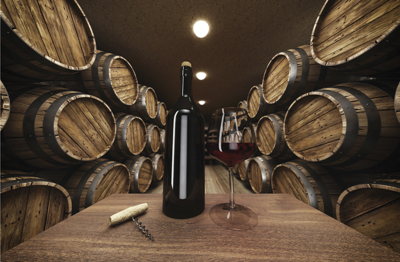
Garrigue, lobster stock, extinguished cigars — the words used by the wine intelligentsia to describe faint flavors and aromas are not as silly as they seem, but they are out of reach for many consumers. Which descriptors, then, are useful to those who don't yet have the palate, nose or vocabulary for extreme subtleties? Luckily, long before we get into whether or not a wine smells of new tennis ball, we can address a more elemental and answerable question: What does it mean for a wine to be oaked?
Most wines are aged — some for a month or two, some for years. Not only does the duration vary, but so does the vessel. Stainless steel vats, concrete tanks and ancient amphorae are all used to age wine. Perhaps the most discussed vessel is the oak barrel, which is used on wines of all kinds. Its influence is most perceptible and polarizing when it comes to universally known chardonnay.
Oak aging bestows benefits on wines that go unnoticed by the lay consumer. But it most profoundly affects things even the novice drinker can perceive: the body and flavor of the wine.
One quick but important detail: New oak barrels wield the biggest stick, flavor-wise. After their initial use, they are, logically, known as used. After several years their influence on flavor is negligible, and they are termed neutral. The amount of new oak used on a wine is therefore very relevant to the finished product, in price as well as flavor. When you are paying more than $30 for an oaky chardonnay, keep in mind that new high-quality barrels cost the vintner well over $1,000 each.
In the case of American chardonnay — especially Californian — new oak is often so closely associated with the grape that many consumers don't know where the grape's flavor ends and the barrel's begins. This is a shame. Countless consumers have been traumatized by over-oaked chardonnays and have closed themselves off to the varietal, wrongly pinning the repellent characteristics on the grape rather than the way it has been treated.
There is a reason I say over-oaked, and not just oaked. Oak is a powerful tool, and when used with care, it is an indispensible player in the winemaking game, adding delicate but noticeable spice notes and imparting body to otherwise steely wines. Think of it like Auto-Tune: When used responsibly, it can invisibly enhance beautiful things that could very easily stand on their own. It can also mask shortcomings that, if exposed, would be fatal. In the wrong hands, though, it can be used to such dominating effect that it creates a whole category unto itself. But as wine and iTunes sales attest, the over-the-top approach by no means implies commercial failure.
Heavy oaking, in fact, sometimes means just the opposite, as some of the most sought-after and popular California chardonnays of recent years — Pahlmeyer, Far Niente, Kistler — boast significant oak. These are high-quality wines, although some people find their toasted qualities and viscous mouthfeel overbearing. Oak imparts vanillin (whose flavor you can probably guess) and, due to attendant reactions, dairy-like characteristics. Butteriness, as a defining term, is just about as prevalent as oakiness to describe basic chardonnay preferences: Drinkers usually either like buttery and oaky chardonnays, or they don't. I say vive la difference; with shellfish, rich seafood and white meats, oaked chardonnays can be sublime.
The grape itself is very versatile. Compare a stark Chablis to a wine from Paso Robles, Calif., and be amazed that they come from the same varietal. Chardonnay boasts tropical fruit flavors — I usually detect pineapple — and many expressions feature a zesty lemon character that is capable of surprising those accustomed to oakier iterations.
The putative tastemakers of the wine world have been lauding minimally and un-oaked chardonnays for years, even as the masses have continued to shell out for oaky powerhouses. But how's this for a shift in taste: My mother, who for years has thought of butter-bomb Rombauer — derisively known as "cougar juice" — as the pinnacle of chardonnay achievement, recently flipped her allegiance to Mer Soleil. Spare me your sales figures — when the grandmas go unoaked, the pendulum is on the move.
Today's wine merchant is wise to enhance her bona fides and her bottom line by stocking chardonnays of varied characteristics, as curious drinkers seek to explore oak — not just as a category, but as a continuum.
Here are a few locally available chardonnays that represent the versatility of styles:
Rombauer, Carneros, Calif.
The lodestar of plump California chardonnays — try it if you want to know what buttery means. Sign of its place in popular culture: It's the prop-bottle Amy Schumer drinks from in her recent HBO special. Midtown Wine and Spirits, Grand Cru, Red (Bellevue), +/-$30.
Neyers Vineyards 304, Sonoma County, Calif.
An unoaked wine, lent significant body by innovative winemaking techniques. An extremely rich, tropical expression that disproves the notion that unoaked equals thin. Wine Shoppe of Green Hills, +/-$27.
Bachelet-Monnot, Bourgogne, France
Expensive for a humble Bourgogne, this is a glimpse into why wine-lovers spend big on white burgundy. Made mainly from fruit from Puligny-Montrachet, it features the lemon curd and flintiness that make the region special. W.S.G.H., +/-$35.
Éric Chevalier, Val de Loire, France
A lean, lively and slightly briny chardonnay, aged in glass lined tanks, from the maritime climate of France's Loire Valley. Woodland Wine Merchant, +/-$14.
I Prandi, Veneto, Italy
The notes at Woodland promise a "whiff of oak," which is spot-on: Baking spices abound from the six months this northern Italian wine spends in barrel. Woodland, Grand Cru, +/-$17.
Email arts@nashvillescene.com



Post a comment as anonymous
Report
Watch this discussion.
(0) comments
Welcome to the discussion.
Log In
Welcome to the discussion.
Keep it clean. Please avoid obscene, vulgar, lewd, racist or otherwise abusive language. Comments featuring hate speech or threatening or violent content will not be tolerated.
PLEASE TURN OFF YOUR CAPS LOCK.
Be truthful. Don't knowingly lie or mislead.
Be proactive. Use the “report” link on any comment that violates our comment policy.
Share with us. We'd love to hear your feedback.