
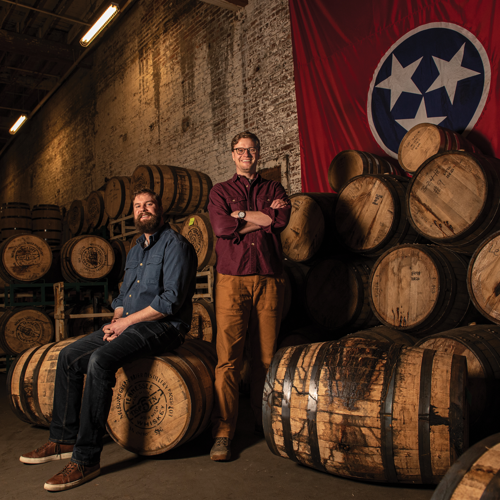
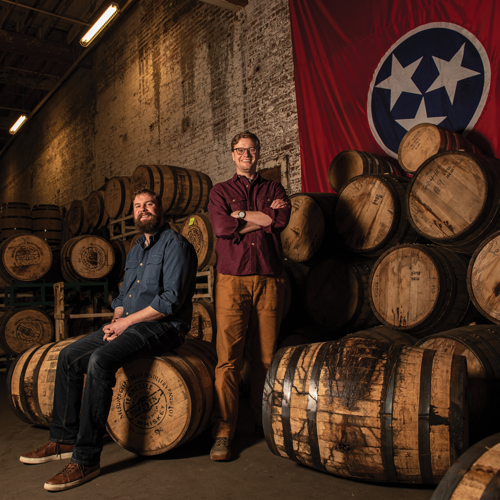


Charlie and Andy Nelson
The story of how brothers Andy and Charlie Nelson of Nelson’s Green Brier Distillery discovered their family legacy and restarted their ancestral distilling business after a multigenerational hiatus has been recounted many times — including in these pages. But it’s just so darned interesting, it merits a quick retelling. The Nelsons’ great-great-great grandfather, Charles Nelson, immigrated to America from Germany in 1850, arriving with just the clothes on his back due to a shocking accident in which his own father was swept overboard during the passage; he sank to the bottom of the Atlantic with the family’s life savings, which he had converted into gold, and had unfortunately sewn into the lining of his coat.
Young Charles moved to Nashville at age 17 to work as a butcher and eventually opened a small grocery store downtown. Seeing his customers clamoring for whiskey, Nelson bought a distillery and began to manufacture some of the first Tennessee whiskey, eventually growing his business to one of the largest in the country — much bigger than the upstarts down the road in Lynchburg who were just starting to sell the booze that bore Jack Daniel’s name. Charles Nelson died in 1891, and his wife Louisa took over the family business, running it until statewide Prohibition shuttered Green Brier in 1909.
That was pretty much the last anyone heard or thought of the business, as bigger players like Jack and George (Dickel) dominated the Tennessee whiskey space for decades following the abolition of Prohibition. Fast-forward to 2006, when Andy and Charlie accompanied their father to Greenbrier, Tenn., to pick up some meat from a butcher. It was there they discovered a sign pointing to the old warehouse where their family whiskey used to be stored, and a visit to the Greenbrier Historical Society revealed two original bottles of Nelson’s Green Brier Tennessee Whiskey. Andy and Charlie realized that whiskey was in their blood — they had to reboot the family business.
But like the brown liquors they create, distilleries take time to mature. Starting up a distillery is kind of like going to a bank and asking to borrow millions of dollars to build what is basically a chemical engineering plant — only to have to wait four to five years to find out if you are actually any good at it. The old spirits maxim is “vodka pays the bills” (because it doesn’t require the same lengthy aging process as a whiskey), but the Nelsons had no interest in making clear spirits. While they waited for their own distillate to spend the years in charred-oak barrels that are necessary to convert white whiskey into bourbon or Tennessee whiskey, Nelson’s Green Brier established an esteemed reputation with their original product, Belle Meade Bourbon.
Starting with sourced bourbon from a much larger distillery, Charlie and Andy added value to the purchased juice by taking control of the aging and blending of the barrels. They created a consistently excellent product that was better than many other whiskeys that popped up during the bourbon boom of the past decade. Quickly becoming a favorite among bartenders and retail customers, Belle Meade Bourbon won numerous spirits awards, especially for the cask-finished versions that the Nelsons created to add even more nuance and value to their purchased whiskey.
While Belle Meade Bourbon provided the necessary cash flow (along with some significant outside investments from a major spirits industry called Constellation Brands), the Nelsons kept their focus on creating their own spirits in a small still — nicknamed Miss Louisa — in their distillery in Marathon Village. Despite the fact that the massive stills at Jack Daniel’s produce more whiskey in a minute than Nelson’s does in a week, the brothers remained committed to creating an original Tennessee whiskey that they could put the legacy Green Brier name on as their flagship product.
Over the past few years, Nelson’s Green Brier has released small batches of its creations from Miss Louisa one barrel at a time. While the scant quantities demonstrated Andy’s progression as a distiller as each barrel came out sequentially, the whiskeys were still rather immature and weren’t quite ready for prime time — either in sufficient availability or in the ultimate quality the Nelsons sought. So the brothers pivoted again to achieve both the dependability of supply and consistency of quality that they needed to finally release the legacy whiskey into the mass market.
Having increased its production to two shifts, Nelson’s Green Brier can now produce up to four barrels a day. That’s still a drop in the whiskey bucket compared to the big boys, but a significant improvement over their former capacity. They have struck an innovative partnership with Tennessee Distilling Group in Columbia to supplement the whiskey coming off of their own still, but not simply by purchasing someone else’s excess product. Nelson’s Green Brier actually rents time on its partner’s still, and Nelson’s employees create the whiskey using their own proprietary recipe, which relies on wheat, instead of the more traditional rye, to add flavor to the dominant corn grain in their mash bill. They also purchase the grains from their own farmers, the same ones who supply Nelson’s Nashville distillery.
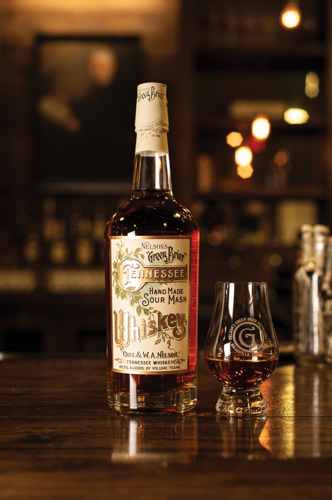
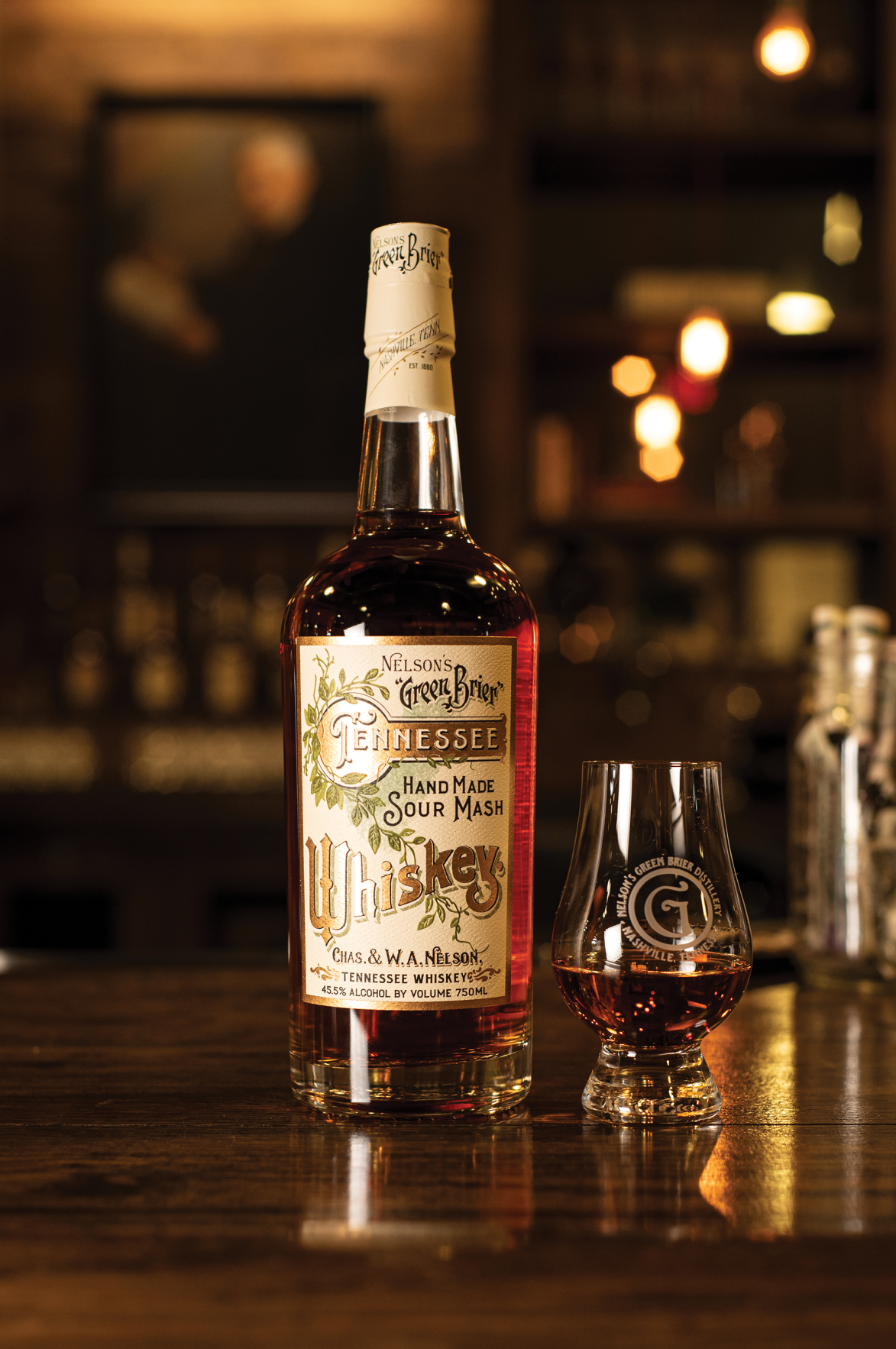
The result is the new Nelson’s Green Brier Tennessee Whiskey, based on a 150-year-old recipe that the Nelsons discovered in their family archives. For the first year at least, the product will be available only in the Nashville market.
“Local supporters brought this brand to life,” Charlie Nelson explains. “We want to support the local retailers and watering holes.” The 91-proof alcohol content makes the whiskey a versatile choice for mixologists, while still offering enough backbone to please whiskey fans who prefer a neat pour. Plus, the Nelsons are big fans of symbolism, history and numerology, so the proof level also refers to the year Charles Nelson passed away — 1891. At a suggested retail of $29.99 a bottle, Nelson’s Tennessee Whiskey is positioned at a much lower price point than Belle Meade Bourbon, and the Nelsons hope this becomes an everyday favorite for local whiskey fans.
“We never had an intention of just being a microdistillery,” says Andy Nelson. “We never even knew those existed. We didn’t lay down our first barrel until 2014, and we’ve had to be open-minded and flexible along the way. But most of all, we wanted to make sure we were putting out products that we 100 percent believe in. We also want to build a portfolio of products at different price points to meet our customers’ needs.”
The new whiskey exhibits a lovely mouthfeel that is softer and smoother than most Tennessee whiskeys, while still maintaining complex aromas and flavors of baking spices and just a hint of sweetness — even after the charcoal mellowing process that defines Tennessee whiskey.
“Making whiskey is a blend of art and science,” says Andy. “We don’t want to try to be something we’re not. And we’re not scientists. We studied philosophy in college, so we skew more to the art side. We make our decisions based on aroma and flavor over lab results. Some argue that might be less consistent, but we feel that adds the heart and soul of the people who make it to the whiskey.”
“We want it to bring people together to share stories,” Charlie adds. “We are so incredibly fortunate to have discovered our family history and to be able to bring part of it back to life. We hope it inspires people to learn about their own family histories. We literally saw a sign and followed it. If you see something and feel something, do something!”
And while you’re at it, do it with a glass of their whiskey in your hand.



