
As a kid, I delighted in the excess of Christmas — too much stuff! Now, the phrase "too much stuff" inspires no enthusiastic exclamation point, but rather an exasperated head-shake. Now I find joy in a more mature dyad: having nothing more than what is needed, and having precisely the right tool for a job — having only the right stuff.
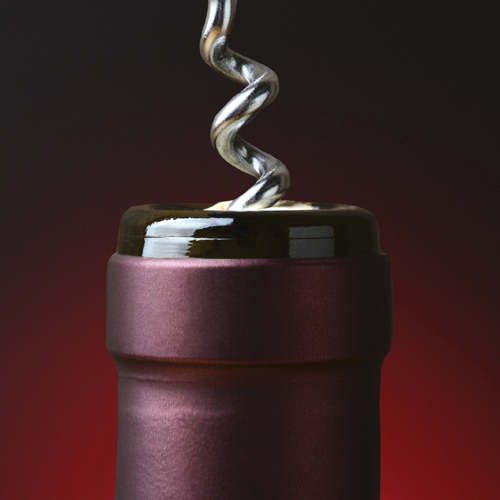
The wine world is awash in needless items. One prominent website promises "essential tools" while shilling monogrammed bottle stoppers and cheeky aerators. Maybe the essential tools are there somewhere, but that word — essential — should burst into flames in the presence of an electric corkscrew. You don't need one of those, nor do you need a mounted corkscrew, label-saver, foil-cutter or whatever a "twister" is. What you do need, and hopefully have, is an unopened bottle of wine. So what now?
The simple corkscrew called the "waiter's friend" is the most practical and cost-effective of all wine-accessing options. It fits comfortably in a drawer, purse or pocket, and it's affordable enough that you can manage to stash a few backups. I have two at work, three in different drawers at home, one in the basement (in case of a tornado), and one in my backpack at all times. The size of a small pocketknife, the tool consists of a main handle, a hinged lever arm, the corkscrew (or "worm") and a foil cutter. Of all the "cheap" openers out there, the Pulltaps brand ($10 or so) makes some of the best — you're much more likely to replace a lost one than a busted one.
As a testament to the unimprovable function of the waiter's friend opener, I must point out that the $395 (really) Code 38 opener is essentially a space-age rehash of every other waiter's friend out there; the difference is that most are not obsessively hand-crafted from the most durable materials on the planet, and most won't make you want to eat a bullet when you lose it. The founder of Code 38 explains his inspiration: "I have always thought that there's something fundamentally wrong with a sommelier uncorking a bottle of premium wine with a cheap waiter's friend." Well, that makes one of us. For those who care more about the car running smoothly than what brand of tool the mechanic uses on it, the cheap and solid-enough Pulltap's tool will do. Buy three, and worry about it again in 10 years.
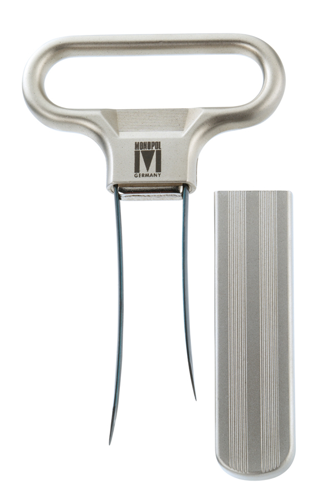
A few more bucks will get you an "ah-so" opener: a quaint tool that consists of a loop handle and two thin metal prongs that are rocked into the bottle between the neck and cork. The ah-so squeezes the cork instead of penetrating it like the worm on a waiter's friend does, and it's therefore less likely to leave chunky tidbits of cork floating in your precious wine — an invaluable virtue when dealing with older wines (more than 10 years old) stopped by deteriorating corks. You can do without an ah-so — it is not a sexy piece of equipment — but even less sexy is passing a 20-year-old wine through the kitchen strainer you last used to filter chicken stock.
There are wine drinkers, and there are winos. I don't want to get snobby here, but if you identify more as the former, you should have a glass. A quality wine glass has good weight and balance; it should never be top-heavy, and it should feel good in your hand. It should also have a thin-walled bowl and a svelte stem, unlike the unbreakable water-spotted weapons in which many chain restaurants serve their wines. Their glasses have to endure clumsy servers and indifferent dishwashers. Yours don't, so don't trade quality for cheap heft.
Riedel (rhymes with needle) is the standard-bearer of the glass realm, as well the chief propagator of the myth that every varietal needs its own precious little glass. I suppose it's revenue-enhancing. As long as there is something new, there is something new to buy — and as such, Riedel pumps out novel glass designs like Cosmo pumps out new ways to please your man. Still, they're the best. So after winnowing their ménagerie of glassware down to three categories — white, red and sparkling — which do you need?
Slender flutes are nice for bubbly, but they reside one rung down the necessity ladder. Red-wine glasses are bigger than white to accommodate reds' bigger aroma. In our house, where the red/white split is about 80/20, we use red-wine glasses almost exclusively; Riedel doesn't want you to know this, but they work with white wine too. Only you know your own drinking tendencies, so choose for yourself — but note that most would rather drink white wine out of a red-wine glass than vice versa.
You can spend more than $100 per glass (per stem, as the pros say) on mouth-blown Riedel glasses, but if you are outfitting your place with basic but respectable wares, the Riedel Vivant series is probably a better place to start. Exclusive to Target, these glasses come in several different shapes and sizes, and cost about $40 for a set of four — not enough to make your hand tremble out of fear of chipping one. Get a set — two if you're extremely social — and consider your glass needs satisfied. Also, trust me on the following: 1) Hand wash without soap (hot water will do); 2) wash when sober; 3) dry until spotless with a lint-free cloth; and 4) store upright, not upside-down.
Although you have probably gotten along just fine without one, the decanter is an essential piece of equipment that allows you to separate wine from its sediment — crucial when dealing with an older wine — as well as introduce oxygen to younger wines, which softens them without any of the folderol hawked online. In a pinch, I have decanted into water pitchers and flower vases, but having a real decanter — again, Riedel makes some nice ones for $30 to $40 — is indispensible, as it looks nice on the table and almost always benefits the wine.
There you have it: less than $100 for everything you need to give your wine its due. Because it doesn't require too much stuff — just the right stuff.
Email Arts@nashvillescene.com



Post a comment as anonymous
Report
Watch this discussion.
(0) comments
Welcome to the discussion.
Log In
Welcome to the discussion.
Keep it clean. Please avoid obscene, vulgar, lewd, racist or otherwise abusive language. Comments featuring hate speech or threatening or violent content will not be tolerated.
PLEASE TURN OFF YOUR CAPS LOCK.
Be truthful. Don't knowingly lie or mislead.
Be proactive. Use the “report” link on any comment that violates our comment policy.
Share with us. We'd love to hear your feedback.