
My father-in-law remembered vividly the first time he ate shrimp in Nashville, when the coastal delicacy first became readily available in his landlocked hometown. In his life, he came to love shrimp, and he enjoyed exploring the many modern-day arrivals on the local food scene, from fast food to Asian cuisine. Still, when he died a couple of years ago at age 86, it was the sturdy staples of Southern cooking—casseroles, biscuits and meat loaf among them—that arrived to comfort us. Friends rang the doorbell, toting my father-in-law's favorite pound cake and yeast rolls named for ladies long gone. Their consoling bounty suggested that, for all the growing worldliness of our communal palate, our appetite has drifted only in terms of our taste buds. Our Southern hearts still crave the comforting tradition of country food.
No one in Nashville has done more to preserve that tradition than chef Martha Stamps. Author of five cookbooks on the genre, Stamps opened a lunchroom eight years ago on the grounds of the historic Belle Meade Plantation, bringing life—or at least lunch—to the 30-acre relic of regional agricultural heritage. In the rolling yard of the former stud farm, Stamps plucks vegetables from a kitchen garden and delivers a menu that balances the soul of "meat-and-three" with the art of "cuisine."
In the cheery dining rooms, painted Granny Smith apple-green and adorned with yellowed photographs of thoroughbreds and sterling-silver racing trophies, Stamps, along with Karla Ruiz and Garrett Wallace, delivers the country classics. Fried chicken, pork chops, fried green tomatoes, grits, fried oysters, catfish and potato salad dot the menu, and recipes make use of local ingredients from nearby farms and growers whenever possible. (Of course, shrimp has found its way to Martha's.)
While there are plenty of ladies who lunch here, Martha's is not a ladies-who-lunch kind of place, in the tradition of so many dainty museum restaurants. With huge portions and many heavy offerings, Martha's attracts a diverse selection of young and old, women and men, neighbors and tourists. On any given day, my father-in-law was there, tucking into chicken salad or paella. On a recent visit, we saw a member of the Harding family—founders of the 200-year-old plantation—dining a table away from a beefy guy in a cutoff Titans jersey. She left carrying a large jar of Martha's spiced peaches. As for us, we dined with an immigrant from above the Mason-Dixon line and endeavored to decode for her the culinary mysteries of chicken croquettes and pickled beets.
Martha's croquettes arrive three to a plate, bathed in a sauce of sherry and mushrooms and plated with a medley of vibrant, crisp green beans and squash. Finely minced white meat—studded with onions and celery and flecked with flat-leaf parsley and thyme—is blended with a cream sauce before it is shaped into spheres, rolled in panko breadcrumbs and deep-fried. To an uninitiated palate, a croquette might raise questions about texture—as in, "Why on earth would you grind perfectly good chicken into something akin to overworked tuna salad?" But to a nostalgic veteran of Sunday dinners—someone who remembers when chicken croquettes were reserved only for special company—the nubbly, golden-fried globes of moist meat might recall a long-forgotten family meal, at which Grandma's food probably wasn't as good as Martha's.
Same with the meat loaf. Now, if you're not a meat loaf girl and you prefer lighter fare in the middle of the day, then Martha's crusty baguette slathered with mashed potatoes and topped with a slice of meat loaf about the size of a princess phone isn't going to convert you. On the other hand, the flavorful medley of ground beef and andouille has a toothsome texture and a spicy kick (akin to sausage) that might make you concede it is the best version of meat loaf you've ever tasted.
Martha's barbecue, made with lean melt-in-your-mouth Berkshire pork from DW Farms, a family farm in nearby Pulaski, Tenn., also hovers among the superlatives. Whisper-light pancakes, made of fine cornmeal and riddled with fresh corn kernels and scallions, provide a soft bed for the juicy pulled pork, which is ladled with a heavy, thick sauce. Dark reddish-brown, the blend of tomato sauce and Vidalia onions has a tangy bite that can overwhelm the sweet, smoky meat if it's not doled out sparingly.
Among such bountiful portions, we were slightly disappointed by the green BLT with fried green tomatoes, thick applewood-smoked bacon, mixed greens and aioli on Tuscan loaf. While each component was delicious, the thin sandwich seemed a little flat and stingy. If we were really after the zingy tang of fried green tomatoes, next time we'd stick with the straightforward appetizer, which piles several of the deep-fried disks under a drizzle of horseradish mayonnaise.
More satisfying among the sandwiches was the ham with Sweetwater cheddar on grilled Tuscan loaf. Topped with homemade chutney, the layers of salty cheese, tender meat and piquant preserves elevated the simple ham sandwich to a celebration of excellent ingredients.
With the growing season in full swing, Stamps & Co. recently plated a salad of mixed greens and grilled shrimp with field peas, corn, October beans, tomatoes and cucumbers. The generous portions of vegetables, pearly beans and succulent shrimp made for a gorgeous, fresh meal. Our one complaint about the summery medley was that the cucumbers were so bitter we almost couldn't eat them. But knowing that they were fresh from the plantation garden helped make up for it.
Underlying Stamps' culinary style is a commitment to details. This extends far beyond the main entrées to the miniature biscuits and honey butter that precede each meal—not to mention the varied roster of seasonal and homemade side items, such as spicy kale, fluffy squash casserole, eggplant stew and the hot-pink medley of pickled carrots, beets, beans and peppers that garnishes many plates.
In that same laborious vein, Martha's churns out a spectacular list of desserts, which both recall and improve upon the piping-hot sweets of country lunches past. We particularly enjoyed an individual deep-dish apple cobbler that must have turned the ratio of flour to sugar and butter on its head. In lieu of a flaky or biscuit-textured crust, the square white bowl was lined with a dense, sugary web more like a lace cookie than a traditional piecrust. We asked for ours with vanilla bean ice cream, which made for an indulgent combination of hot and cold—with the added effect of making the pliant, warm crust harden on contact.
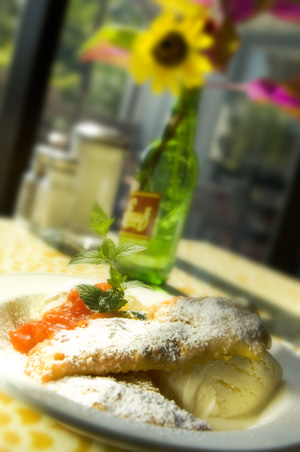
Maybe more than any dish on the menu, the fried fruit pies reflect Stamps' passion for traditional Southern food. Made with whatever fruit is in season, the sculptural presentation arrives with two half-moons of pastry buttressed over a mound of ice cream. The pockets of flaky crust burst with steaming, syrupy fruits or berries. "It's literally my first food memory," says Stamps, who dedicated her cookbook, The New Southern Basics, to her grandmother's housekeeper who made fried pies.
Stamps' latest step toward promoting the Southern culinary vernacular was to invite the James Beard Foundation—an organization charged with preserving the heritage of American cooking—to see Nashville firsthand. The august keepers of food tradition accepted her offer and will arrive Thursday, Sept. 4, for a six-course meal prepared by Stamps and Southern culinary luminaries. Among her guests are former Blackberry Farm chef John Fleer, Mike Lata of FIG in Charleston, Donald Link of Herbsaint in New Orleans, Tandy Wilson of City House and Joe Shaw of The Standard. Proceeds from the event will benefit an oral history project that seeks to record the stories and techniques of traditional regional cuisines.
Meanwhile, Stamps is doing her part locally to keep tradition alive. As if we needed any proof that the Southern legacy of comfort food survives, we saw it plain as day in the dining room at Martha's. Just as one guest was leaving with her jar of spiced peaches, another arrived at the door with a toddler in tow and a baby on her hip. We said hello and chitchatted about our meal, then asked if she was picking up lunch to go. "No, I'm picking up six apricot fried pies," she said, explaining that a family member had just died and she wanted to do something nice for his widow. "She always had fried pies for us, and I wanted to give her that trip down memory lane."
Martha's at the Plantation serves lunch 11 a.m. to 2 p.m. Monday through Friday, brunch from 11 a.m. to 2 p.m. on Saturday and brunch 10 a.m. to 2 p.m. on Sunday. Dinner is served on Thursday, with live music and a limited menu for $25 per person.



