
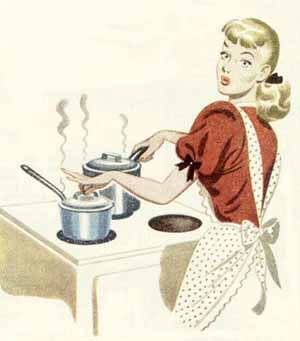
There's a hot convo going on in the blogosphere/online lit mag world about feminism's culpability in the death of the decent meal. If women hadn't trampled the family meal en masse on the way to those high-paying jobs — stopping only to spit on the entire culture of food prep as they grabbed a pack of Virginia Slims on their way out the door — we might not all be porkers too busy double-fisting cheeseburgers to stare down the obesity epidemic. Or something like that. (It's
a writer critiquinga
book review, so the he said/she said gets a bit tedious.) From revered food scribe Michael Pollan's review of Janet Flammang's book ""The Taste of Civilization: Food, Politics, and Civil Society":
In a challenge to second-wave feminists who urged women to get out of the kitchen, Flammang suggests that by denigrating “foodwork”—everything involved in putting meals on the family table—we have unthinkingly wrecked one of the nurseries of democracy: the family meal. It is at “the temporary democracy of the table” that children learn the art of conversation and acquire the habits of civility—sharing, listening, taking turns, navigating differences, arguing without offending—and it is these habits that are lost when we eat alone and on the run.
Umm, OK? I mean, yes, we get it. When women went to work, there was stuff at home they stopped doing. The cult of domesticity was no longer. So shit didn't get done, and, shocker, men didn't exactly rush in and start vacuuming their balls off either. (See the results of
this up-to-the-second study, in which women still do most of the housework and childrearing in households, even where both partners work equally.) Or, as Anna Clark puts it in
her critiqueof Pollan's take on Flammang's book:
My take, as a feminist and local foodie? Blaming feminism for luring women out of the kitchen, stealing the ritual of the family meal, and thereby diminishing "one of the nurseries of democracy" is both simplistic and ridiculous. It's true that shared meals are powerful spaces for building relationships and "the habits of civility." But if we're going to talk about who's to blame for our current culture of processed food, why not blame untold generations of men for not getting into the kitchen, especially given Pollan's characterization of the family meal as having a meaningful role in cultivating democracy? If it's so important, why is their absence excusable?
It's excusable because men are too busy doing something else: Ruling at cooking professionally.



