


I wake up extremely irritable. This was not the case over nearly two decades of childless adulthood, during which I had the luxury of rolling out of bed whenever. But now I have a baby daughter, and when that un-snoozable 20-pound alarum pries me out of bed in the early hours, my foul mood fades slowly, even in the light of her irresistible smile. For a while, I just figured I wasn’t a morning person, either by nature or by dint of DNA that has been altered by years and years of working restaurant hours. Gradually it dawned on me that most mornings, I am in fact suffering from a mild hangover. Well, I have the hangover; my wife and daughter are the ones who suffer.

My hangovers are no longer the stark black-or-white affairs of my 20s. Back then I either got hammered and paid the price, or showed some modest restraint and arose from bed relatively unscathed and ready to seize the late morning. But now I can get away with nothing. Now I pay, and I pay no matter what — a painful morning is no longer a reliable indicator of a forgotten but unforgettable night. To paraphrase writer Tim Kreider, the fun-to-hangover ratio gets out of whack.
I have no one else to blame for my paucity of self-control. Despite flashes of terrible judgment, in my early adult days, I was a college football player capable of micromanaging my desires, vices and urges — if not in the service of academics, then at least in the service of being a more effective 270-pound obstacle. Now, even though I have matured in every appreciable way, my internal martinet is AWOL. I simply want for self-discipline, as evidenced by my morning crucible.
A quote attributed to Winston Churchill suggests that a magnum of Champagne — two regular bottles — is the perfect amount for one. That may have been true for Churchill, but for me that volume would merit a schedule-clearing and a bucket by the bed. Some drinkers cheekily imply that the perfect amount of wine is whatever amount happens to be around, boasting that there’s never any wine left over at their place. Well, there’s rarely any wine left over at my place, but that isn’t a point of pride — that’s the problem.
The ironclad discipline that makes my wife a great half-marathoner also makes her an unreliable weekday drinking partner, so I often go it alone: One night’s bottle usually sits corked on the counter until I put it out of its misery the next. Most of the wines I drink are just fine the next night. Some are even better. But I rarely push them beyond that, so on that second night, I drink with alacrity. Which means that if I only dent the bottle on the first night, I will have a kitchen-counter stare-down with the remaining wine on the second: It’s either you or me. One of us is getting wasted.
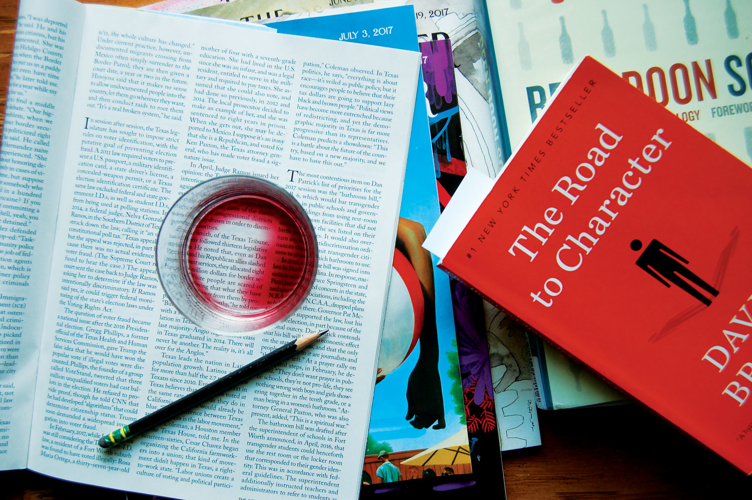
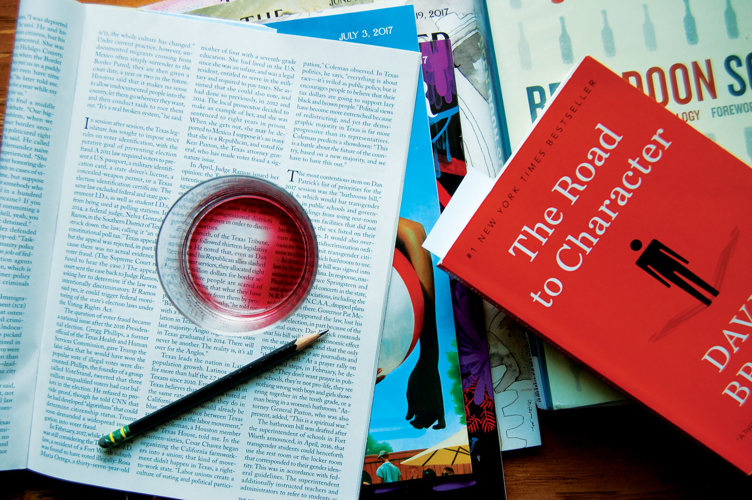
Here’s how silly it gets. When I finally decide to go to bed around 2 a.m., I switch to a stemless glass, which I believe lessens the chances of me spilling on my bedside table and the half-read books and New Yorkers strewn thereupon. Prone and with my head propped up, I read by a battery-powered light, sipping with my chin on my chest as my wife sleeps. Twisting and reaching for the glass on the table is hard work, but I do it anyway, and it counts as my core workout for the day.
When I actually extinguish the light to go to sleep, my stomach contains a consequential amount of unprocessed alcohol, and the glass on the table contains a few ounces more, which I gulp with haste. I fall asleep, and my body goes to work on the wine I have drunk dutifully, sending alcohol coursing, pleasurelessly and pointlessly, through my bloodstream as I lie unconscious. I am asleep for the buzz. I am awake for the brutality.
Currently I am reading The Road to Character, a book by David Brooks that I thought sounded interesting and might help me shore up some gaps in my own virtue. In a chapter about Dwight D. Eisenhower, Brooks mentions that Ike was a four-pack-a-day smoker in his younger days, until one day the career military man quit cold turkey. How did he manage that? Well, according to Ike, he simply gave himself an order. Christ — was this supposed to help me? The story fits snugly into the book’s theme, and I should have known that a book with “Road” in the title would be short on easy prescriptions. But that is about as helpful as a baseball coach telling a pitcher to improve by, you know, just striking everyone out. Once again, this is my fault. I bought a book on character-building when what I guess I wanted were character hacks.
There is one external factor in my plight. There is something I can address that might help me improve my situation without actually improving myself: the tyranny of the 750-milliliter bottle. The ideal size for two at dinner is decidedly suboptimal for the man who tends to crack one open at midnight on an empty stomach. Half-bottles are better, but the pathetic selection available makes them an unsuitable substitute. Bag-in-box wines allow for maximum freshness over months and months, but are best suited for what critic Robert Parker calls “uncritical quaffing.”
Well, it’s the quaffing that got me here, where I drink every drop and go down with the bottle, knowing that tonight’s leftovers might be tomorrow’s vinegar. But this has got to change. I want to go to the basement and choose what I feel like drinking, not what I don’t mind wasting. I want to crack a bottle without committing to the entire bottle. I want to sip, savor and contemplate one decent glass — maybe even one excellent glass — and not feel pressured to euthanize the entire thing.
Most of all, I want to know: Is this too much to ask?
Email arts@nashvillescene.com



Post a comment as anonymous
Report
Watch this discussion.
(0) comments
Welcome to the discussion.
Log In
Welcome to the discussion.
Keep it clean. Please avoid obscene, vulgar, lewd, racist or otherwise abusive language. Comments featuring hate speech or threatening or violent content will not be tolerated.
PLEASE TURN OFF YOUR CAPS LOCK.
Be truthful. Don't knowingly lie or mislead.
Be proactive. Use the “report” link on any comment that violates our comment policy.
Share with us. We'd love to hear your feedback.