
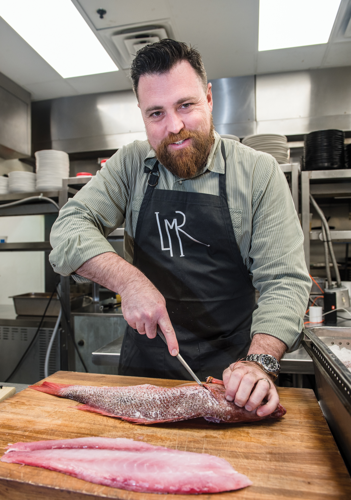


Matt Bolus at The 404 Kitchen
You wouldn’t describe chef Matt Bolus of The 404 Kitchen as lacking in confidence. Eight years ago he came to Nashville to take over the kitchen at Watermark, and his first day in town he headed straight to the Country Music Hall of Fame to show off his culinary chops as a competitor in the Scene’s annual Iron Fork event. While he didn’t win that evening, it was immediately apparent that the East Tennessee native would be bringing an ambitious new energy to the local dining scene. After a short stint at Watermark, Bolus moved on to helm the kitchen at Flyte before opening The 404 Kitchen with business partners Howard Greenstone and Ken Levitan. After operating out of the tiny kitchen in 404 to great acclaim, Bolus made the leap across the street, reopening the restaurant in the expansive former home of his first Nashville employer, Watermark. It was a bold move that paid off.
“Chefs have an inherent attitude to jump off a cliff before you know what’s at the bottom,” Bolus explains. His latest leap is a venture with his backers to take over operations at the former Fin & Pearl, just a short walk from 404, at 211 12th Ave. S. in the Gulch. The restaurant opened in 2016 with intentions of invigorating the seafood offerings in Nashville while concentrating on sustainably sourced fish primarily from the Gulf of Mexico, and maintaining green restaurant practices in their operations. While that concept was appreciated, diners never quite bit when it came to the higher prices associated with Fin & Pearl’s philosophy. The investment group headed by Tom Morales backed out after a little more than two years, leaving a shell for Bolus and his group to inhabit. They’re currently in transition now, with hopes to enact all their changes by the end of March.
Why does Bolus think he’s the one to revitalize the spot, the way he did with the former Watermark space? “Stupidity!” he jokes. But the chef actually has a culinary background that dovetails nicely with the concept of a seafood-centric restaurant.
“One of my first jobs was interning in London for John Blagden Fishmongers in 2002-03,” he says. “Then I worked as a sous chef in The Ocean Room at The Sanctuary Hotel in Kiawah Island [S.C.], where the dining room literally opened up to a view of the Atlantic Ocean.” He went on to join the kitchen at FIG in Charleston, S.C., the acclaimed flagship restaurant of James Beard Award-winning chef Mike Lata.
“Charleston is a great place to learn about seafood and fishing practices,” says Bolus. “I fell in love with seafood working in London, and I’ve always been the person in charge of purchasing, butchering and portioning the fish wherever I’ve worked. I was Lata’s fish butcher, and we used to get fish in and slice it really thin to taste it fresh, to figure out whether to serve it as a crudo or fry it as part of an entrée. Mike was always looking for new ways to cook fish, and ever since, I’ve been dreaming of opening up a true seafood restaurant. This is kind of a dream come true.”
Bolus learned more than just fish-cooking techniques during his years in Charleston. He also gained a passion for the sea.
“It’s super intoxicating in a great way when you’re in that environment. You can tell if there have been oil spills or storms just by looking at the size and tasting things. It’ll tell you the health of the ocean.”
The new ownership has taken over Fin & Pearl without having to shut down operations, but they still might take a few days off to change the interior and retrain the staff. Currently, Fin & Pearl is operating under an interim menu. “I don’t feel like it’s ours yet,” says Bolus. “We haven’t put our twists on it yet, but there’s never a right time to make a big change like this. It’s like having a baby. If you wait for the perfect time to do it, you never will.”
Among the changes that the chef has in mind is a new name, but the team hasn’t settled on one yet. Bolus is still a proponent of sourcing sustainable seafood, but he has a vastly different attitude than the former management of his new space. “They were unfortunately unsustainable in their sustainable practices,” he says. “Guests walked into what felt like a casual atmosphere and walked out with a fine-dining bill. You can’t always buy the perfect everything, the same way that some people are sustainable by buying a Nissan Leaf while others drive a Tesla. Maybe everybody can’t spend $45-per-pound on fish. Instead you can offer something like sheepshead, an amazing fish that’s affordable and sustainable.”
Bolus’ background as a fishmonger should also be a great asset to the new restaurant. “You have to buy smart,” he explains. “When looking at a fish, you have to decide how to buy it. Amberjack is a perfect example. You can pay $11.99 for fillets or buy the whole fish for $4.99 a pound, and then break it down and figure out ways to use the carcass. I’ll buy whole halibuts and use the bones for stock. We’ll cut down on the number of oyster selections. It’s expensive to stock nine varieties. Fin & Pearl’s inventory costs were huge, more than twice what we run at 404. Mainly, it will be about what’s delicious, and part of sustainability is staying in business.”
His grand vision for the new restaurant is “like a steakhouse with fish.” He’ll offer a menu of starters and shareable sides, plus “a couple of obligatory land-animal options.” Bolus is particularly excited about a steak dish that will offer a Pacific twist: “I want to do a cool Hawaiian-style ribeye. It’s going to be sweet and delicious and charred on the outside.” He’s also dreaming about one particular side dish he’s designing. “I’m obsessed with this lobster mac-and-cheese. I’ll cook the pasta in lobster stock and also use the stock to make the bechamel. Why not? You’ve never had anything like this before!”
Another big change will be moving away from Fin & Pearl’s focus on strictly Gulf seafood. “Don’t get me wrong,” he cautions. “I love Gulf seafood, but I also love Carolina coastal halibut and salmon from the Pacific Northwest and Pacific moonfish and abalone. I don’t want to be limited. Nashville doesn’t have a coastline, so we can serve whatever we want. I want to pick up monkfish that are sweet as candy.” Bolus has spent years eating out in places like New York City and Boston and talking to chefs about where they get their fish. “If I’m lucky, they tell me.”
It seems like FedEx has become the primary fish market for many great restaurants. “The question of how to get fresh fish is moot,” says Bolus. “We can get fish that is less than a day out of the water via FedEx, or there’s the option of fish that has been blast-frozen at sea immediately after being caught. It’s like people that go crazy for fresh English peas. In actuality, English pea season is like two weeks long, so they’re frozen in the fields. Arguably those are better than fresh peas that are a week old by the time they get to your restaurant, and many fish can be better if they’re frozen at sea. That king crab you’re eating? Unless it’s alive, it ain’t fresh!”
Bolus has a vision for his restaurant to change the way Nashville eats: “I want it to be sort of a choose-your-adventure thing. I want to see people in the dining room drinking Champagne and eating oysters. I want to serve a lunch dish of grilled mackerel over raw greens with a tangy vinaigrette. The oily fish right off the plancha will wilt the greens like a seafood kilt salad that will leave you satiated and your body feeling good instead of wanting to take a nap after eating a 14-ounce steak for lunch.”
“We want it to be fun like a sexy steakhouse, darker with more art on the walls and less neon. We’re thinking more purposeful and less whimsical,” Bolus adds. “We get to be artistic as chefs, and you get to be delighted as customers.”



