
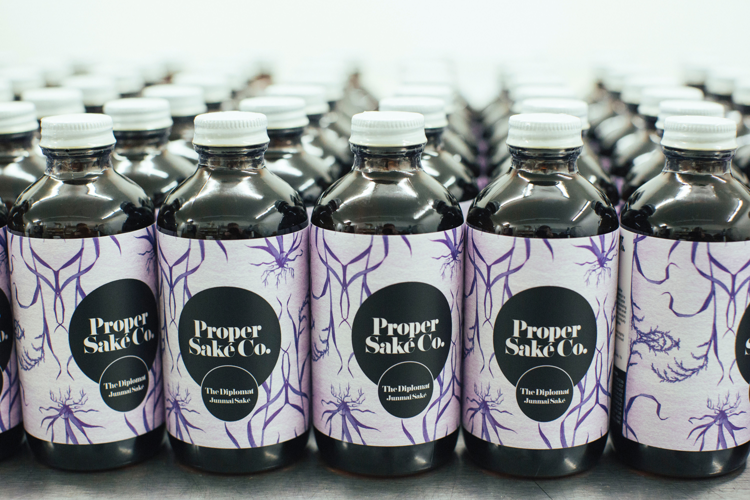



Something is brewing in Nashville and its surrounding environs. While there’s no doubt that craft beer culture is booming thanks to the two-dozen-plus breweries operating in Middle Tennessee, malted barley isn’t the only thing fermenting in stainless-steel tanks. Local entrepreneurs have begun to produce more exotic products, such as premium sakes, artisan ciders and honey-based mead. Stretch your palate while staying local with these innovative brewing operations:

Byron Stithem of Proper Sake
Proper Saké Co.
628 Ewing Ave.
If your only experience with sake is the cheap rice wine served hot in a tiny vase as you await the next raft of California rolls, there’s a big surprise for you in Nashville’s Pie Town neighborhood. While lesser-quality sakes do benefit from being heated to mask their less-than-refined character, the good stuff should be treated more like a fine wine, served slightly chilled, just below room temperature to enhance the subtle nuances and delicate fragrances introduced by the brewing process.
At Proper Saké, brewmaster Byron Stithem makes only the good stuff. He’s spent most of a decade studying the science and art of fermentation, working in various culinary jobs — including culinary director of Dinner Lab — and at notable restaurants and bars including Husk Nashville and Clover Club in Brooklyn. It was while he was living in New York that the sake bug bit him hard. “I was surrounded by all this great sake and immersed in the culture,” says Stithem. “I decided I wanted to bring it back to Nashville.”
Stithem also recognized that sake could be a way to set himself apart from all the breweries in town, but it is by no means an easy road to success. Working primarily by himself in the small warehouse space behind Proper Saké’s modern Zen-inspired tasting room, Stithem spends five to six days producing each 100-gallon batch of his three flagship products.
“During the first 48 hours of the brewing process,” he explains, “there’s something required to do every two or three hours to keep the yeast propagating and to maintain the proper temperature.”
Proper Saké is made using four main ingredients. Stithem purchases sake-grade rice that is grown in Arkansas and milled in Minnesota, and he cooks it using traditional Japanese methods in bamboo steamers over propane heat. He then mixes the rice with special yeasts, hyper-soft water treated to mimic the well water of the noted center of fine Japanese sake in Nishinomiya, and the most critical ingredient: koji.
Koji is a mold that acts as a super enzyme to encourage fermentation in products like sake, soy sauce and miso paste. Stithem acquires special spores from Japan that he uses to inoculate the steamed rice, koji’s favorite food. The efficiency with which koji converts starch to alcohol is the reason why sake can reach an alcohol-by-volume level of 18 to 20 percent. That’s higher than any beer or wine product can achieve without distillation.
Stithem makes progressively larger additions of rice, water, yeast and koji until he completes a batch, which is then bottled or transferred into kegs. In addition to being available in the tasting room, Proper Saké products are also distributed to restaurants like Husk, TKO, Bastion, Butcher & Bee and Sinema, as well as to select retail establishments. Proper Saké’s flagship brand is Diplomat, a delicate drink that exhibits lovely round tropical notes of coconut and vanilla. A cloudy unfiltered version of Diplomat is also available, made with the same recipe as its clearer cousin but with added texture and complexity from the elements that are left in the final product. Stithem’s third offering is Grand Parlay, made using a strain of saison yeast instead of the traditional sake yeast. A complex beverage that occupies the Venn diagram intersection between sake, white wine and a farmhouse ale, Grand Parlay is a truly unique product.
Diskin Cider
1235 Martin St.
As if Wedgewood-Houston wasn’t hip enough — with its new bars, breweries, restaurants and distilleries popping up all over in the past couple years — they are about to be home to Nashville’s first craft cider maker. While cider isn’t as exotic as sake, it is probably at least equally misunderstood. In Europe and apple-growing regions like New York or the Pacific Northwest, cider drinkers are used to craftier products made in small batches that exhibit complex flavors and appropriately dry characteristics. The rest of us grew up on ciders from huge production facilities that ferment reconstituted apple juice concentrate sweetened with corn syrup.
Diskin founders Adam Diskin and Todd Evans had been fans of fine cider for years, and Diskin grew up in apple-centric Washington state. After years of success in other industries, the pair of friends decided to start up a passion project. “We made some really bad cider at first,” says Diskin. “We bought some lousy apples and didn’t have good control of our internal processes.” They knew they would have to acquire proper training.
The pair attended a cider school (yes, that’s a thing) taught by noted British expert Peter Mitchell. After the intensive training, Diskin and Evans knew they were ready to venture out, and they consulted with Mitchell to design the ideal production facility. In the meantime while they were building out their cidery, the duo continued to study the culture of cider and think about exactly what sorts of beverages they wanted to produce.
“Cider was a colonial drink, long before beer,” says Diskin. “That’s what Johnny Appleseed was spreading, cider apple trees. Until the Prohibitionists plowed under the orchards, cider was among the most popular drinks in the country.”
Ultimately, cider is a regional product, and not every part of the country has access to the best varieties of apples to make it. Even if a grower planted an orchard today, it would be at least seven years before those trees produced their first fruit. With this in mind, Diskin Cider sought out apples from premier growing areas in Michigan, Washington and Pennsylvania. For freshness, the apples are pressed and fermented at the orchard and shipped by the truckload to Tennessee.
Once the Diskin cidery opens for production in May, it will receive these fresh-pressed juices and completely eschew the use of concentrates. Their brewhouse will employ three 3,200-gallon fermenters and two 2,000-gallon bright tanks for blending and carbonating their ciders after fermentation has finished. Production will take about two weeks including time in both tanks, filtration and packaging in bottles or cans. All canned products will also go through the extra step of pasteurization.
The attractive tasting room and cidery is located in a former truck repair shop. Diskin and Evans intentionally chose to remodel instead of building from scratch to help preserve the integrity of the neighborhood. “We’re ecstatic to be the first at something in Nashville,” says Diskin. “It’s hard to do that anymore! We recognize that we’ll have to educate our customers about cider, but that’s why we’re building out the tasting room to be so approachable.”
The taproom will feature eight or nine Diskin products, along with a handful of local beers and a selection of local spirits to make cider-based cocktails. The cidery has already earned acclaim for four products that are available in bars and retail stores around town. The most popular is Lil’ Blondie, Diskin’s first product made for cider newcomers. Crisp and slightly sweet, Lil’ Blondie weighs in at 5.6 percent ABV, similar to a craft beer. Bob’s Your Uncle is a more traditional English-style dry cider, with a higher alcohol level and a more tannic character that makes it popular with fans of IPAs and dry white wines. Sweeter options include Tiki Tonic, a “pool pounder” perfect for hot weather thanks to the addition of pineapple juice and a hint of lime, as well as Six One Five, Diskin’s homage to fruit tea that combines apple cider with pineapple, orange, lemon and real Southern sweet tea.
Trazo Meadery
3824 Trough Springs Road, Adams, Tenn.
Adams, Tenn., is best known as the home of the Bell Witch, but now there’s something less diabolical than “Old Kate” coming out of the small town about an hour north of Nashville. Mead is one of the world’s most ancient alcoholic beverages, made using basically only honey, water and yeast. While some other meaderies add flavors like fruits, grains and spices to their products, the folks at Trazo prefer to let the essence of the honey shine through.
David Powell is the head mead maker (or “mazer”) at Trazo, and he explains this choice: “The way we do it, the only variation in flavor comes from the variety of honey, depending on what time of year it is, what flowers the bees have been pollinating and where it comes from. It shows through in the color and the flavor, and you can really tell the difference between the avocado mead we make with honey from Mexico and other varieties like mesquite, buckwheat and wildflowers.”
Powell got into the buzz biz when his son Travis started beekeeping with his grandfather at age 9. Always an entrepreneur, even at a young age, Travis began to sell lip balm made from his beeswax under the Bee Boy brand. When Travis went off to college, his father took over the care of the bees. “Trying to get 10 hives through the winter took a lot of work and a lot of trial and error,” says David Powell. “The Williamson County Beekeeping Society basically kept me from killing them.”
After graduating, Travis looked for another way to monetize his hobby with his father. The two discovered that mead was a completely open market in a region already crowded with craft beers, wines and ciders. Because mead is not grain-based, Tennessee considers it a wine for regulatory purposes, and the Powells had to acquire a wine license. Taking advantage of the fresh limestone well water up the road from the Powell farm, which has been in the family since 1935, the Powells started up Trazo Meadery, named after Travis and his grandmother Zo.
Grandma Zo contributed more than just her name; she also pitched in the yeast of her 50-year-old sourdough bread starter, which has been maintained for three generations. Travis and his dad combine the starter with a more traditional mead yeast, along with honey and water in 250-gallon totes to begin the fermentation process. Since honey isn’t the most efficient food for yeast, the process can take as long as nine months to fully convert the sugars to alcohol. Honey is also much more expensive than grapes, so making mead is not a cheap undertaking.
But the result is a true expression of season and place, barely filtered and light on the tongue. Depending on the variety, Trazo mead can vary from sweet to dry, but Zo’s sourdough starter is always detectable in the character. Sold in 750-milliliter bottles and at an ABV around 14 percent, Trazo meads are similar to wine and pair similarly with food, particularly roasty meats — whatever a Viking might have eaten while he drank mead out of a horn.
Trazo meads are available directly to the consumer through the company’s website or at an expanding roster of fine restaurants around Middle Tennessee. Although most of Trazo’s products are made using honey purchased from other areas to demonstrate a variety of terroir, Trazer also intends to experiment with estate releases from its own hives and barrel-aged versions of their products. Aimed at both wine lovers and craft beer drinkers, mead is a fascinating alternative to those products.
Email arts@nashvillescene.com



