
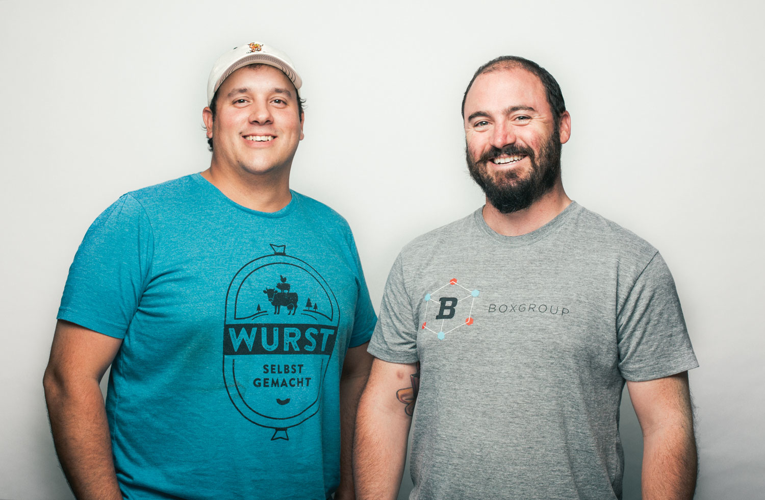


Chris Carter (left) and James Peisker, the founders of Porter Road Butcher
It’s been five years since the Scene put Porter Road Butcher on our cover, and a lot has happened since then to Nashville’s only whole-animal butchers. Launched as an alternative to the factory-raised meat you find in grocery stores, Porter Road has gained a reputation among consumers and restaurants for producing some of the highest-quality meat in the region. We sat down with co-owners and founders Chris Carter and James Peisker for a look at the meat business here in Nashville. Excerpts appear below, but you can hear the full interview on our podcast, available here or on iTunes, SoundCloud and Stitcher.
What have you learned in the past five years?
Peisker: I think we’ve learned a lot of things over the past five years — some good, some bad, some ugly. I think pushing forward, [one] of the most important things that we have learned along the way is perseverance usually wins out. Chris and I have spent many long days, many long weeks, trying to make sure that we are bringing the best product we possibly can to our loving community here in Nashville.
Carter: We have learned a lot. We have, like you said, expanded and contracted a little bit, ups and downs, learning to work with employees and people and ... just being busy and not being busy and learning to not only persevere, but pivot as much as needed. If something’s not working, fix it and find a way to make it work.
Peisker: Business is definitely not a straight path. You have an idea that you want to do, and luckily, every pivot Chris and I have made and every bump along the way and every turn, we have definitely learned from. And we’ve grown, we’ve contracted. We purchased a slaughterhouse. By doing everything we’ve done, we’ve tried to just take care of our customers and our friends and our community as best we could, and I feel like five years later, we have a better product. We have a more standard product, and we’re able to supply our customers with more of what they want. … And I don’t feel like I’m drowning every day any more.
When most Nashvillians go into a grocery store to buy meat — and we’ll just say beef for example here — what don’t they understand about what they’re buying?
Peisker: I think the biggest thing they don’t understand is where that meat comes from and how it actually is truly raised. I like to say there’s a curtain put up in front of us, between us and our food supply, because what other companies try to do, where larger firms actually don’t want you to see anything. There are states out there that have "ag-gag" rules, that are laws that you cannot take pictures, you cannot take video of these people’s farms. Why would you need a law that says you can’t take a picture of a farm? You’re obviously doing something that you’re wanting to hide.
Carter: We try to be as transparent as possible.
Peisker: Absolutely. So with that, they’re hiding something from there because it’s not a good product. It’s not something that they would stand behind and show and scream out on the mountaintops. That’s what we do at Porter Road Butcher and the products they buy at the shop. You know, I don’t want to encompass all of them, because there are good companies out there and there are people who are actually trying to do good, but just because you see a buzzword on the label doesn’t necessarily means it’s so.
USDA Prime, USDA Choice?
Carter: Prime’s grading. Now they’ve even dropped [that] because they can’t hit the grading scale of Prime. Now they’re actually selling themselves as “USDA-inspected” meat. [Laughs]
Peisker: Which is all meat across the country. Legally, you have to be USDA-inspected.
Carter: We like to refer to meat in the supermarket as faceless meat. Basically, there’s no story behind it. You have no clue where it came from. ... You could pick any piece of meat in our case and we could tell you exactly where it came from, introduce you to the farmer, tell you where their farm is, and the farmer would greet you with open arms, because they’re very proud of what they do. You just have to have a very open schedule, because they will take up your entire day because they are so proud.
Peisker: One of the big things, too — the reason [other meat providers are] hiding this, and the reason why it’s what you’re getting at the grocery store — it’s all about money, and it’s all about profit. I’m not saying that Porter Road Butcher is not a for-profit company, but it’s not our No. 1 drive. It’s about creating the community, it’s about creating a family and giving people the best product possible. Along the five years of us being open, there are many ways we could have figured out how to actually become rich off of this, and we never cut a corner.
Carter: None of them are ethical.
Peisker: It’s always about making sure that the farmer is taken care of, making sure that the animal is taken care of, and making sure that the customer is taken care of.
Carter: You’ve seen our entire process many times.
You’re in an industry in which anything that’s food-related, there’s cost pressures, and they’re very real, and they’re very immediate. It’s not like you’re making 30, 40, 50 percent on what you’re doing. Restaurant margins are anywhere from 3 to 15 percent, 15 percent if they’re doing really well. What are you pressured to do?
Carter: One of them would be our farmer Joey Rittenberry that has given us a very long hour in order to pay him back in times when we couldn’t.
Peisker: Developing relationships, there was always an easy way out, and an easy way out was to be unethical and do something that wasn’t right. But I would rather look at a person in their eyes and tell them I don’t have a tenderloin, and they tell me that I’m a stupid person and a bad business owner because I don’t have a tenderloin for them.
Carter: I can’t just buy boxes of tenderloin, that’s not our business model.
Peisker: That’s not what we do, and that’s not the way to help the agriculture industry around Middle Tennessee and Kentucky. It’s not the way to help save family farms. What we’re doing, everything has a reason behind it, even the size of our hot dog, there’s a reason behind it, and it’s because it’s two inches longer than the bun. Your first bite and your last bite will always be just hot dog.
That’s great. I applaud that. More meat on my hot dog.
Peisker: Everything behind it. ... You could go buy a box of tenderloins and nobody would probably be the wiser.
Carter: Some people would be very excited because we would always have tenderloins, but a lot of people get what we’re doing and understand and embrace the fact that we don’t have tenderloins because of the fact that there’s two tenderloins per animal.
Peisker: And the people that get it, get it. The people who want to be a part of it and want to be involved and spend the extra dollar, spend the extra money, they’re the people that we know and love and see every week. People that want it for a special occasion, come on in. It’s going to be the most delicious steak you’ve ever had, I guarantee it.



