
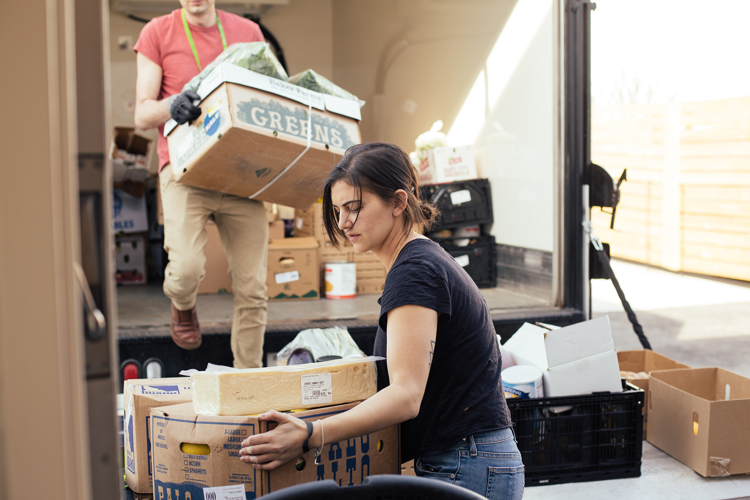


The Nashville Food Project unloads donated food from Tin Angel last month
When Rick and Vicki Bolsom decided to retire and close their 26-year-old West End restaurant Tin Angel, it was bittersweet. Locals were devastated. The Bolsoms have been part of Nashville dining life for a generation. Before Tin Angel they owned the Cakewalk Cafe, where they hired Deb Paquette, who in turn went on to open Etc. and Etch, and changed the way Nashville dined out.
But thanks to The Nashville Food Project and efforts to redirect Nashville’s food waste, the food at Tin Angel served the city beyond the restaurant’s March 23 closing date. When Tin Angel closed, the nonprofit picked up produce, spices and raisins, even a few nonperishables including aluminum foil and aprons left in the kitchen.
According to The Nashville Food Project, as many as 1 in 6 Nashvillians may lack access to healthy food. The organization makes from-scratch meals to feed those in need by partnering with other nonprofits. Partners who receive some of the more-than-5,500 meals made weekly include Green Street Sanctuary and Project Return. Some of the partners formerly ordered pizza or other quick eats to feed their clients, but working with The Nashville Food Project allows them to serve healthy, made-from-scratch food.
“What our partners say is, ‘This is so much better — this is made with love,’ ” says Tallu Schuyler Quinn, executive director of The Nashville Food Project. “There is this stigma around food that poor people eat. But we are so proud of the quality food we create.”
From Tin Angel, The Nashville Food Project collected 1,264 pounds of food, a sizable donation, filling about one-half of the refrigerated truck it used to pick up the goods. The nonprofit scheduled a special pickup, not on its regular route to grocery stores and other businesses, to work with Tin Angel’s schedule.

Food from Tin Angel is sorted at the Nashville Food Project
Rescued foods are weighed and sorted when they arrive at The Nashville Food Project, where items are prioritized according to what needs to be used first (perishables before canned goods, for example). Then volunteers arrive to prep vegetables while another set of volunteers batch-cooks meals that are then transported to the partner organizations.
While he is passionate about reducing food waste, Rick Bolsom says his restaurant didn’t donate a lot of food to shelters and facilities like The Nashville Food Project while it was in business. He says that’s because Tin Angel ran a tight ship with little excess, and because there are logistical barriers to making such donations.
Small independent restaurants doing from-scratch cooking, like Tin Angel, have to be incredibly efficient with their ingredients, Bolsom explains. They’ll often use ingredients in an appetizer, and then a soup, and then in a daily special, and maybe when there are enough ingredients for just two or three servings remaining, they’ll be cooked up for a staff meal. Also, small restaurants have limited storage space to keep donations at proper temperatures and are unlikely to have the staff to drop off donations or a refrigerated truck to make the process happen safely. What’s more, donations typically become available late at night, after a restaurant closes — not when organizations are typically open to receive.
“What used to be hard was on Saturday night at 11 p.m. when we would we get a text from a caterer who does not have a place to take that food to hold at temp until we can pick it up,” Quinn says. “People are good, people want to do the best they can. But logistics can be an issue.”
The Nashville Food Project moved into a new building in the Nations in January that better allows the nonprofit to accept rescued food, with features such as doorways big enough to accommodate a pallet and a door with keypad access to one of the walk-in refrigerators. As a result, the organization can participate in a pilot program with Postmates, the delivery service fueled by locals driving their own vehicles.
As Quinn points out, it’s not necessarily cost-effective for a group like hers to send a truck and a driver across town to pick up a small quantity of meat or fish. But Postmates’ drivers can — it’s literally their job, after all. So as part of what is now a four-city pilot, restaurants let drivers know through the Postmates app when they have small donations to deliver. Drivers pick up the food and drop it off at designated sites, including The Nashville Food Project, within a 5-kilometer radius.
Disney Petit is head of Civic Labs for Postmates. She says Nashville is the only city in Postmates’ FoodFight! pilot to have two facilities approved for accepting donations (The Nashville Food Project and Safe Harbor of Nashville). Thanks to the keypad with access to The Nashville Food Project’s refrigerator, drivers can drop off food late at night when no one is on staff, placing the donation on designated shelves where the staff can evaluate it in the morning. Petit says any nondiscriminatory shelter with the ability to accept food donations around the clock is welcome to join Postmates’ program. (The public is encouraged to submit suggestions to FoodFight@postmates.com.)
Drivers are paid by Postmates to pick up donated food, and there is currently no charge to restaurants to donate, although Petit says a $10-per-restaurant charge has been discussed. The pilot was designed to be one-touch so it’s easy for restaurants to use, but future versions will have a drop-down menu to enter quantity. That way Postmates can keep track of the amount of food being rescued.
“We designed this drop-off system so that when any after-hours donation comes up, we can now accommodate it,” says Quinn. “That has really worked out.”
The Nashville Food Project has rescued food from a number of restaurant closings. When Bread & Co. on West End closed in mid-December, the organization reclaimed unused oils, vinegars, bags of flour and sugar, and chocolate chips. When Inglewood’s Fort Louise closed in January, The Nashville Food Project welcomed its exotic produce, pantry goods, frozen meats, cheeses and canned goods, as it did when Germantown Depot closed 10 days later. Such donations come not just when a restaurant shuts down permanently, but when it closes temporarily for a remodel — or even when a business overhauls a menu with a new chef or season change, resulting in excess ingredients.
While it varies depending on time of year, about one-third of The Nashville Food Project’s meal ingredients comes from donations from caterers, hotels and restaurants; one-third comes from what is grown in the organization’s gardens; and the final third is purchased, often from local farms. The gardens run by the nonprofit include one at Wedgewood Urban Gardens and one at Mill Ridge Park in Antioch, Metro Parks’ newest facility.
The volume that Tin Angel donated — for which it will receive a receipt for tax purposes — was larger than Bolsom thought it might be. But he concedes that the kitchen ordered ingredients until the last minute, because there were so many dinner reservations — that includes Quinn, who ate at Tin Angel on its last night.
“We were hugely busy at the end, so we were ordering more than usual,” says Bolsom. “We did not want to run out. And you cannot order half a case of lettuce, so we had lettuce left over.”
“It is not just the impact of keeping [the rescued food] out of the landfill, although there is enormous environmental impact,” Quinn says. “We despise waste: waste of time, waste of food, waste of people. When you pair donated food with donated labor, you are able to do something really beautiful in the community.”



Post a comment as anonymous
Report
Watch this discussion.
(0) comments
Welcome to the discussion.
Log In
Welcome to the discussion.
Keep it clean. Please avoid obscene, vulgar, lewd, racist or otherwise abusive language. Comments featuring hate speech or threatening or violent content will not be tolerated.
PLEASE TURN OFF YOUR CAPS LOCK.
Be truthful. Don't knowingly lie or mislead.
Be proactive. Use the “report” link on any comment that violates our comment policy.
Share with us. We'd love to hear your feedback.