

When Kaitlin Zurdosky’s friends came to town for a bachelorette party, they had leftover food in their Airbnb at the end of their trip. They didn’t want it to go to waste, so they asked Zurdosky, who lives in Nashville, if she wanted to take it.
She didn’t need it, but she didn’t want it to be tossed, so she took it. Zurdosky knew there were people in town who needed nonperishable food more than she did, and she realized that if her friends had unopened snacks, other people staying at Airbnbs probably did too. She couldn’t stop thinking about how many bachelorette party groups must leave piles of snacks untouched when they go home.
“People come to Nashville to celebrate, and they don’t want people to go hungry,” Zurdosky says. “So they overestimate how much they need, and then there is lots of uneaten food.”
Last year Zurdosky launched Bach Bank, a nonprofit that helps connect visitors with food banks that distribute food to people in need. She funds the project with small public donations and a few small grants.
Food waste is a huge problem in the U.S. The Natural Resources Defense Council estimates as much as 40 percent of food in our country goes uneaten. While Metro Nashville and other groups have been addressing food waste for years, more help is needed.
“What Kaitlin did was really inspiring,” says Jack Stell, manager of community partnerships at Second Harvest Food Bank of Middle Tennessee, one of the organizations that accepts donations from Bach Bank. “You don’t see people very often who say, ‘I am going to solve this,’ and then stick with it.”
Second Harvest is a large organization that accepts millions of pounds of food annually. Stell says it’s not efficient for the group to send a truck to pick up donations of less than 800 pounds. So while Second Harvest was aware that there’s food to rescue from tourists, logistically, they didn’t have a way to get it. Public food donations are accepted at the warehouse on Great Circle Road (as well as in Smyrna and Camden, Tenn.), but Zurdosky points out that many visitors don’t have cars when they visit — or the time or the will to Uber to the warehouse to drop off a donation before they leave town. Also, donations at Second Harvest are accepted only Monday through Friday, and many donations to Bach Bank come in on weekends.

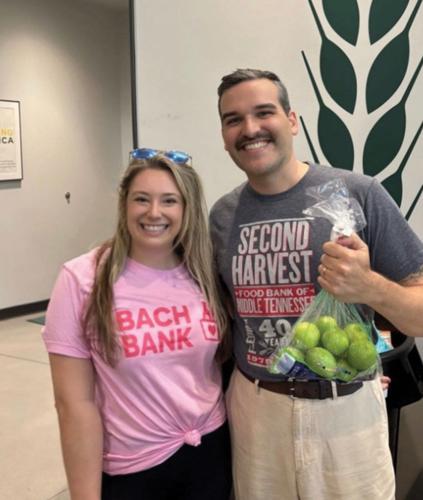
Kaitlin Zurdosky and Jack Stell
Originally, Zurdosky anticipated most of the donations would be on Sundays — but in practice, she says, people arrive and leave all week, and Bach Bank is active in picking up food on weekdays too.
Zurdosky organized Bach Bank on a volunteer network. Those staying in short-term rentals and hotels with extra food (and drink) fill out a web form that alerts volunteers to come pick it up. They then drop it at one of the shelters and food banks with which Bach Bank partners. As is the case with Second Harvest, many have regular donation drop-offs that volunteers use. Bach Bank doesn’t have its own warehouse or physical space yet; donations go from the porch of an Airbnb to a volunteer’s car trunk to the food bank. So far, Zurdosky tells the Scene, Bach Bank has rescued 2,000 pounds of food.
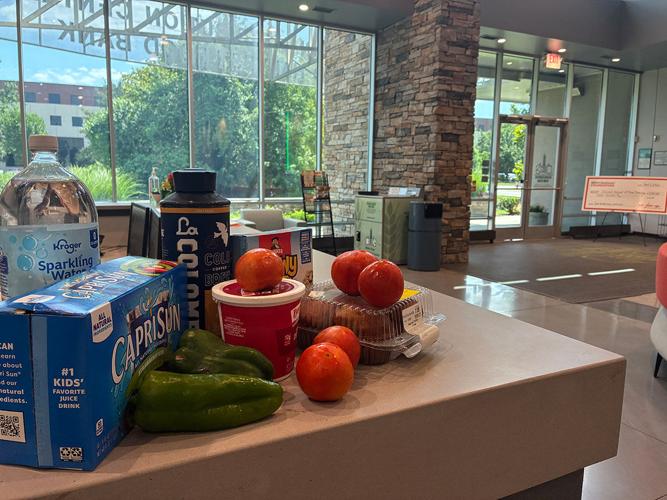
Bach Bank generally accepts unopened, nonperishable foods, including bottled water, chips, pasta and snacks. They can also take perishable and frozen foods on ice and will even take alcohol, which is given to other nonprofits to use for fundraising events. The most frequently rescued food item? Limes. “People buy a lot of limes for margaritas,” Zurdosky says.
Indeed, Stell says when he sees several bottles of margarita mix in the donation sorting room, he thinks, “Kaitlin was here.”
Zurdosky has partnered with some short-term rental groups to have bags and information about Bach Bank in their spaces so people know they have an option besides letting food go to waste. Visitors can place the food in the bags on the porch; the bags are then returned inside for the next renters.
In addition to running Bach Bank, Zurdosky has a full-time job in political communications and a background in technology. She’s currently designing an app that will streamline the process for tourists to schedule a pickup and for volunteers to see where they’re needed. The app could also help tourists see which organizations received their goods. She hopes Bach Bank will be her career in the future — it’s the first nonprofit organization she launched, and she’s learned as it has grown. Zurdosky received the Tallu Quinn Serving Spoon Award from the Phila Awards — an annual culinary community awards group — in her first year in the industry.
Zurdosky thinks an app will not only streamline donations, but also help her expand Bach Bank to other cities. She’s scoping out communities with large tourist draws, lots of short-term rentals and a population that can use food donations. Las Vegas is first up for expansion, partly because of demographics and partly because she has been spending time there. (Her boyfriend lives there.)
“It’s the perfect marriage of people who are in need and people who want to help,” Zurdosky says of the Bach Bank model. “It’s the coolest thing.”



Post a comment as anonymous
Report
Watch this discussion.
(0) comments
Welcome to the discussion.
Log In
Welcome to the discussion.
Keep it clean. Please avoid obscene, vulgar, lewd, racist or otherwise abusive language. Comments featuring hate speech or threatening or violent content will not be tolerated.
PLEASE TURN OFF YOUR CAPS LOCK.
Be truthful. Don't knowingly lie or mislead.
Be proactive. Use the “report” link on any comment that violates our comment policy.
Share with us. We'd love to hear your feedback.