
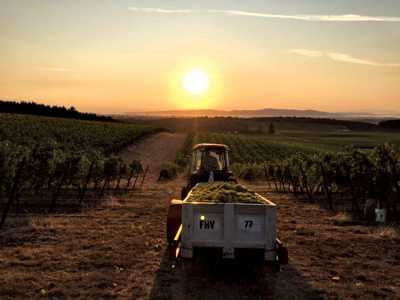

Freedom Hill Vineyard in Willamette Valley
Oregon is both a minor and major wine state: It produces a mere 1 percent of the wine made in the United States, but that tiny percentage is good enough for fourth-highest production in the nation, after California, Washington and New York.
Three-quarters of Oregon’s 750 wineries are located in the Willamette Valley, which stretches 120 miles, from Portland in the north to Eugene in the south, and is limited on its east and west sides by the Cascade and Oregon Coast mountain ranges. Since David Lett of The Eyrie Vineyards planted the first pinot noir vines there in 1965, the Willamette Valley has earned a reputation as one of the top pinot noir-producing regions in the States. Its cool and cloudy climate is unique on the West Coast, and offers much milder growing conditions than those of dusty Napa, dry and sunny (really) Washington, and warmer Southern Oregon.
The four wines below are an excellent introduction to Oregon’s Willamette Valley.
2015 Beaux Frères Willamette Valley pinot noir — $69.99, Midtown Corkdorks
One could argue whether or not Beaux Frères is one of the most famous wineries in Oregon, but there’s no disputing the fame of its founder, wine critic Robert Parker Jr., who purchased an 88-acre pig farm in Yamhill County with Mike Etzel, his brother-in-law (beau frère in French). They planted their first vines on the property in 1988, and in 1990 harvested their first grapes, most of which they sold to neighboring winemakers. In 1992, they produced what Parker calls their first “real” vintage.
Beaux Frères winery is located in the Ribbon Ridge AVA (American Viticultural Area), which, with only 500 acres planted, is the smallest of the Willamette Valley’s six sub-appellations. While the single-vineyard pinot noirs from the Beaux Frères estate tend to make the biggest critical waves — the 2014 Beaux Frères Vineyard pinot earned the No. 3 spot in Wine Spectator’s 2016 Top 100 — it’s the vineyard’s Willamette Valley pinot noir (sourced from multiple vineyards in the valley) that provides easiest access, in terms of early elegance and relative affordability. Sourced from the Beaux Frères estate as well as from prestigious Willamette vineyards like Zena Crown, Gran Moraine and Guadalupe, the 2015 edition is lush, with tons of ripe strawberries, clove and orange peel, and a bright acidic lift. It’s truly something special, and worth the handsome price.
2014 Benton-Lane Estate Grown Willamette Valley pinot noir — $29.99, Midtown Cork Dorks
“I made some dreadful wines,” Steve Girard says candidly about his first attempts at making pinot noir. He and his wife Carol, after falling in love with the delicate wine, took a stab at producing pinot by trucking the fruit from Oregon to their home in Napa. It didn’t take long for the Girards to realize that to make the pinot they envisioned, they would have to commit. They decided to relocate to Oregon.
From 1982 until 1988, Steve Girard “lived at the library,” researching the perfect location. He’d heard whisperings of something called the “Banana Belt,” a section of the southern Willamette Valley nicknamed a century ago by the prune growers who noticed that the produce there tended to ripen a bit early. He concluded that this particular stretch of land, protected from the brunt of coastal storms by Prairie Peak in the Oregon Coast Range, was ideal for pinot noir. The Girards purchased a sheep farm called Sunnymount in the tiny town of Monroe, bucking the trend of pinot noir producers clustering in the northern part of the valley. They renamed the property Benton-Lane for the two counties that converge there.
The Girards have endured three decades of ribbing from their up-valley friends, but settling in the Banana Belt seems to have paid off: In the past 10 years, no Oregon winery has placed more wines in Wine Spectator’s Top 100 than Benton-Lane.
2017 Swick Wines Only Zuul American Red Wine — $27, Craft Brewed
Don’t get Joe Swick wrong — he loves Oregon pinot noir. He makes Oregon pinot noir. He just isn’t thrilled about how the Willamette Valley has marketed itself as a “monovarietal” region. So he has taken it upon himself to walk a different path, making wines from (and venturing outside the valley for) lower-profile grapes like melon de bourgogne, touriga nacional, mourvèdre, counoise and many varieties that are even more esoteric.
“Wine is natural,” Swick reasons, so he thinks the “natural winemaker” label that has been slapped on him is a little obtuse. But he does prefer to make wines as “naked” as possible, adding minimal sulfur only at bottling (if at all), and aging his wine in steamed acacia and neutral oak barrels, concrete “eggs” and other vessels that don’t impart the invasive coconut and vanilla flavors of toasted oak.
Joe’s Only Zuul American Red Wine may be labeled as a red, but it’s actually a skin-fermented “orange wine,” and it is as aggressively nonconformist as a face tattoo. Vinifying gewürtztraminer and pinot gris for a month on their skins, as if he were making a red wine, has yielded a bright-but-murky pink wine that displays an orange tint, audacious rosewater aroma and a tongue-tingling bit of tannin on the finish. It’s an excellent springtime wine, and an even better conversation piece.
2015 St. Innocent Freedom Hill Vineyard Chardonnay — $26.99, Salt & Vine
According to St. Innocent winemaker Mark Vlossak, winemakers who make chardonnay often tout the interventionist techniques they use on their chardonnay: They add special yeast strains, stir the lees and follow a careful oak-aging regimen. “In the old days, I actually did a lot of those things,” Vlossak says. “But I found that the more that I did, I lost what was interesting in the wine. So the way we make it now is to do almost nothing.”
What does almost nothing entail? Vlossak and his team pick the grapes by hand, slowly press them as whole clusters, and then “just put the juice in barrels.” Very old barrels, which impart no oak flavor to the wine.
Vlossak has been sourcing chardonnay from the Freedom Hill Vineyard since 1992, because the vineyard hits what he sees as a viticultural trifecta: Its southeasterly exposure means the vines see the sun as soon as it peeks over the Cascade Mountains, it has some of the oldest oceanic sedimentary soils in the state, and it is closer to the ocean than 95 percent of vineyards in the Willamette Valley. Ripeness, minerality and a generous acidic backbone are the spoils. The wine is creamy and ripe, with tropical fruit notes and an energetic streak of lemon and sulfur.



