
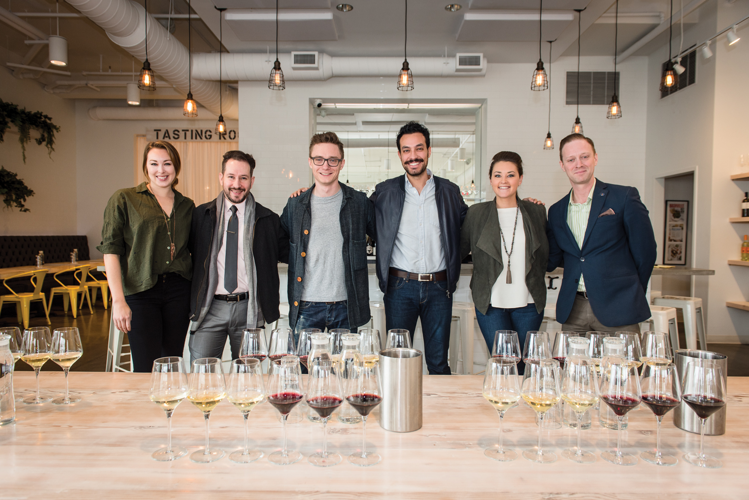
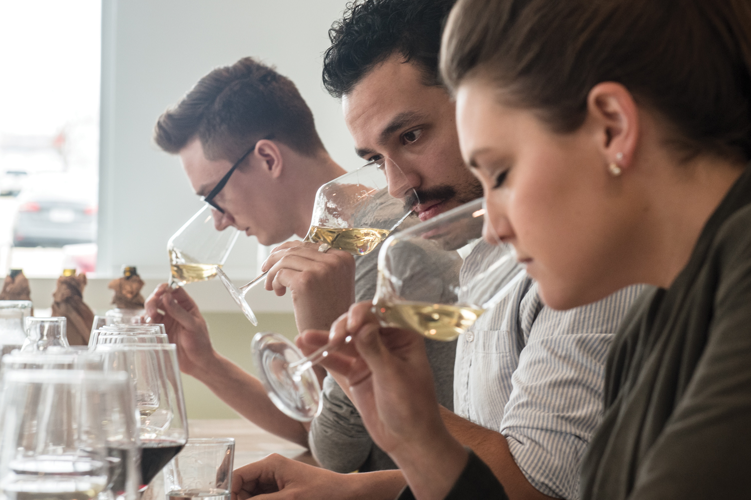
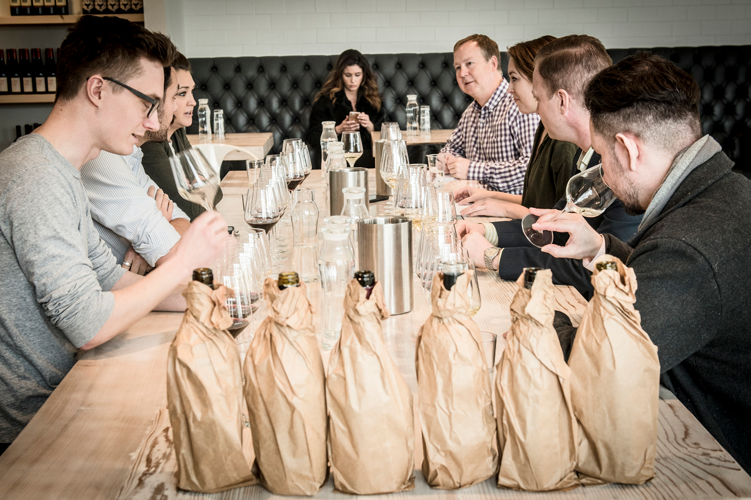


From left: Jenelle Engleson, Rob Guimaraes, Alex Burch, Todd Johnston, Mattie Selecman, Chris Stowe
If your mental image of a sommelier looks like the sneering food critic in Ratatouille pulling an expensive bottle off his voluminous wine list, prepare to have your mind changed. Some of Nashville’s most talented and dedicated up-and-coming sommeliers are in their 20s and 30s, and they are looking to bring some youthful vigor to the wine experience in local restaurants while remaining respectful of the traditions of the profession.
Becoming a certified sommelier has always been a bit of an arcane process involving classroom work, intense exams and palate training to help with identifying and describing wines. Certification can come in many forms, but the two most popular are from the Wine & Spirit Education Trust and the Court of Master Sommeliers. Thanks to documentaries like Somm and the television series Uncorked, we have some idea of what goes on behind the scenes as budding somms study for months for their certification, practicing service, reading about the minutiae of the wine industry and tasting. Lots and lots of tasting.

While the opportunity to taste wine as part of your job might sound glamorous, it is a serious business. In addition to tasting with wine reps to try out potential additions to the wine list, sommeliers taste with their staff to educate the servers on describing and recommending specific wines. They also taste alone and in groups to practice for the most rigorous section of the certification exams — the blind tasting, in which they must attempt to identify a flight of wines.
Recently, Mattie Selecman, the owner and sommelier of restaurant Salt & Vine and its adjoining wine shop, brought together some of Nashville’s most talented somms for a special tasting. Joining Selecman in the Bottle Shop at Salt & Vine were Todd Johnston of Marsh House, Rob Guimaraes from Union Common, Bastion’s Alex Burch, Jenelle Engleson from City Winery and Chris Stowe of Flyte. The tasters ranged in age from 27 to 41 and represented different levels of experience, but they were all there to taste and learn.
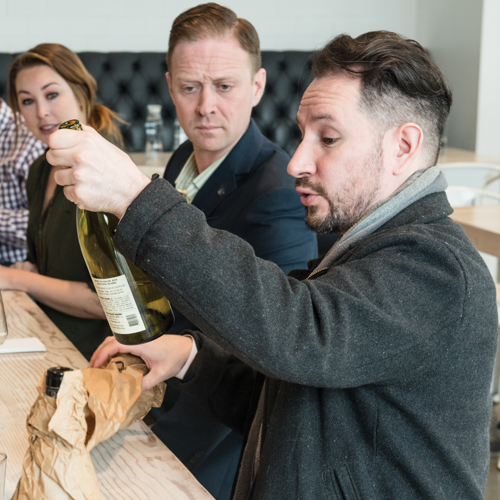
Usually, each taster brings a bottle in a brown bag that conceals the wine’s label. Looking like a gathering of high-tone winos, the sommeliers line up their bagged bottles at the end of the table to be numbered and tasted one at a time. All the somms taste at the same time, but they take turns describing each wine, finally making an informed guess as to the region, varietal and vintage. During the real certification test, six wines must be identified in 25 minutes, so members of the tasting group set timers for 4:20 to ensure they don’t take too long with the wine assigned to them. And yes, somebody giggles at a pot joke almost every time the clock is set.
Tasting for the test is very different from choosing wines for a restaurant’s list. Marsh House’s Johnston explains, “If I’m tasting for our list, I’m looking for nuances that I think customers might enjoy or something that might pair particularly well with one of our menu items.”
“It’s different if I’m tasting to train my palate,” says Flyte's Stowe. “It doesn’t matter if I like a wine or not. I’m only trying to decide if it’s a successful expression of what the wine should be.”

Union Common’s Guimaraes describes the process as more about figuring out what the wine isn’t until you decide what it is. “It’s a deductive process,” he says. “You might be tasting the same grape from different parts of the world, so you have to discover the connective tissue.”
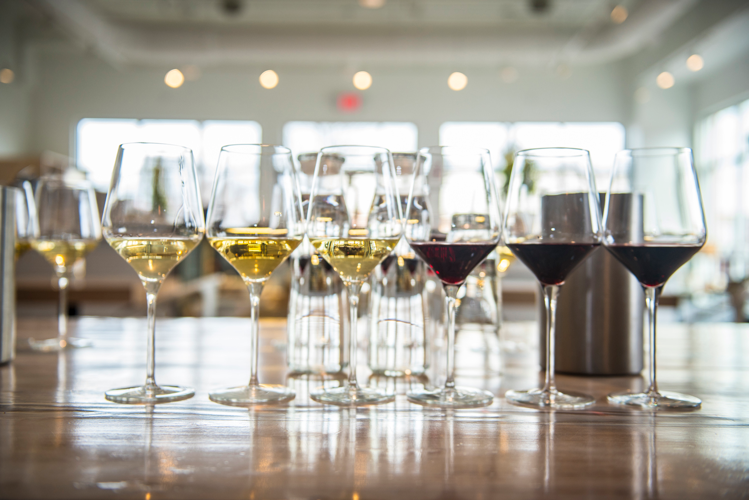
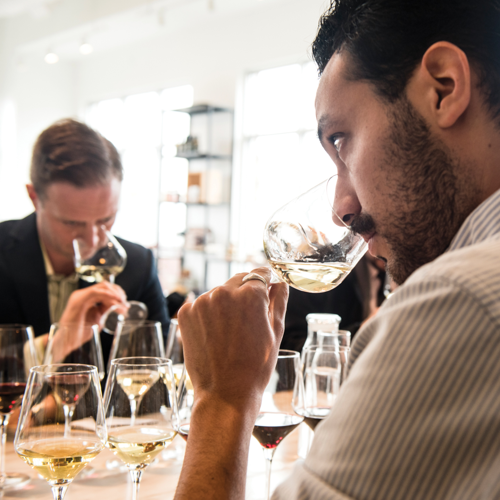
At this particular tasting, the Bottle Shop provided three whites and three reds for analysis. One at a time, the tasters took turns leading the discussion on one wine. The taster in the hot seat made his or her final call on the wine, and then the group came together to discuss their impressions and offer suggestions, descriptors or hints. They then offered their guesses as to the identity of the specific bottle. In his or her own style, each somm ran through a rubric of deductive decisions to narrow down what the wine might be before homing in on an educated guess. Engleson, Stowe and Guimaraes tackled the white wines. Engleson had her phone out, consulting a standardized chart to make sure she asked herself all the essential questions. During the actual exams, there is abundant partial credit to be had for spouting out proper descriptions of the wine’s character, even if the student eventually misses on the call at the end. Engleson made sure to check every box. She swirled the glass vigorously and sniffed repeatedly.
“This is a white wine of pale color,” she said. “The nose is of moderate intensity with elements of green apple and under-ripe pear. No evidence of oak on the nose.” She tasted and spat. “Possible varietals and countries of origin include Sauvignon Blanc, Chenin Blanc, Albariño from France, Spain or New Zealand, I think.” In the end she called it a 2016 Albariño from Spain. She was close: It was a Sauvignon Blanc from the Loire Valley, so she would have gotten plenty of partial credit had this been a real exam.
Stowe went next, and because he picked up tropical fruits, he also thought he might be dealing with an Albariño. “You have to be careful not to pick up on one characteristic and go down the rabbit hole,” said Engleson, who had just emerged from the Albariño warren herself. Stowe swirled and considered, and the other somms listened silently, lost in their own glasses and Sherlock Holmesian deductions. Stowe waffled between a white Burgundy, Northern Italian white and Albariño. He went with the third option, but should have trusted his first instinct: It was indeed a Burgundian white.
The first two tasters’ missteps were understandable. “The neutral wines are the hardest to figure out,” explained Selecman. Burch concurred, “You’re in the Bermuda Triangle of wines with Sancerre, Pinot Grigio and Albariño.”
Guimaraes tasted third, and it was immediately evident that the Union Comm somm was further along the testing and certification spectrum than most of his compatriots. He was very confident, running quickly through his descriptors which included more nuanced and complex terms — “aroma of peach skin” and “salinity akin to rock salt” — before arriving at a call of, you guessed it, Albariño. In this case, Albariño was correct. After the wine was revealed, the somms acknowledged their individual weaknesses during tasting. “I miss out on floral notes sometimes,” admitted Guimaraes, pointing to his nose.
Although Bastion’s Burch was one of the youngest in the group, he boldly plunged through his wine, the first red of the morning. His description was very conversational, as if he were talking with a customer. His guess of a 2015 Beaujolais nailed it almost exactly, missing the vintage by only a year.

With a bottle tattoo plainly visible on his left forearm, Johnston, who tasted the second red, doesn’t look like your typical sommelier. He doesn’t take the classic approach to certification and testing either. “For me, the Court [of Master Sommeliers] is more about guidance and learning my stuff,” he said. “I’m more taking the ‘indie’ route.” The Court of Master Sommeliers includes a service component, which some students feel isn’t always appropriate in every restaurant setting.
Johnston was self-assured and detailed in his impressions, using descriptors that probably weren’t the standards in a court examination. (“I’d call it a ‘smedium’ acid,” for instance.) In the end, he went with a guess of a 3- to 5-year-old Cabernet or Merlot from Bordeaux. When the bottle was revealed to be a 2009 Syrah from Washington, the table erupted in a collective Oooh!
As the host, Selecman went last and tasted like an old pro. She’s camera-ready and confident, right down to her gracefully timed sharing of a spit bucket with two other tasters. She demonstrated her sense of humor, first guessing Albariño before settling on a 2014 Left Bank Bordeaux from a medium-quality producer. It proved to be the biggest miss of the tasting, but most of the group thought she was on the right track before discovering it was a 2013 Creta Roble Tempranillo from Ribera del Duero in Spain.
These tasting sessions aren’t about pinning down the exact varietal and region every time. These talented sommeliers dedicate a lot of their free time to developing their palates so they can pass the exams, but even more importantly, so they can make the best suggestions to their customers. In a restaurant industry that can be deadly competitive, the support the wine community offers to one another is admirable, and Nashville diners and drinkers are better off because of it.
Email arts@nashvillescene.com



